

Types of Dad Hats: How to Pick the Right Style
A dad hat is an unstructured, low-profile baseball cap with a soft crown, gently curved brim, and an adjustable strapback closure. According to Hewore’s style guide, those four features together define the style. Everything else, material, finish, panel count, and closure hardware, is a variation on that core.
The main classification axes are:
- Material: cotton twill, canvas, corduroy, denim, leather/suede, technical fabrics
- Structure/profile: unstructured (true dad hat) vs. structured; low-profile vs. mid/high-profile
- Back closure and panel count: strapback with metal buckle, Velcro, occasional snapback; 5-panel vs. 6-panel
- Finish and variant: washed/distressed, embroidered logo, patch, performance/technical
This guide covers all four axes, explains how dad hats differ from snapbacks, trucker hats, and fitted caps, and ends with a practical buying checklist and care tips.
Table of Contents
- What are the parts of a dad hat?
- What materials are dad hats made from?
- How does structure and profile change the look?
- What back closures and panel counts will you find?
- How do retail labels translate to actual dad hat features?
- How do dad hats compare to snapbacks, truckers, and fitted caps?
- How do you choose and care for a dad hat?
- Where did the dad hat come from?
- Key Takeaways
- Why the dad hat’s simplicity is the point
- Dkbeanleaf carries dad hats worth wearing
What are the parts of a dad hat?
The crown is the defining element. A true dad hat uses no front buckram, the stiff interfacing that holds a snapback or structured cap upright. Without it, the front panel collapses slightly when you take the hat off, giving it that relaxed, lived-in look right out of the box. The crown sits low on the head, meaning there is less vertical height above the brow line compared to a high-profile cap.
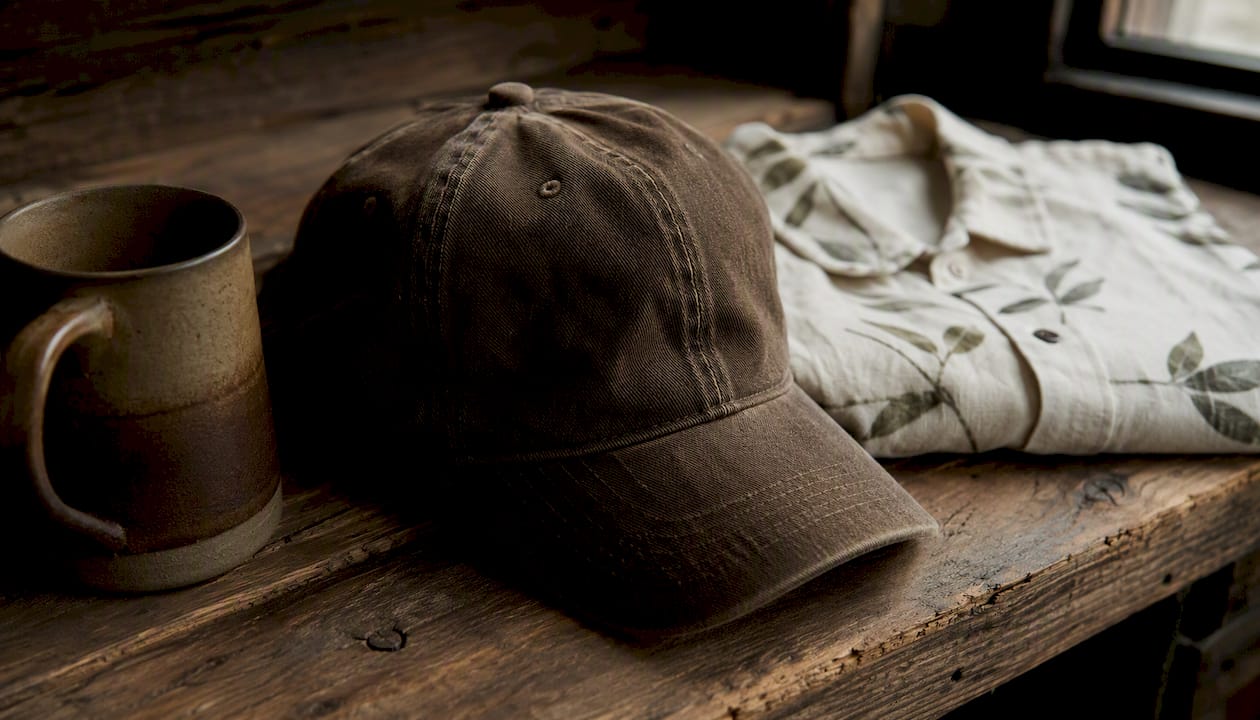
The brim, sometimes called the visor, curves downward in a gentle arc. That curve is pre-set at the factory but softens further with wear. The front seam runs vertically up the center of the front panel; on an unstructured hat, you can see it flex when the panel moves.
| Part | Description | Dad hat characteristic |
|---|---|---|
| Crown | Top and sides of the cap | Unstructured, soft, no buckram stiffener |
| Front panel | Forward-facing section | Collapses slightly; no rigid shape |
| Brim/visor | Horizontal bill | Pre-curved, moderate arc (not flat) |
| Front seam | Vertical center stitch | Visible and flexible |
| Sweatband | Interior band | Fabric or cotton; no fitted sizing |
| Back closure | Rear adjustment | Fabric strapback with metal buckle (most common) |
Panel count shapes the silhouette. Most dad hats are six-panel, meaning six fabric sections meet at a central button on top. A five-panel design removes the center-front seam, creating a wider, cleaner front face that works better for large embroidery or graphic patches. The five-panel also sits slightly flatter across the forehead.
What materials are dad hats made from?
Material is where dad hat styles diverge most visibly. The same unstructured silhouette reads completely differently in washed cotton versus corduroy.
- Canvas — is heavier and more durable than standard twill. It holds its shape slightly better over time and suits outdoor or workwear contexts. Hewore’s cap-type breakdown lists canvas as a common dad-hat material alongside cotton twill.
Pro Tip: For fall and winter, corduroy and heavier canvas hold up better in cooler weather. For summer outdoor use, a cotton twill or technical-fabric dad hat with a moisture-wicking sweatband is the practical choice.
How does structure and profile change the look?
The unstructured crown is the single feature that separates a dad hat from most other cap styles. Remove the front buckram and the hat conforms to your head rather than holding a rigid shape. That conforming fit is why dad hats feel comfortable immediately; there is no break-in period for the crown itself.
Structured caps, by contrast, use a stiff interfacing in the front two panels. The result is a cap that stands upright on a shelf, presents a logo cleanly, and maintains a consistent silhouette regardless of how it is worn. Snapbacks and most fitted caps are structured. The trade-off is a stiffer fit that can feel less forgiving on larger or irregularly shaped heads.
Low-profile vs. mid/high-profile is the second axis. Low-profile means the crown height from brow to button is relatively short, typically under three inches. This creates a flatter, more understated look that suits most face shapes. Mid- and high-profile crowns add vertical height, which can elongate a round face but can overwhelm a narrow one.
Dad hats are almost always low-profile. If you see a cap described as “unstructured” but with a noticeably tall crown, check the back closure and brim shape before assuming it is a true dad hat.
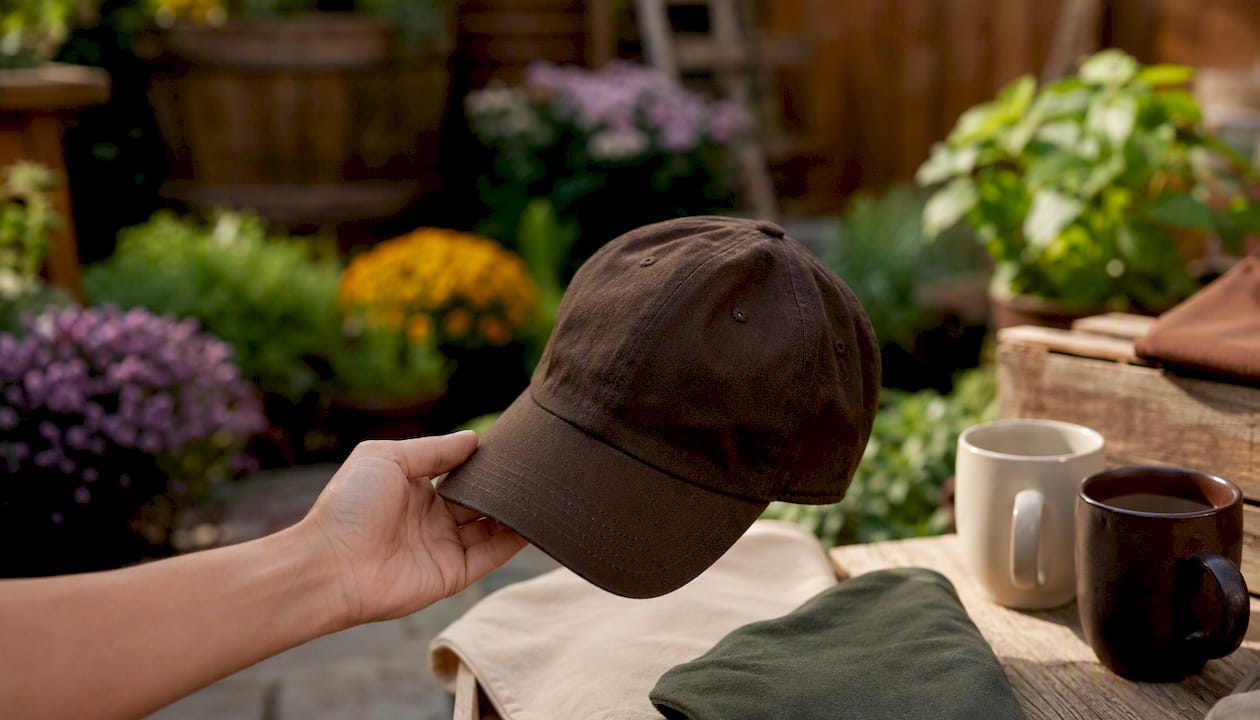
A useful visual test: hold the cap by the brim and let the crown hang. A dad hat will droop forward. A structured cap will hold its shape.
What back closures and panel counts will you find?
The back closure is the second-quickest way to identify a dad hat after the crown structure.
- Fabric strapback with metal buckle: — the classic dad-hat closure. A woven or leather strap threads through a metal frame buckle, similar to a belt. It adjusts in small increments and lies flat against the back of the head.
Five-panel vs. six-panel matters for fit and decoration. Six panels create a rounded crown with a center-front seam, which is the standard dad-hat shape. Five panels eliminate that seam, producing a wider front face. If you want a large embroidered graphic or a clean printed patch, a five-panel gives you more uninterrupted real estate.
How do retail labels translate to actual dad hat features?
Retail naming is inconsistent, and the same hat can appear under four different labels depending on the store. Here is what the common terms actually mean:
- Patch: a separate piece of material (leather, woven fabric, rubber) stitched or heat-applied to the front panel. Leather patches on corduroy dad hats are a current fashion-forward combination that fashion coverage notes as a premium finish signal.
When a listing says “vintage cap” or “relaxed fit cap,” look at two things in the product photos: does the front panel show any visible collapse or soft drape, and does the back show a fabric strap rather than a plastic snap? Those two details confirm a dad hat regardless of what the retailer calls it.
How do dad hats compare to snapbacks, truckers, and fitted caps?
| Feature | Dad hat | Snapback | Trucker hat | Fitted cap |
|---|---|---|---|---|
| Crown structure | Unstructured, soft | Structured, stiff front | Structured foam front | Structured, stiff |
| Crown profile | Low | Mid to high | Mid | Low to mid |
| Brim shape | Curved | Flat (usually) | Curved or flat | Curved |
| Back closure | Fabric strapback/buckle | Plastic snap | Plastic snap or mesh tie | None (sized) |
| Front panels | Fabric | Fabric | Foam | Fabric |
| Back panels | Fabric | Fabric | Mesh | Fabric |
The fastest visual IDs:
- Foam front + mesh back = trucker hat. The Dkbeanleaf trucker cap is a good reference for what that construction looks like in person.
- Flat brim + plastic snap + high crown = snapback. The Dkbeanleaf snapback shows the structured silhouette clearly.
Real Thread’s comparison guide makes the point well: when a product description uses overlapping terms, the crown structure and back closure together are the reliable identifiers. An adjustable cap with an unstructured crown is a dad hat even if the retailer calls it a “baseball cap” or “relaxed cap.”
For styling contrast, the trucker hat style guide on the Dkbeanleaf blog shows how the taller, stiffer trucker silhouette pairs with different outfits compared to the lower-profile dad hat.
How do you choose and care for a dad hat?
- Decide on crown profile first. Low-profile works for most face shapes. If you have a longer face, a slightly taller crown adds balance; if your face is round, stay low-profile to avoid adding height.
- Match material to use. Cotton twill for everyday wear. Technical fabric for outdoor activity. Corduroy or leather-trim for fashion-forward occasions.
- Choose your closure. A fabric strapback with a metal buckle is the most durable and the most traditional. Velcro is fine for casual use but wears out faster.
- Check the crown in product photos. Look for a visibly soft or slightly collapsed front panel. If the front panel looks rigid and upright, it is a structured cap.
- Set a budget based on finish. Washed cotton twill is the most affordable. Corduroy, suede patches, and luxury-brand treatments push the price up significantly.
Care by material:
- Cotton twill: machine wash cold, air dry. Avoid the dryer; heat shrinks the sweatband.
- Corduroy: spot-clean with a damp cloth and brush the nap back into place with a soft bristle brush.
- Leather/suede trim: wipe with a dry cloth; condition leather patches with a small amount of leather conditioner every few months.
Pro Tip: To break in a new dad hat faster, wear it for a few hours while slightly damp after a gentle hand wash. The crown will conform to your head shape as it dries.
Where did the dad hat come from?
The dad hat’s origin is straightforward: Wikipedia’s entry on the dad hat traces the style to the 1990s, when wearers began deliberately distressing and softening structured baseball caps to achieve a worn-in look. Retailers eventually started producing caps with that broken-in quality built in from the start, and the style found a mass market.
Celebrity adoption accelerated the transition from niche to mainstream. By the mid-2010s, the hat had moved from utility item to fashion statement, picked up by streetwear labels and eventually by luxury houses. The Fader’s cultural analysis describes the appeal as “aspirational universalism,” the idea that a neutral, low-key design translates across social groups and style registers in a way that more aggressive silhouettes cannot.
The Los Angeles Times covered the dad hat’s staying power as a function of simple utility: it fits almost any head, requires no styling effort, and pairs with nearly any outfit. That combination of low effort and broad compatibility is why the silhouette has outlasted dozens of trend cycles. Dad hats also work well as branded merchandise; their wide fit range and flat-friendly shipping make them a practical choice for branded event giveaways and promotional programs.
D&K Bean and Leaf’s hat collection reflects that same logic. The brand’s apparel line, including hats and caps, is built around the same everyday-quality philosophy that drives its coffee and tea selection.
Key Takeaways
A dad hat is defined by three features: an unstructured soft crown, a low-profile fit, and an adjustable fabric strapback. Every other variation in material, finish, and panel count builds on that foundation.
| Point | Details |
|---|---|
| Three core features | Unstructured crown, low-profile fit, and curved brim together define a true dad hat. |
| Material drives context | Cotton twill suits everyday wear; corduroy and leather-trim work for fashion; technical fabrics handle outdoor performance. |
| Crown structure is the test | A visibly soft or collapsed front panel in product photos confirms an unstructured dad hat, regardless of the retailer’s label. |
| Closure and panel count | Fabric strapback with metal buckle is the standard; 6-panel is most common, 5-panel gives a cleaner front for large graphics. |
| Dkbeanleaf hats collection | Dkbeanleaf’s hats and caps collection offers dad hats and caps that match the styles and materials covered in this guide. |
Why the dad hat’s simplicity is the point
The conventional take on dad hats is that they are popular because they are comfortable and inexpensive. That is true but incomplete. What the style actually does is remove every signal of effort. A high-crown snapback announces that you thought about your hat. A fitted cap requires you to know your exact head size. A dad hat asks nothing of you, and that is precisely why it works across so many contexts.
Fashion writers have noted the “aspirational universalism” angle, but the more practical version of that idea is this: the dad hat is the only cap silhouette that reads as equally appropriate at a coffee shop, a farmers market, a stadium, and a streetwear boutique. No other cap style manages that range without looking out of place in at least one of those settings.
The material and finish choices covered in this guide are worth taking seriously because they are where you can actually express a preference. A washed cotton twill dad hat in a neutral color is invisible in the best possible way. A corduroy version with a leather patch is a deliberate choice. Both are dad hats. The silhouette is the constant; the material is the variable you control.
Dkbeanleaf carries dad hats worth wearing
If you have read this far, you know what to look for: a soft crown, a curved brim, and a fabric strapback. Dkbeanleaf’s hats and caps collection is a direct next step. The selection covers the everyday cotton twill styles that work for most people and the more considered finishes for readers who want something with a bit more character.
Sizing is handled through the adjustable strapback, so there is no need to measure your head before ordering. If something does not fit as expected, check the brand’s return policy on the product page before you buy. Browse the collection, pick the material and finish that match how you plan to wear it, and you are done.