

What is coffee bloom: your complete brewing guide
That gentle bubbling and swelling you see in the first seconds of a pour-over is not just a pretty visual. What is coffee bloom, really? It is a chemical reaction happening right in your brewer, one that determines whether your final cup tastes bright and balanced or flat and muddled. Most home brewers treat it as a pause before the “real” brewing starts. That is a mistake. Bloom is the brewing. Get it right, and everything that follows improves. This guide covers what bloom is, why it works, how to do it well, and what goes wrong when you skip it.
Table of Contents
- What is coffee bloom and why does it matter?
- The science behind coffee bloom: extraction and flavor development
- Bloom techniques and how to choose the right one for your brew
- Practical brewing tips to master the coffee bloom
- Common bloom misconceptions and troubleshooting
- Why the coffee bloom deserves more attention among enthusiasts
- Explore premium coffee and accessories to enhance your brewing journey
- Frequently asked questions
Key Takeaways
| Point | Details |
|---|---|
| Coffee bloom defined | Bloom is the initial wetting stage where carbon dioxide escapes, preparing grounds for extraction. |
| Bloom influences flavor | Effective bloom ensures even extraction and enhances clarity, sweetness, and balance. |
| Technique matters | Swirling, stirring, or leaving the bloom undisturbed yield different extraction results requiring experiment. |
| Freshness indicator | A lively bloom with bubbles signals fresh coffee full of trapped carbon dioxide. |
| Bloom optimizes brewing | Proper bloom timing and saturation prevent channeling and improve final cup quality. |
What is coffee bloom and why does it matter?
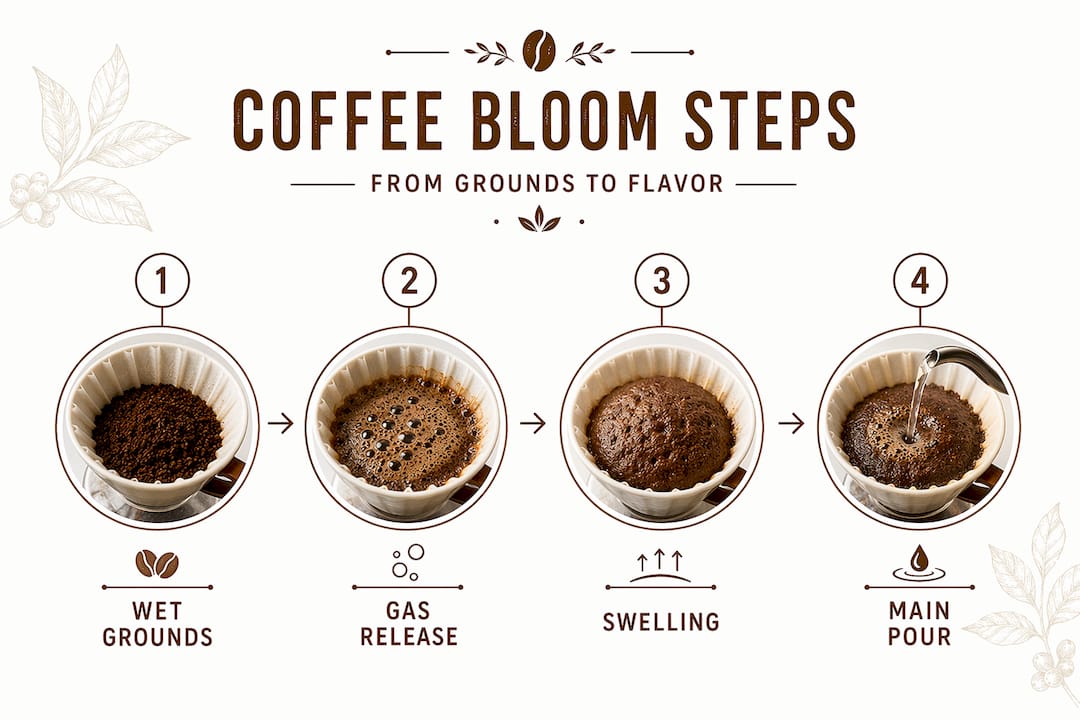
Bloom starts the moment hot water hits dry coffee grounds. The grounds swell up, sometimes dramatically, and small bubbles push through the surface. This is carbon dioxide escaping. During roasting, heat drives chemical reactions inside each coffee bean that produce CO2 as a byproduct. That gas gets trapped inside the bean’s cellular structure. When you grind the coffee, you break those cells open. When you add water, the CO2 rushes out.
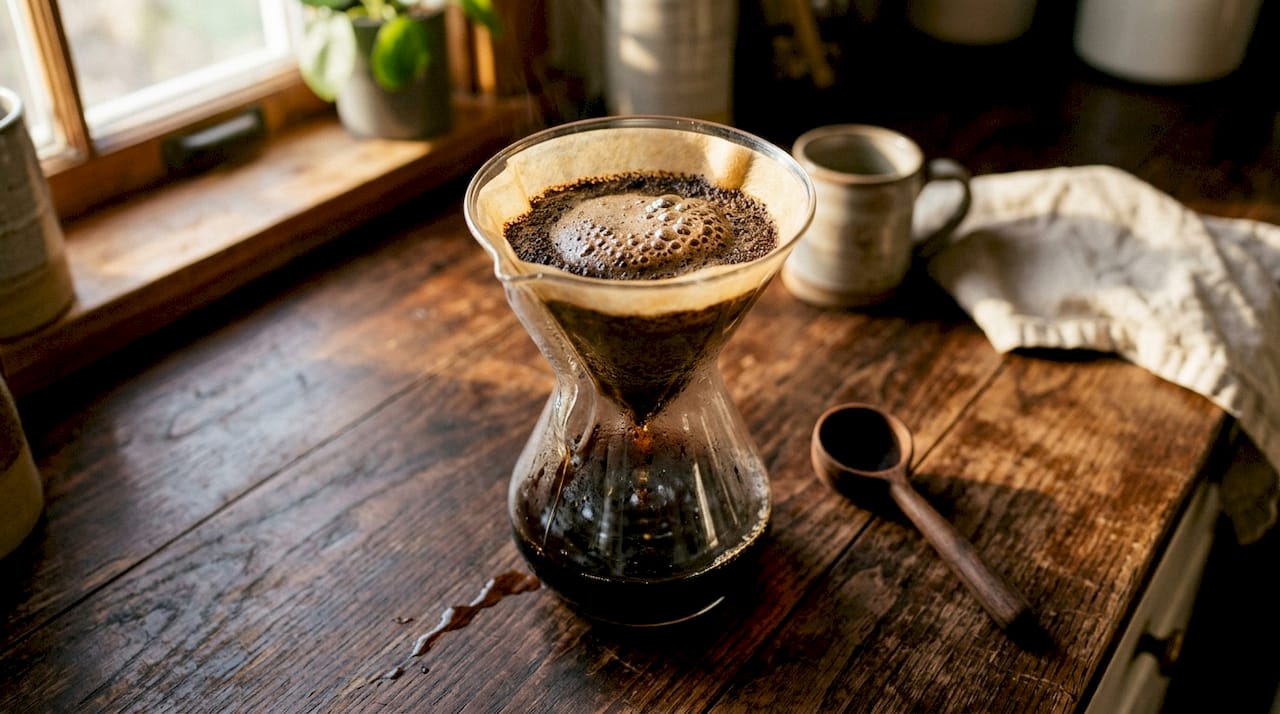
Here is why that matters for your cup. CO2 is hydrophobic, meaning it actively repels water. If you skip the bloom and pour straight through, that trapped gas creates a barrier between the water and the coffee solids. Water channels around the grounds instead of soaking through them evenly. The result is patchy extraction, where some grounds are over-extracted and bitter while others are barely touched. As the first stage of any pour-over recipe, bloom releases stored carbon dioxide, which facilitates better extraction across every ground particle.
What good bloom looks like in practice:
- Grounds rise and dome upward within the first 5 to 10 seconds
- Visible bubbling at the surface, especially in the center
- The bed stays relatively even rather than collapsing to one side
- A slight hissing or fizzing sound in very fresh coffee
- The bloom settles and flattens as CO2 release slows after 30 to 45 seconds
The standard bloom ratio is roughly 1:2 to 1:3 coffee to water. For 20 grams of coffee, that means 40 to 60 grams of water for the bloom pour. You want enough water to fully saturate every ground, but not so much that you start actual extraction before the gas has escaped. Timing matters too. Thirty to 45 seconds is the sweet spot. Less than that and CO2 is still fighting the water. More than that and the grounds start cooling, which affects the thermal dynamics of the main pour.
Pro Tip: If you brew with flavored coffees, pay close attention to bloom behavior. Added flavoring can sometimes coat the grounds and slightly alter how CO2 escapes, making a slower, more deliberate bloom pour especially useful.
The science behind coffee bloom: extraction and flavor development
The coffee blooming process is not just about releasing gas. It is about setting up the conditions for even, controlled extraction. Think of it this way: coffee grounds are like a sponge that has been compressed and sealed. Before water can pull out the soluble compounds you want, the grounds need to fully open up and absorb water uniformly. Bloom is that opening step.
Carbon dioxide bubbles visible during bloom do two things simultaneously. They push outward through the grounds, which physically loosens the bed and creates micro-channels. And they signal freshness. Older coffee has already off-gassed much of its CO2 during storage, so a weak or absent bloom is a reliable indicator that your beans are past their prime.
Here is the extraction sequence during a well-executed bloom:
- Water contacts the outer layer of each ground and begins dissolving surface compounds
- CO2 pressure from inside the ground pushes outward, temporarily slowing water absorption
- As CO2 escapes, the internal pressure drops and the ground becomes porous
- Water penetrates deeper into the ground’s cellular structure
- The bed settles into an even, fully saturated state ready for the main pour
“The release of carbon dioxide during bloom facilitates even extraction by preventing channeling and allowing water to penetrate all coffee particles.” Specialty coffee research consistently points to this as the core mechanism behind bloom’s impact on flavor.
Agitation during bloom, whether you stir, swirl, or leave it alone, affects this process significantly. Gentle swirling redistributes grounds and helps water reach dry spots. Stirring increases water contact faster but introduces risk. Over-stir and you drive fine particles into the filter, which slows water flow and creates a muddy, over-extracted bottom layer. The impact of coffee bloom on flavor is directly tied to how evenly you manage this saturation phase.
Medium roast coffees tend to show particularly expressive bloom behavior because they retain more CO2 than darker roasts, which off-gas more aggressively during roasting itself.
Bloom techniques and how to choose the right one for your brew
The coffee bloom during brewing is not one-size-fits-all. Your technique should match your coffee’s freshness, your grind size, and the shape of your brewer. A flat-bottomed brewer like a Kalita Wave behaves differently from a conical dripper like a V60 because water distribution and drainage rates differ.
| Technique | Best for | Risk | Water ratio |
|---|---|---|---|
| Swirl | Conical drippers, fresh coffee | Grounds stick to filter walls | 2:1 to 3:1 |
| Gentle stir | Flat-bottom brewers, medium-fresh coffee | Fines clogging if overdone | 2:1 to 3:1 |
| Leave undisturbed | Multiple small pours, older coffee | Dry pockets if grounds are uneven | 3:1 to 4:1 |
Some baristas prefer swirling during bloom for better taste, while others recommend gentle stirring to improve water contact without causing bypass or clogging. Neither camp is wrong. The difference in the cup is real but subtle, and your best results will come from experimenting with your specific setup.
Choosing your bloom technique:
- Fresh coffee roasted within two weeks: swirl or stir to help the active CO2 escape evenly
- Coffee roasted two to four weeks ago: a gentle stir or undisturbed bloom both work well
- Older coffee with minimal bloom activity: use a higher water ratio (3:1 to 4:1) and stir to compensate for reduced gas release
- Fine grind: leave undisturbed or swirl only, stirring risks clogging
- Coarse grind: stir gently to ensure full saturation since water drains faster
Pro Tip: For cold brew, the bloom concept still applies but works differently. Cold water releases CO2 far more slowly, so a short room-temperature pre-wet before adding cold water can improve extraction consistency.
Practical brewing tips to master the coffee bloom
Knowing the significance of coffee bloom is one thing. Applying it consistently is another. These steps translate the science into a repeatable routine you can use every morning.
- Weigh your bloom water. Use twice the weight of your coffee dose. For 18 grams of coffee, pour 36 grams of water. Eyeballing this leads to inconsistent saturation.
- Pour in a slow, even spiral. Start at the center and work outward, then back in. This covers the entire bed without creating a single wet spot surrounded by dry grounds.
- Watch the clock. Start your timer when the first water hits the grounds. Aim to begin your main pour at the 30 to 45 second mark. Bloom effectiveness diminishes after about 40 seconds, and starting the main pour around this time preserves thermal mass and optimizes extraction.
- Keep your pour height low. Pouring from above 20 centimeters creates turbulence that agitates the grounds more than you want during bloom. Stay close to the bed.
- Use freshly roasted beans. Coffee roasted within the past two weeks produces the most active bloom and the most flavorful extraction. The CO2 is still there, doing its job.
- Match your grind to your bloom. A uniform medium grind allows water to penetrate evenly. Inconsistent grind sizes mean some particles bloom fast while others lag behind, creating uneven extraction from the start.
Pro Tip: Try freshly roasted beans delivered to your door and compare the bloom activity to older coffee you have on hand. The visual difference is immediate and makes the chemistry feel real.
Common bloom misconceptions and troubleshooting
The most persistent myth about bloom is that the bubbles are just visual feedback with no functional role. Ignoring bloom leads to uneven extraction and flat flavors, because carbon dioxide actively repels water during brewing. The bubbles are not decoration. They are the process.
Common bloom problems and what they signal:
- No bubbles at all: Your coffee is likely stale. CO2 has already off-gassed during storage. Buy fresher beans.
- Bloom collapses immediately: Grind may be too fine, causing the bed to compact and block gas escape.
- Uneven swelling: Grounds were not distributed evenly in the filter before pouring. Level the bed before your bloom pour.
- Bitter final cup despite correct bloom: Over-agitation during bloom drove fines into the filter, slowing flow and over-extracting.
- Weak or sour cup: Bloom water was insufficient, leaving dry pockets that channeled during the main pour.
| Problem | Likely cause | Fix |
|---|---|---|
| No bloom activity | Stale coffee | Use beans roasted within 2 weeks |
| Channeling in main pour | Insufficient bloom water | Increase bloom ratio to 3:1 |
| Slow drip after bloom | Fines clogging filter | Reduce agitation, use coarser grind |
| Flat flavor | Skipped or rushed bloom | Allow full 30 to 45 second bloom |
| Inconsistent strength | Variable bloom timing | Use a timer every brew |
Instant coffee behaves differently here. Because it is pre-extracted and dried, it has no CO2 to release and no bloom phase. That is one of the clearest ways to see what bloom actually does: remove it entirely and the brewing dynamic changes completely.
Why the coffee bloom deserves more attention among enthusiasts
Here is an opinion that might push back on how most coffee content frames this topic: bloom is not a preliminary step. It is the most important 40 seconds of the entire brew. Everything else, the pour pattern, the water temperature, the grind size, all of it depends on whether the bloom was done well. A perfect main pour on a poorly bloomed bed is still going to produce an uneven cup.
Most brewing guides treat bloom as a box to check before the “real” instructions begin. That framing misses what bloom actually represents: the moment when physics, chemistry, and your own sensory attention all converge. You are watching CO2 escape in real time. You are seeing the freshness of your beans made visible. You are setting up the extraction conditions that will determine every flavor compound that ends up in your cup.
There is also something worth saying about experimentation. Bloom is the easiest variable to change and observe. Adjust your water ratio. Try swirling versus stirring. Use beans at different points in their post-roast window and compare the bloom activity. The feedback is immediate and the stakes are low. One cup. You will learn more about extraction from two weeks of bloom experiments than from reading a month of brewing theory.
Bloom is also the gateway to understanding coffee freshness in a way that roast date labels cannot fully communicate. A bag that says “roasted 10 days ago” tells you one thing. Watching that coffee erupt with CO2 when water hits it tells you something more immediate and honest. Explore coffee blends with strong bloom potential and you will start to feel the difference between fresh and stale in a way that changes how you shop for beans.
Explore premium coffee and accessories to enhance your brewing journey
Now that you understand how bloom shapes every cup, the next step is making sure your gear and beans are working with you, not against you.

Our medium roast mushroom coffee is sourced and roasted for active bloom potential, giving you a vibrant, expressive first pour every time. Pair it with a white glossy mug that keeps your brew at the right temperature while you take in the aroma after a perfect bloom. Or go for a mug with color inside that turns your morning ritual into something worth slowing down for. Fresh beans, quality gear, and the knowledge to use both. That is the full picture.
Frequently asked questions
What exactly causes the coffee bloom during brewing?
Coffee bloom is caused by the release of carbon dioxide gas trapped inside freshly roasted coffee grounds when they first contact hot water. The bloom releases stored CO2 from the roasting process, which is what facilitates better extraction.
How long should I let the bloom phase last for optimal coffee flavor?
Thirty to 45 seconds is the standard window. Blooming is typically allowed 30 to 45 seconds before proceeding with the rest of the pour, giving CO2 enough time to escape without letting the grounds cool too much.
Should I stir or swirl the coffee bloom, or just let it rest?
There is no single correct answer. Little agreement exists on agitation during bloom; swirling suits conical drippers, stirring works for flat-bottom brewers, and leaving it undisturbed pairs well with multiple small pours. Try each and taste the difference.
Can coffee bloom indicate the freshness of my coffee beans?
Absolutely. A vigorous bloom with active bubbling means more CO2 is still present in the beans, which signals freshness. CO2 bubbles visible during bloom signify freshness, while a flat or absent bloom usually means the coffee has been sitting too long.
What happens if I skip the bloom step when brewing coffee?
Skipping bloom leaves CO2 trapped in the grounds, where it repels water and causes uneven saturation. Ignoring bloom leads to uneven extraction and flat flavors, because the water cannot penetrate the grounds evenly when gas is still blocking absorption.