

Why Sweatshirt Cuffs Have Ribbing: A Shopper's Guide
Ribbed cuffs are not a style choice. They are a deliberate piece of apparel engineering that controls stretch, protects the sleeve edge from daily abrasion, and seals warmth at the wrist. Every time you pull on a sweatshirt and the cuff grips your wrist snugly, then springs back after you push the sleeve up, that is rib knit doing exactly what it was designed to do.
The four core functions of ribbed cuffs:
- Fit retention — the cuff grips the wrist and holds the sleeve in place during movement
- Shape recovery (snap-back) — alternating knit and purl columns let the fabric stretch and return to its original form
- Abrasion resistance — the denser rib construction protects the sleeve edge from friction against skin, watches, and bag straps
- Thermal seal — the snug fit blocks cold air from traveling up the sleeve
Garments with ribbed trims can last about 40% longer in heavy-use scenarios and experience significantly fewer cuff and collar failures in long-term laundering studies compared to plain-knit alternatives.
Table of Contents
- Why do sweatshirt cuffs have ribbing? The knit mechanics explained
- Why designers pick ribbing over single jersey or interlock
- How ribbed cuffs affect fit, warmth, and how long your sweatshirt lasts
- How to tell a high-quality ribbed cuff when you’re shopping
- Care tips that keep ribbed cuffs from bagging out
- Cuff styles and how they change the look and feel of a sweatshirt
- Key Takeaways
- The case for caring about cuff construction
- Well-trimmed sweatshirts from Dkbeanleaf
Why do sweatshirt cuffs have ribbing? The knit mechanics explained
The stretch and recovery you feel in a ribbed cuff comes directly from its construction. Alternating knit and purl columns create high lateral (circumferential) elasticity while limiting lengthwise stretch. In plain terms: the cuff expands easily around your wrist but does not sag down your arm.
A 1×1 rib alternates one knit column with one purl column. The result is a tight, fine-textured cuff with strong grip — the standard choice for fitted sweatshirt cuffs. A 2×2 rib alternates two knit columns with two purl columns, producing a thicker, more textured band with a sportier feel. The 2×2 is common on heavier hems and sweaters where more body and visual weight are wanted.
Attachment ratio matters just as much as the knit pattern. The cuff must be physically smaller than the sleeve opening it is sewn to. That size difference creates inward tension, which is what keeps the sleeve from riding up or flaring out. Get the ratio wrong and the cuff either grips too hard or sits loose and wavy at the seam.
“The quality of ribbing makes or breaks garment longevity; a good rib snaps back immediately while poor ribbing will lose shape after only a few washes.” — knitwear instructors
Pro Tip: When shopping online, zoom into the cuff seam where the rib meets the sleeve. If the seam is wavy or puckered, the attachment ratio is off — the cuff will not grip correctly regardless of fiber quality.
Why designers pick ribbing over single jersey or interlock
Rib knit wins for cuffs and collars because it balances stretch, recovery, and abrasion resistance better than the alternatives in edge applications. Single jersey curls at the edges and lacks the recovery to hold a cuff shape. Interlock is stable and smooth but has limited stretch, making it uncomfortable at a wrist opening that needs to slide over a hand.
Key trade-offs at a glance:
- Rib knit — high lateral stretch, strong recovery, resists edge curl, handles abrasion well; the standard trim choice
- Single jersey — soft and lightweight but curls at cut edges and loses shape quickly under tension
- Interlock — smooth, stable, and pill-resistant but too stiff for cuffs that need to stretch over the hand
Fiber blend changes the performance picture significantly. A pure cotton rib is soft but will eventually bag without elastane to pull it back. Adding elastane to a cotton rib can greatly increase crosswise stretch and reduce collar deformation in production testing. Polyester-nylon blends add durability and moisture management, which is why they show up in performance and activewear cuffs.
| Construction | Stretch & Recovery | Abrasion Resistance | Edge Behavior | Best Use |
|---|---|---|---|---|
| Rib knit | High stretch, strong snap-back | — | Stable, no curl | Cuffs, collars, waistbands |
| Single jersey | Moderate stretch, weak recovery | Lower | Curls at edges | Body fabric, not trims |
| Interlock | Low stretch, stable | Moderate | Flat, no curl | Panels, not cuff openings |

How ribbed cuffs affect fit, warmth, and how long your sweatshirt lasts
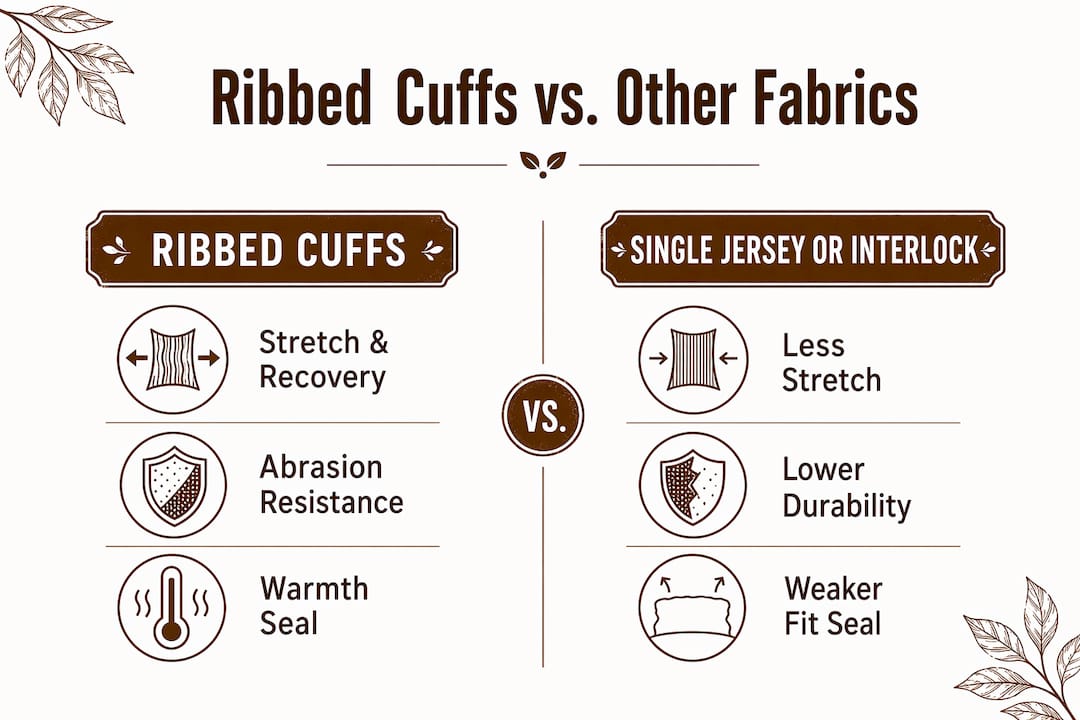
A properly engineered ribbed cuff does three things beyond looking tidy. It improves perceived fit by anchoring the sleeve at the wrist. It reduces heat loss by sealing the gap between fabric and skin. And it concentrates daily wear on the cuff trim rather than the body fabric, which is a replaceable or at least more durable zone.
High-grade rib knits can retain around 89–95% of their original elasticity after thousands of stretch cycles. That number drops fast with poor fiber choices or incorrect laundering. The thermal benefit is real too: the snug fit at the wrist blocks drafts and keeps body heat from escaping up the sleeve, which matters more than most people expect in cold weather.
“Trim quality largely determines sweatshirt durability; designers prefer rib knit for cuffs because it withstands abrasion from skin, watches, and bags better than flat knits.” — industry professionals
One situation where ribbing underperforms: a heavy, dense rib attached to a lightweight body fabric. The weight mismatch creates drag at the seam, which stresses the attachment and causes the cuff to pull away from the sleeve over time. The rib weight should match the body fabric weight.
How to tell a high-quality ribbed cuff when you’re shopping
Quality signals are testable, whether you are in a store or reading a product page.
- Snap-back test — stretch the cuff fully and release it. Immediate return to shape means good recovery; a slow creep back signals weak elastane content or loose gauge
- Stitch density — hold the cuff up to light. Tight, even columns with no gaps predict longevity; visible holes or uneven spacing mean the rib will bag faster
- Fiber blend — check the label for at least 5% elastane (spandex/Lycra) alongside cotton or a cotton-polyester blend; pure cotton ribs without elastane will lose shape
- Attachment seam — the join between cuff and sleeve should be flat and even; puckering or waviness means the attachment ratio is off
- Cuff firmness — it should feel snug but not constrictive when worn; a cuff that feels loose straight off the rack will only get looser
The Dkbeanleaf unisex organic sweatshirt is a practical example to inspect: check the cuff seam join and the snap-back on the rib band to see these quality signals in a real garment.
Pro Tip: In product photos, look for a cuff that sits flat against the model’s wrist with no visible bunching or flare at the seam. A cuff that photographs cleanly under tension is a good sign the attachment ratio is correct.
Care tips that keep ribbed cuffs from bagging out
The single most important thing you can do for a ribbed cuff is keep it away from high heat. Heat relaxes elastane fibers permanently. Once that snap-back is gone, no amount of reshaping brings it back.
“Wash gently and dry flat or on low heat — heat is the primary cause of permanent elastane relaxation in rib trims.” — textile care guidance
Practical dos and don’ts:
- Do wash in cold or warm water (under 86°F / 30°C) on a gentle cycle
- Do dry flat or tumble dry on low heat for cotton-elastane blends
- Don’t wring or twist the cuffs when wet; that distorts the rib columns
- Don’t iron directly on the rib; steam from a distance reshapes without heat damage
- Don’t use fabric softener regularly — it coats elastane fibers and degrades recovery over time
If a cuff has stretched slightly from wear, a light steam while gently squeezing the rib back into shape can restore some structure. If the elastane has fully relaxed from repeated high-heat drying, replacement is the only real fix.
Cuff styles and how they change the look and feel of a sweatshirt
Cuff length, rib width, and elastane content all change how a sweatshirt fits and reads visually. These are not interchangeable choices.
- Short, tight 1×1 rib cuff — the classic athletic look; grips the wrist firmly, works well under a jacket, reads clean and sporty
- Long rib cuff (3–4 inches) — adds visual weight at the wrist, suits oversized or vintage silhouettes, and gives more warmth coverage
- 2×2 rib cuff — thicker texture, more visual presence, common on heavier fleece sweatshirts and streetwear pieces
- Elasticated cuff (no rib) — a flat band with sewn-in elastic; functional but lacks the stretch-and-recovery feel of true rib knit and tends to look less refined
- Ribbed beanie cuff — the same rib engineering applied to headwear; the Dkbeanleaf cuffed beanie uses a folded rib band that grips the head and holds its shape across washes, the same principle as a sweatshirt cuff
Match rib weight to body fabric. A heavy 2×2 rib on a lightweight French terry body will drag the sleeve down and stress the seam. A fine 1×1 rib on a thick fleece will look undersized and lose tension quickly. The practical rule: if the body fabric is heavy, go heavier on the rib; if the body is light, keep the rib fine.
Key Takeaways
Ribbed cuffs are engineered trims that control stretch, protect sleeve edges, and seal warmth — and their quality is the single biggest factor in how long a sweatshirt holds its shape.
| Point | Details |
|---|---|
| Core function | Ribbed cuffs control stretch, resist abrasion, and seal warmth at the wrist. |
| Durability gain | Garments with ribbed trims last significantly longer in heavy-use scenarios. |
| Elasticity retention | High-grade rib knits retain 89–95% of their original elasticity after thousands of stretch cycles. |
| Top quality signal | Snap-back test: a quality cuff returns to shape immediately when released. |
| Dkbeanleaf pick | The unisex organic sweatshirt and cuffed beanie show rib trim quality you can inspect before buying. |
The case for caring about cuff construction
Most people buying a sweatshirt look at the color, the fit, and the price. The cuff barely registers. That is exactly why so many sweatshirts end up looking worn out after a season: the body fabric is fine, but the cuffs have gone limp and the whole garment reads as tired.
The ribbing is where a sweatshirt earns its keep or fails. A well-engineered rib cuff, with the right fiber blend, correct attachment ratio, and appropriate gauge for the body weight, will outlast the rest of the garment. A cheap one, pure cotton with no elastane and a loose gauge, will bag out within a few months of regular wear and washing.
The apparel industry has known this for decades. Shoppers are only now starting to ask the right questions about trim quality, and that shift matters. When you know what to look for, a quick snap-back test and a glance at the seam join tell you more about a sweatshirt’s longevity than the price tag does.
Well-trimmed sweatshirts from Dkbeanleaf
If you want a sweatshirt where the cuffs actually hold up, the Dkbeanleaf hoodies and sweatshirts collection is worth a look. The unisex organic sweatshirt is a direct example of the trim quality this guide covers: check the rib cuff seam, run the snap-back test, and see how the attachment sits against the sleeve.

Dkbeanleaf is a small-batch coffee, tea, and apparel brand that puts the same attention into its garment trims as it does into its roasts. Browse the sweatshirt and hoodie range to find a piece built to last past the first season.