

Fold Tee Shirts to Save Drawer Space: Best Methods
File-fold your tee shirts into upright rectangles and you can fit the equivalent amount of shirts from multiple drawers into one. That single change, swapping horizontal stacks for vertical filing, is the fastest way to reclaim drawer space and actually see every shirt you own.
Here is the quick version:
- File fold (KonMari method) for drawers: Fold the shirt into a compact rectangle, then stand it upright so shirts line up front to back like files in a cabinet. Every shirt stays visible.
- Ranger/military roll for travel: Roll tightly from the hem up, tuck the collar cuff over the roll to lock it. Takes up less luggage volume and stays put in transit.
- Two-second pinch fold for speed: Pinch at the shoulder and midpoint, cross your hands, and snap the shirt flat. Under five seconds per shirt, great for bulk folding sessions.
Pro Tip: Fold warm from the dryer. Fabric tension is lower right out of the machine, so creases set cleanly and wrinkles are far easier to smooth out before they cool.
Table of Contents
- How do you file-fold a tee shirt for a dresser drawer?
- What is the fastest way to fold tee shirts in bulk?
- Rolling vs. folding: which actually saves more space?
- How to prepare your drawers before you start folding
- Which tee shirts should you fold vs. hang?
- How to keep your drawers tidy week after week
- Why vertical filing wins: what the evidence shows
- Key Takeaways
- The habit that actually changed how I store shirts
- Sources and further reading
How do you file-fold a tee shirt for a dresser drawer?
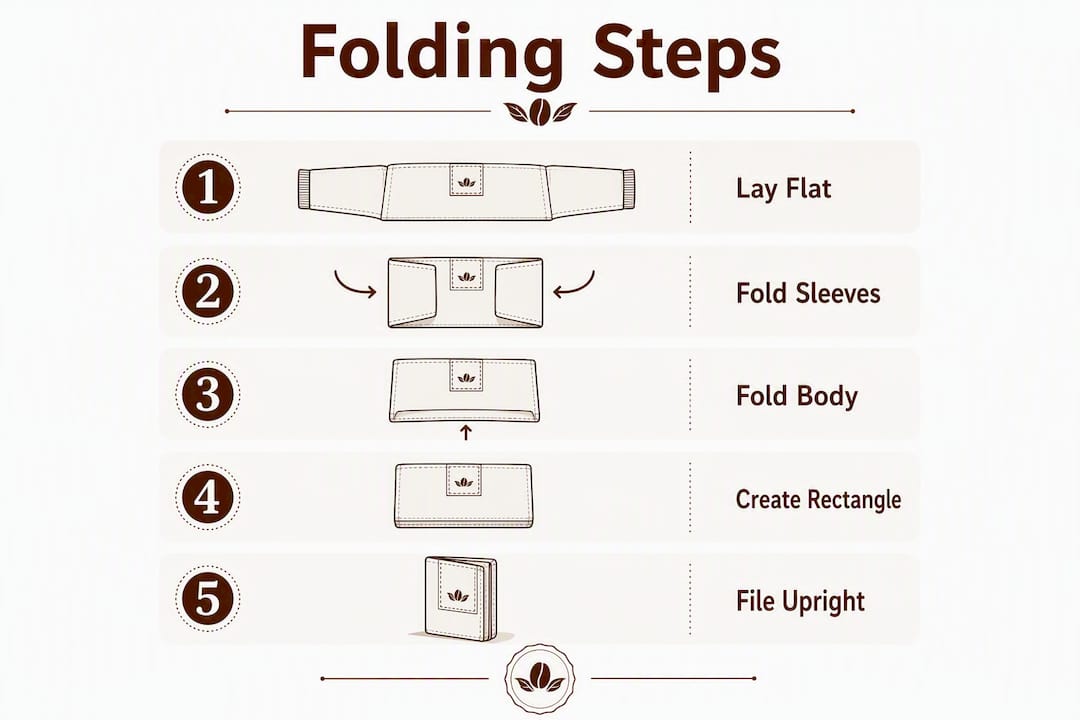
The file fold, popularized by Marie Kondo’s KonMari method, turns every shirt into a self-standing rectangle. Consistent rectangle width is the whole game: uneven widths waste sideways space and cause shirts to topple.
- Lay the shirt face-down on a flat surface. Smooth out any bunching around the collar and hem.
- Fold one side in to the center. Bring the sleeve back across the shirt body so the edge lines up near the middle.
- Repeat on the other side. You now have a long rectangle roughly one-third the original width.
- Fold the bottom hem up about one-third of the length. Then fold that section up again, or fold the top third down to meet it, depending on shirt length. Aim for a final height of about 4–5 inches.
- Stand the rectangle upright. The folded edge faces up. If it flops over, the rectangle is too tall; fold it once more.
For long-sleeve shirts, fold the sleeves diagonally back across the body before step 2 so they do not add bulk. V-necks and scoop necks fold the same way; just align the collar edge when you fold the sides in.
Pro Tip: A folding board creates identical rectangles every time without measuring. A piece of cardboard cut to your target size works just as well.
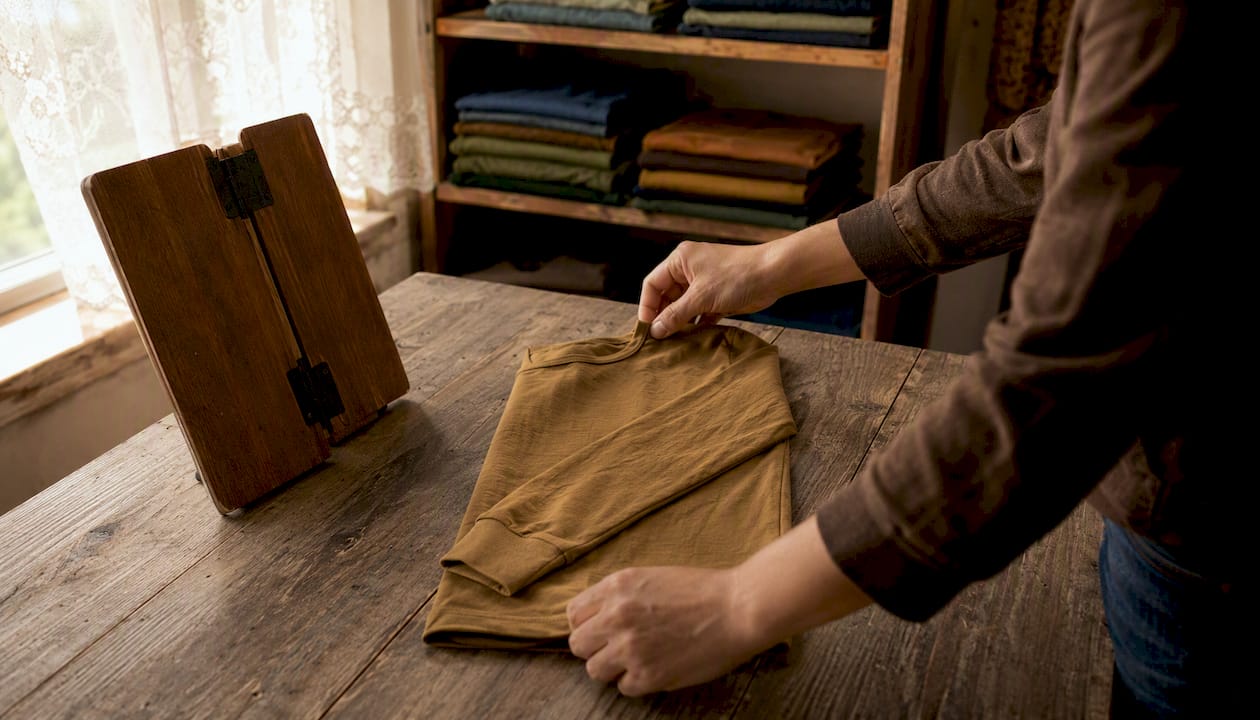
Target a final width slightly narrower than your drawer’s depth so shirts stand without leaning against the front panel. A Dkbeanleaf Short-Sleeve Unisex T-Shirt folds cleanly to about 4 inches wide using this method, which fits most standard dresser drawers with room for two or three rows.
What is the fastest way to fold tee shirts in bulk?
The pinch-and-fold method, sometimes called the two-second fold, skips the lay-flat step entirely. Maytag’s guidance clocks it at under five seconds per shirt, which adds up fast when you are working through a full laundry load.
- Hold the shirt up by the shoulders. Pinch the left shoulder seam with your left hand and a point midway down the left side with your right hand.
- Cross your right hand over your left. Bring the midpoint up to meet the shoulder in one motion.
- Shake the shirt out gently. It should hang as a folded half with the sleeve tucked inside.
- Fold in thirds. Bring each side edge toward the center to form a rectangle, then fold the bottom up once.
Speed note: The pinch fold produces a neat rectangle very quickly. For a drawer, follow it with one more lengthwise fold to get the standing height right.
Use the pinch fold when you need to move fast through a big pile. Switch to the full file fold when you are setting up a drawer from scratch and want every shirt at exactly the same height.

Rolling vs. folding: which actually saves more space?
Both methods work, but they work for different jobs. Rolling is best for packing; file folding is best for drawers.
| Dimension | File fold (vertical) | Ranger roll |
|---|---|---|
| Best for | Dresser drawers | Luggage, backpacks |
| Space efficiency | Maximizes drawer capacity | Maximizes bag packing volume |
| Speed | Moderate (5–10 sec) | Slower (10–15 sec) |
| Wrinkle risk | Low with uniform folds | Low if rolled tightly |
| Fabric suitability | Cotton, blends, most knits | Cotton, synthetics; avoid delicate knits |
- Use the file fold when shirts live in a drawer long-term. Visibility is the real win: you see every shirt at a glance instead of digging through a stack.
- Use the ranger roll for travel. The tight roll locks the shirt so it does not shift or unfold in a bag.
- For printed or embellished tees, roll or fold inside-out to protect the graphic surface.
Pro Tip: For delicate fabrics like a thin modal or a special-finish tee, place a sheet of tissue paper between folds before storing. It reduces friction and keeps the surface from pilling.
Space fact: Switching from horizontal stacks to vertical file folding can condense two full dresser drawers into one, according to professional organizer reports.
How to prepare your drawers before you start folding
No folding technique fixes an overstuffed drawer. Decluttering comes first, every time.
- Empty the drawer completely. Pull everything out so you can see what you have.
- Remove anything unworn in the past year. Donate, sell, or toss it.
- Measure the drawer interior. Width, depth, and height. Your folded rectangle’s width should be slightly narrower than the drawer’s depth so shirts stand upright without pressing against the front.
- Decide on categories. One drawer per category works best: everyday tees, workout shirts, graphic tees. Mixing categories is how drawers revert to chaos.
- Add dividers if needed. Shallow fabric bins or simple cardboard dividers keep rows from collapsing into each other. No specific brand required; any compartment that matches your fold width works.
Pro Tip: Put daily-wear shirts at the front of the drawer and seasonal or occasional shirts at the back. You will never dig past a summer shirt to find your favorite everyday tee in January.
Which tee shirts should you fold vs. hang?
Most tee shirts fold well. A few do not.
- Fold: Cotton, cotton-poly blends, jersey knits, and performance synthetics. These hold a rectangle cleanly and do not stretch from being stored flat. The Dkbeanleaf DryBlend® T-Shirt is a good example: the poly-cotton blend resists wrinkles and keeps its shape through repeated folding.
- Hang: Linen, silk, structured knits, and anything with a stiff collar or shoulder construction. These crease along fold lines and look worse for it.
- Check the label. If the care tag says “lay flat to dry,” that shirt probably does not want to be folded tightly either.
- Protect prints. Fold graphic tees inside-out. The print faces inward and avoids friction against adjacent shirts.
- Avoid pilling. Use a cool dryer setting and fold immediately after the cycle ends rather than leaving shirts in a warm heap.
Pro Tip: Fold warm-from-dryer shirts right away. Fabric tension is lower when warm, so creases set cleanly. A shirt left to cool in a pile takes twice as long to smooth out.
How to keep your drawers tidy week after week
The system only works if putting shirts back is as easy as taking them out.
- Fold directly from the dryer. Pull shirts out warm, fold each one before setting it down.
- Return each shirt to its category. Same drawer, same row, every time.
- Do a 5-minute weekly tidy. Stand up any shirts that have fallen over, pull forward anything pushed to the back.
- Refold anything that comes out of the wash. Never stuff a shirt back in unfolded, even once.
A few habits that make this stick:
- Fold one shirt per minute during a podcast or show. A full load of ten shirts takes ten minutes.
- Keep a small overflow bin on top of the dresser for shirts that need refolding. Empty it before laundry day.
- When a drawer starts feeling tight, that is the signal to declutter again, not to fold smaller.
Why vertical filing wins: what the evidence shows
The core claim is simple: vertical file folding turns a drawer into a visible display rather than a stacked pile. You stop rummaging, shirts stay folded, and you actually wear everything you own.
Timed comparison: The pinch-and-fold method produces neat folds quickly per shirt. A standard lay-flat fold typically takes 10–15 seconds. Over a typical load of shirts, that difference saves a few minutes per laundry session.
The practical test you can run at home:
- Count how many shirts currently fit in your drawer using horizontal stacks.
- Empty it, file-fold every shirt, and recount.
- Most people gain enough space to consolidate two drawers into one.
Consistent rectangle width is the single biggest factor separating a tidy drawer from a messy one. Uniform folds stand upright; uneven ones lean, collapse, and waste the sideways space you just freed up.
Key Takeaways
File-folding tee shirts into uniform upright rectangles is the most effective way to maximize drawer space, keep every shirt visible, and maintain order with minimal daily effort.
| Point | Details |
|---|---|
| File fold for drawers | Stand folded shirts upright so every shirt is visible and drawers hold more. |
| Roll for travel | A tight ranger roll locks shirts in luggage and prevents unfolding in transit. |
| Uniform width matters | Aim for a rectangle slightly narrower than drawer depth so shirts stand without toppling. |
| Declutter first | Remove unworn shirts before folding; no technique fixes an overstuffed drawer. |
| Fold warm from dryer | Folding immediately after the dryer cycle sets creases cleanly and cuts wrinkle time. |
The habit that actually changed how I store shirts
Most drawer-organization advice focuses on the fold itself. The part people skip is the moment right after the dryer beeps.
Every folding system falls apart at the same point: you pull warm shirts out, set them on the bed, get distracted, and come back to a cold wrinkled pile. The fix is not a better fold. It is folding before you put the basket down. Stand at the dryer, fold each shirt as you pull it out, and carry a stack of neat rectangles to the drawer instead of a heap of laundry.
The other thing worth doing: limit each drawer to one category. Not “tops,” but specifically “everyday tees” or “workout shirts.” When a category has its own drawer, you never have to sort through the wrong type to find what you want. It also makes the weekly tidy trivial because anything out of place is obvious immediately.
If you are looking for tees that hold their shape through repeated folding and washing, Dkbeanleaf carries a range of classic and performance tees worth keeping neatly filed.
Sources and further reading
These are the main references used for step instructions, timing guidance, and research claims in this article.
- How to Fold Clothes to Save Space in Your Closet or Dresser — Real Simple: Best for the vertical filing rationale and the two-drawer-to-one result. Strong on professional organizer recommendations.
- How to Fold Clothes Fast — Maytag: Best source for timed-fold guidance and the pinch-and-fold method. Includes setup tips for bulk folding.
- How to fold shirt to save space — Yard and Garden Guru: Detailed practitioner guidance on rectangle width, drawer depth targets, and consistency rules.
- How to Fold Clothes for Organized Dresser Drawers — The Container Store: Covers the declutter-first process and drawer organizer recommendations.