

Recyclable Coffee Bags: How to Tell and Where to Take Them
Coffee bags are recyclable sometimes, not always, and the material is what decides it, not the brand or the roast inside. Check the bag for a resin code (look for #4 or #5) or the words “store drop-off” printed near the seal, then act accordingly.
- #4 or #5 stamped on the bag: Take it to a store drop-off bin for soft plastics.
- No resin code, foil lining, or shiny mixed-material feel: Skip curbside entirely and use a mail-back program.
- Unsure either way: Empty and clean it, then default to mail-back rather than guessing.
Key Takeaways
Recyclable coffee bags depend on mono-material construction (LDPE #4 or PP #5), and the correct disposal route is store drop-off for labeled bags or a mail-back program like TerraCycle for everything else.
| Point | Details |
|---|---|
| Check the resin code first | Look for #4 (LDPE) or #5 (PP) before assuming a bag is recyclable. |
| Skip curbside bins | Most curbside programs reject flexible film; use store drop-off or mail-back instead. |
| Prep the bag properly | Empty grounds, remove tin ties and detachable valves before recycling. |
| Mail-back covers the gaps | Programs like TerraCycle’s Zero Waste Box accept bags curbside won’t, for a box fee. |
| Dkbeanleaf favors clear labeling | Dkbeanleaf uses mono-material bags with plain disposal instructions printed on the package. |
Table of Contents
- Which Coffee Bag Materials Are Recyclable
- Where to Recycle Coffee Bags: Curbside, Drop-Off, and Mail-Back
- Preparing Coffee Bags for Recycling Without Fouling the Batch
- Choosing Between Recyclable, Compostable, and Reusable Packaging
- Practical Tips and Proof Points from Dkbeanleaf
- Sources
Which Coffee Bag Materials Are Recyclable
A coffee bag made from a single plastic, usually low-density polyethylene (LDPE, resin code #4) or polypropylene (PP, resin code #5), is what packaging engineers call mono-material. These bags can theoretically be reprocessed into new plastic products because there is nothing to separate out first. Suppliers increasingly market these as recycle-ready, and some now produce fully recyclable coffee bags made from LDPE specifically to meet that standard.
The problem is that most coffee bags on shelves are not mono-material. They’re laminates, thin layers of plastic, foil, and paper glued together to block oxygen, light, and moisture from staling the beans inside. That barrier does a genuinely good job protecting flavor. It also makes the bag close to impossible to recycle, because sorting equipment has no reliable way to peel those layers apart at scale.
Here’s what to look for on the packaging itself:
- Resin code #4 (LDPE): Flexible, often slightly stretchy, generally the best mono-material candidate.
- Resin code #5 (PP): Slightly stiffer, also mono-material and accepted at many soft-plastics drop-offs.
- “Recycle-ready” or “store drop-off” labeling: A manufacturer’s signal that the bag was designed for the soft-plastics stream.
- Metallic sheen with no resin code: Almost always a laminate, treat it as non-recyclable through standard channels.
Packaging suppliers now recommend mono-material LDPE or PP construction precisely because it sidesteps the bonded-layer problem that makes traditional foil bags a dead end for recyclers.
Where to Recycle Coffee Bags: Curbside, Drop-Off, and Mail-Back
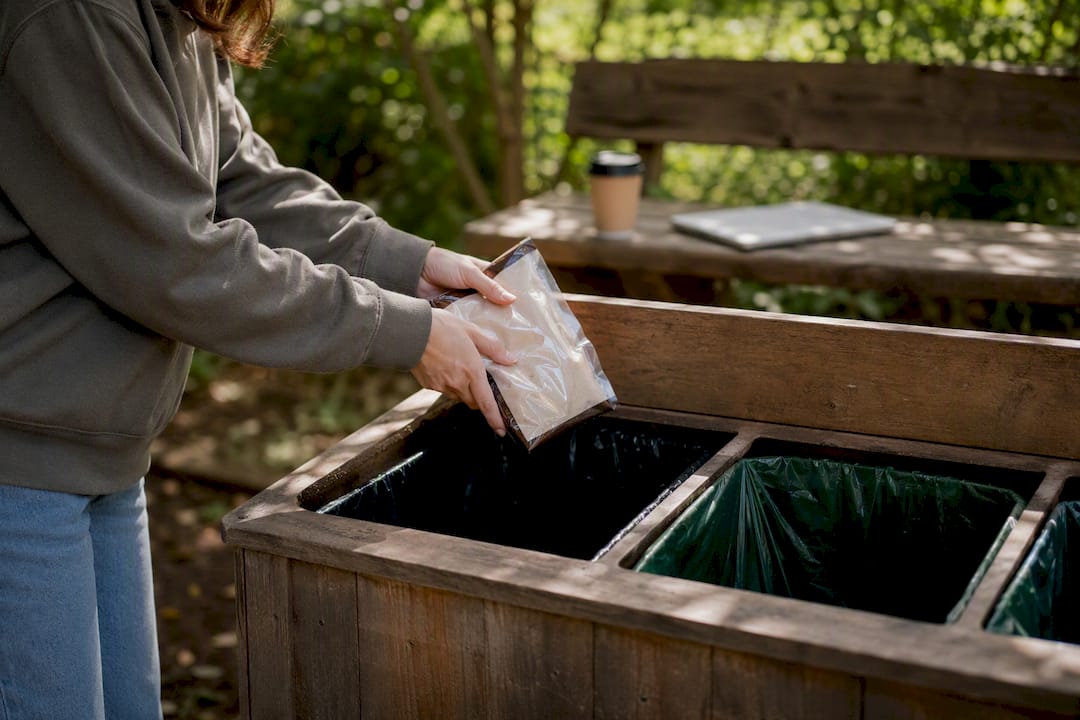
Your curbside bin is almost never the right answer for a coffee bag, and that’s not a local quirk. Most household curbside programs reject flexible film packaging because multi-layer laminates jam sorting equipment built for rigid containers like bottles and jugs. Even a mono-material bag can get rejected curbside if your municipality doesn’t sort flexible film at all.
That leaves two realistic paths, depending on what the bag is made of and what’s available near you.
- Store drop-off for soft plastics. Grocery and retail chains often collect flexible LDPE film in bins near the entrance, the same ones used for shopping bags and bread bags. A #4 coffee bag, once emptied, generally belongs here.
- Mail-back specialty programs. Services like TerraCycle’s Zero Waste Box for coffee bags accept packaging that curbside and drop-off bins won’t touch, processing collected material into durable recycled goods. You buy a box, fill it, ship it back, and TerraCycle handles the rest.
The trade-off is cost and effort. Store drop-off is free but limited to true mono-material film. Mail-back accepts nearly any brand or bag size but comes with a box fee, which makes more sense for a household saving up bags over months or a roaster running a customer take-back program than for a single empty bag.
| Disposal route | Best for | Cost |
|---|---|---|
| Curbside bin | Almost never appropriate for coffee bags | Free, but usually rejected |
| Store drop-off (soft plastics) | Labeled #4/#5 mono-material bags | Free |
| Mail-back (e.g., TerraCycle Zero Waste Box) | Unlabeled, laminated, or mixed bags | Fee-based, by box size |
If the bag is labeled #4 or #5, drop-off is your move. If it’s unlabeled or clearly a foil laminate, mail-back or reuse is the more honest option.
Preparing Coffee Bags for Recycling Without Fouling the Batch
Prep work is where a recyclable bag actually gets recycled, or gets tossed out at the sorting facility for contamination. Skipping these steps is what recycling programs call “wishcycling,” and it does more harm than just tossing the bag in the trash outright, because it can force an entire batch of otherwise good material to be discarded.
- Empty the bag completely. Loose grounds are the most common contaminant. Compost them separately if you have the option.
- Cut away tin ties. These small metal-and-paper closures are common on kraft coffee bags and are not recyclable with the plastic film.
- Remove rigid zipper strips if they detach. Molded plastic zippers welded permanently to the bag typically can’t be removed and don’t disqualify an otherwise mono-material bag, but a snap-off piece should come off first.
- Check for a one-way valve. These small plastic discs let CO2 escape without letting oxygen in, and they’re almost always a different plastic than the bag itself. Attached valves and mixed closures are a leading cause of rejection at recycling facilities.
Pro Tip: Removing detachable metal or rigid plastic pieces before drop-off measurably improves acceptance rates. When a valve or zipper is fused into the bag and can’t be removed, skip the drop-off bin and send it to a mail-back program instead, since those facilities are built to handle mixed components.
Choosing Between Recyclable, Compostable, and Reusable Packaging
None of the three main packaging strategies wins on every measure, which is exactly why the choice depends on what a roaster or shopper actually values most.
- Recyclable mono-material bags (LDPE/PP): Fit into an existing collection stream once consumers know where to bring them. The catch is that “recyclable” only means something if a real drop-off or mail-back option exists nearby.
- Compostable coffee bags: Break down under the right composting conditions but usually need industrial composting facilities, not a backyard bin, and those facilities aren’t available everywhere in the U.S.
- Reusable or refill systems: Cut packaging waste at the source entirely, though they require a customer relationship, a refill station, or a bring-your-own-container habit that not every buyer will adopt.
For roasters, the practical move is to specify mono-material film, insist on recycle-ready labeling from your packaging supplier, and print plain disposal instructions or a QR code linking to a recycling explainer right on the bag. A simple label like “Empty bag, remove valve, drop off where you recycle plastic film” does more for actual diversion rates than any sustainability claim buried in fine print. Bonus: bags that can’t take a strong barrier laminate sometimes trade a little shelf life for recyclability, so pairing the switch with better home storage guidance for customers helps offset that freshness gap.
Yes, mono-material film sometimes costs a bit more per unit than a standard foil laminate. Roasters who’ve made the switch treat it as a brand credential worth paying for, not just a packaging line item.
| Packaging type | Best fit | Main limitation |
|---|---|---|
| Recyclable mono-material | Roasters with drop-off or mail-back access | Depends on consumer follow-through |
| Compostable | Regions with industrial composting access | Limited facility availability in much of the U.S. |
| Reusable/refill | Local roasters with repeat customers | Requires infrastructure and customer habit change |
Practical Tips and Proof Points from Dkbeanleaf
Sustainability claims mean little without specifics, so here’s where Dkbeanleaf’s own approach has actually moved.
- We prioritize mono-material bag formats for new packaging runs and phase out foil laminates where freshness data allows it.
- Every bag we ship carries plain-language disposal instructions instead of a vague recycling symbol nobody can act on.
A resin code printed in tiny type does nothing if the customer never reads it. Clear, direct disposal instructions on the front of the bag change behavior more than the material choice alone.
If you roast coffee yourself, consider piloting a small take-back or mail-back box for a season and telling customers what happened with the results, good or bad. Our guide to freshly roasted coffee covers more on balancing freshness needs with packaging choices.
Why Packaging Waste Is a Personal Issue for Dkbeanleaf
Every bag we sell is packaging waste eventually, and pretending otherwise doesn’t help anyone. Committing to recycle-ready materials and printing clear disposal steps on our bags is a small, unglamorous decision, but it’s the one that actually gets bags out of landfill instead of into it. Our resources on storing and roasting coffee reflect that same instinct: give people the plain information they need to make the better choice, not just the marketed one.
— Kristopher
Choosing Packaging You Can Feel Good About
Beyond the bag itself, one of the simplest ways to cut packaging waste is buying less packaging in the first place. A shared bundle or a larger bag used slower does more for your footprint than any recycling symbol.
- Our tea and coffee bundles are built around fewer, larger packages instead of a string of small ones.
- Proper storage, covered in our coffee storage guide, stretches freshness so you’re not opening a fresh bag before the last one is even empty.
If you’re ready to stock up on loose leaf tea packaged with recyclability in mind, browse our tea collection and see what fits your routine.