

Print This Tea Steeping Times Chart, Start Low and Add 30s
Most teas taste best within tight, predictable windows: green at 160 to 175°F for 1 to 3 minutes, white at 170 to 185°F for 3 to 5 minutes, oolong at 185 to 205°F for 2 to 5 minutes, black at 195 to 212°F for 3 to 5 minutes, pu-erh rinsed then steeped 2 to 4 minutes, and herbal or rooibos at a full boil for 5 to 10 minutes. Matcha isn’t steeped at all, it’s whisked into 175°F water. Start at the low end of any range, taste, and add 30 seconds if it needs more. Subtract about a minute for tea bags, and if you’re cold steeping, plan on 2 to 12 hours in the fridge instead.
TL;DR:
- Use lower water temperatures for green and white teas to prevent bitterness and extract natural sweetness, starting at 160-185°F depending on the subtype.
- Black teas require boiling water at 195-212°F and steeping for 3 to 5 minutes, with broken leaves steeping faster than whole leaves.
- Tea bags typically need about one minute less steeping time than loose leaf, due to their smaller particle size and faster extraction.
- Cold steeping in the refrigerator for 2 to 12 hours can yield higher antioxidants and smoother flavors compared to hot brewing.
- Adjust steeping time based on taste, starting low and tasting frequently, as variables like water quality and equipment affect optimal brewing.
Table of Contents
- Tea Steeping Times and Temperatures Chart
- Why Do Green and White Teas Need Cooler Water?
- How Long Should Oolong and Pu-erh Steep?
- Black Tea, Herbal Tea, and Rooibos Timing
- Do Tea Bags Need Less Steeping Time Than Loose Leaf?
- Can You Cold Steep Tea Overnight?
- How Many Times Can You Resteep the Same Tea Leaves?
- How to Steep Tea Step by Step
- How Do You Fix a Bitter or Weak Cup of Tea?
- Kristopher’s Notes on Steeping Time in Practice
- Ready to Put the Chart to Work?
- What Actually Matters When You Steep Tea
- Sources
Tea Steeping Times and Temperatures Chart
Print this, tape it inside a cabinet, or just bookmark the page. It covers the starting point for every major tea category, but “starting point” is the key phrase. Your water, your teapot, and your palate will all push you slightly off these numbers, and that’s fine.
Use the chart the way a recipe uses a suggested cook time: as a launch point, not a law. The complete steeping chart research behind these ranges backs every row here, and it’s worth revisiting once you know your own tea’s quirks.
Why Do Green and White Teas Need Cooler Water?
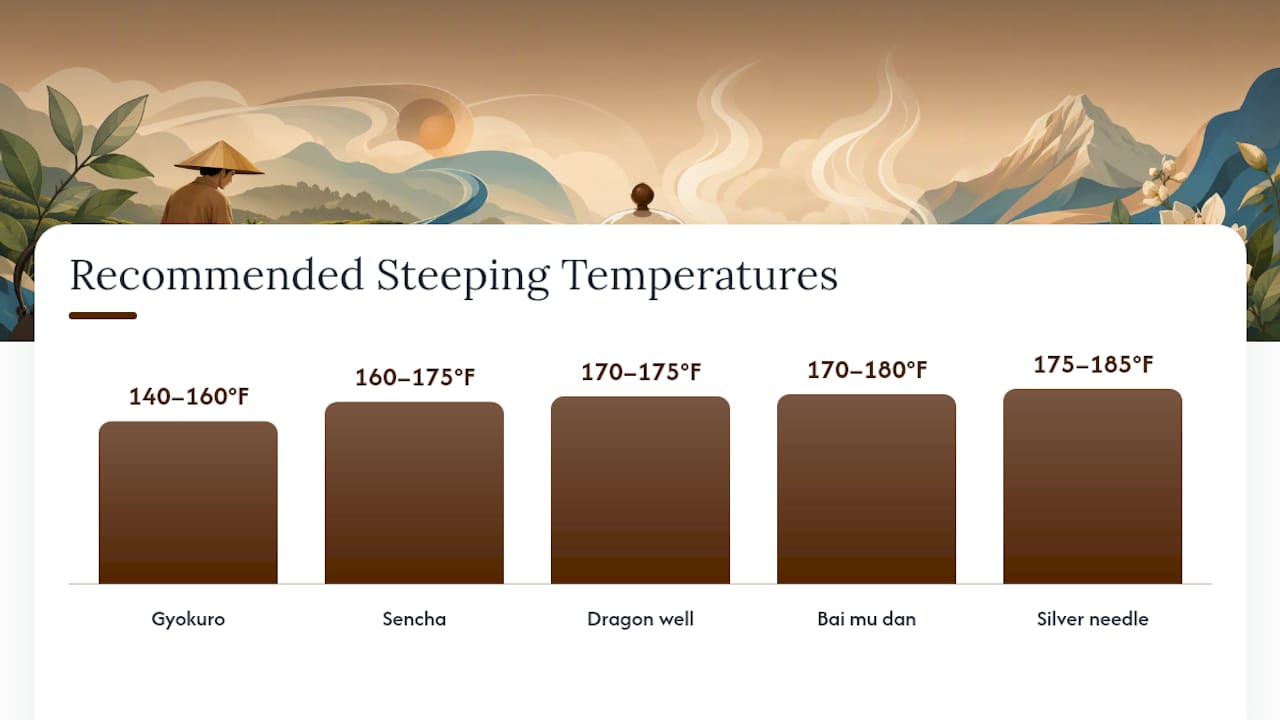
Boiling water scorches the delicate leaves in green and white tea, pulling out excess catechins that taste sharp and astringent. Keeping the water between 160 and 185°F protects the natural sweetness while still extracting enough flavor to make the cup worth drinking. This is the single most common mistake casual drinkers make: they pour straight from a boiling kettle onto a green tea that wanted water 40 degrees cooler.
Starting times vary by subtype:
- Sencha: 160–175°F, 2 to 2.5 minutes, based on UK Tea & Infusions Association guidance for this popular Japanese green.
- Dragon well (longjing): 170–175°F, 2 to 3 minutes, slightly warmer than sencha since the leaves are pan-fired, not steamed.
- Gyokuro: 140–160°F, 1 to 2 minutes, the coolest and shortest steep of any green because the shade-grown leaves are unusually tender.
- Silver needle white: 175–185°F, 4 to 5 minutes, since the whole buds need extra time to unfurl and release flavor.
- Bai mu dan (white peony): 170–180°F, 3 to 4 minutes, a bit faster than silver needle because the leaf is more broken and open.
Pro Tip: Taste at the low end of the range first. If the cup feels thin, don’t crank the temperature up. Add 15 to 30 seconds to the steep time instead. Temperature controls bitterness; time controls strength.
How Long Should Oolong and Pu-erh Steep?
Oolong’s steep time swings more than any other category because oxidation level and leaf shape both change how fast flavor releases. A tightly rolled Taiwanese oolong behaves differently in the cup than a loosely twisted Wuyi strip style, even at the same temperature.
- Light, rolled oolong (jade, milk oolong): 185–195°F, 2 to 3 minutes, floral and light bodied.
- Dark, roasted oolong (Wuyi rock tea, aged oolong): 195–205°F, 3 to 5 minutes, needs the extra heat and time to unlock roasted, mineral notes.
- Pu-erh, sheng or shou: rinse the compressed leaf for 5 to 10 seconds first and discard that water, a step that wakes up leaves that have been pressed into cakes for years and clears off any storage dust.
After the rinse, steep pu-erh 2 to 4 minutes in Western-style brewing. Gongfu drinkers skip the long steep entirely and flash-brew for 10 to 20 seconds per round instead, repeating the process 6 to 10 times as the flavor shifts cup by cup.
Resteep progression matters here more than in any other category. Oolong and pu-erh both reward patience: add roughly 30 to 60 seconds to each additional Western-style infusion, and expect 3 to 5 good rounds from oolong, and 4 to 8 from quality pu-erh.
Black Tea, Herbal Tea, and Rooibos Timing
Black tea is the one category where you genuinely can’t overheat the water. A full boil, 195 to 212°F, is exactly what these fully oxidized leaves want, and the standard steep runs 3 to 5 minutes.
- Whole-leaf black (Assam, Darjeeling, Ceylon): 3 to 4 minutes at full boil, based on tea.co.uk brewing guidance for Assam specifically.
- Broken or CTC grade black tea: closer to 3 minutes, since the smaller particle size releases flavor faster than whole leaf.
- English Breakfast blends: 3 to 5 minutes, adjust toward the longer end if you’re adding milk, since a slightly stronger brew holds up better once diluted.
Herbal blends and rooibos play by different rules entirely. There’s no caffeine and almost no tannin-driven bitterness to worry about, so a boiling steep for 5 to 10 minutes is standard, and root-heavy blends (ginger, licorice, dandelion) can often go even longer without turning harsh. If you’re steeping for a milked cup, lean toward the top of whichever range applies. Extra strength survives the milk; a weak base tea doesn’t.
Do Tea Bags Need Less Steeping Time Than Loose Leaf?
Yes, tea bags almost always need less time than loose leaf, sometimes by a full minute. The reason comes down to surface area: bagged tea is typically broken or “fannings” grade, cut small specifically so it infuses fast, and that smaller particle size means water reaches more surface area more quickly.
- Take roughly one minute off whatever the loose-leaf chart recommends when you’re using a bag of the same tea type.
- Taste at the low end and stop early. Bags cross from “brewed” to “bitter” faster than whole leaf does.
- Reach for bags when you want speed and simplicity, a single mug before work, a hotel room kettle, no cleanup.
- Reach for loose leaf tea when you want control over strength, multiple infusions from the same leaf, and a fuller, more complex cup.
Extraction research backs this up directly: roughly a third of the caffeine in tea releases within the first 30 seconds of steeping, and about 90% is out by the five-minute mark. A bag’s broken leaf hits that curve faster than a whole leaf does, which is exactly why the one-minute rule works.
Can You Cold Steep Tea Overnight?
Cold steeping works, and for some teas it works better than a hot brew. Refrigerator-temperature steeping, around 40°F, takes anywhere from 2 hours for delicate greens up to 12 hours for sturdier black teas and herbals.
- Green and white tea: 2 to 6 hours in the fridge, using slightly more leaf than you would for a hot steep.
- Black tea and herbals: 8 to 12 hours, ideal for a pitcher you start before bed and drink the next day.
- If you’re short on time, brew hot at double strength, then pour over ice. You lose some of the smoothness, but you get a cold cup in minutes instead of hours.
Cold steeping at refrigerator temperatures for up to 12 hours can pull out higher levels of antioxidants and a smoother flavor compared with a standard 3-minute hot steep, largely because the slower extraction pulls less of the compounds responsible for bitterness.
How Many Times Can You Resteep the Same Tea Leaves?
Good whole-leaf tea rarely gives up everything in one steep. Here’s how to get more out of the same leaves, whether you’re brewing Western style or going gongfu.
- Western resteep: keep the same water temperature and add 30 to 60 seconds to each additional infusion. Oolong, pu-erh, and quality white teas hold up best across multiple rounds.
- Gongfu style: use significantly more leaf in a small vessel, and steep just 10 to 30 seconds per round, repeating 6 to 10 times as flavor evolves from round to round.
- Track it: keep a timer running and jot a quick note on steep count and time. It sounds fussy until you realize it’s the only way to reproduce a great cup you brewed by feel.
How to Steep Tea Step by Step
- Measure roughly 1 teaspoon of loose leaf, or about 2 to 3 grams, per 8 ounces of water. Bulkier leaves like white tea may need slightly more by volume.
- Heat water to the target range for your tea type. No thermometer? Watch the kettle: a gentle simmer with small bubbles is roughly 175 to 185°F, a rolling boil is 212°F.
- Pour water over the leaves and set a timer at the low end of your tea’s range.
- Cover the cup or pot while it steeps. This traps aromatic compounds that would otherwise escape as steam, which matters more than most people assume.
- Strain or remove the leaves the moment the timer goes off. Taste, and note whether you’d add time next round.
No infuser? A fine mesh strainer, a French press, or even a clean sock works in a pinch, as long as the leaves can move freely in the water.
Pro Tip: Never leave the leaves in “to save time.” Pulling them out on schedule is the single easiest way to guarantee a repeatable cup.
How Do You Fix a Bitter or Weak Cup of Tea?
A bitter cup almost always means one of three things: water too hot, steep too long, or too much leaf for the amount of water. Cool the water 10 to 15 degrees, cut 30 to 60 seconds off the steep, or dilute the finished cup with hot water. A splash of milk can also round off harshness in black tea, though it won’t fix a truly over-steeped green.
A weak, thin cup usually means the opposite problem: not enough leaf, or too short a steep for a whole-leaf tea that needs time to open up.
- Add more leaf before you add more time. It’s the faster fix and it doesn’t risk over-extraction.
- If the leaf amount is already generous, add 30 seconds and taste again.
- Water quality matters more than people expect. Heavily chlorinated or very hard tap water mutes flavor no matter how well you time the steep.
- Let a freshly boiled kettle rest 30 seconds before pouring over delicate greens or whites. It’s a free way to hit the right temperature without a thermometer.
Pro Tip: Keep a small notebook or notes app entry for your favorite teas. Two lines: temperature and time. Six months from now, you’ll thank yourself.
Kristopher’s Notes on Steeping Time in Practice
Kristopher, who writes brewing guides, treats every new tea the same way: start at the bottom of the chart, taste, and adjust in small steps rather than guessing at a number and hoping. The step-by-step loose leaf brewing guide and the brewing without an infuser walkthrough both repeat this same rule because it works regardless of what tea you’re holding.
The most consistent lesson from testing dozens of teas this way: written charts get you close, but your specific water, your specific leaf, and your specific cup size will always shift things slightly. Document what works for your favorites instead of re-guessing every time. For readers curious how far bag brewing diverges from the real thing, the bags versus loose leaf comparison breaks down exactly where the two methods part ways.
Ready to Put the Chart to Work?
A chart only helps if you’ve got tea worth brewing carefully. Dkbeanleaf’s loose leaf tea collection is built around exactly the categories covered here, so you can match the leaf to the steep time instead of guessing. If you’re drinking three or four cups a day anyway, a good mug matters more than people admit. For general brewing tips beyond tea steeping specifically, The Functional Sip covers other botanical brewing angles worth a read.
What Actually Matters When You Steep Tea
The conventional wisdom on tea steeping times treats charts as gospel, and that’s the mistake. A chart is a starting coordinate, not a destination. The research on extraction is clear: a huge share of caffeine and flavor compounds move into the water within the first 30 seconds to a minute, which means your margin for error is narrower than most guides admit, and also more forgiving than you’d think if you taste as you go.
What gets overlooked is that the “start low, taste, adjust” method matters more than memorizing any specific number. Water hardness, altitude, kettle type, and even the cup you’re using all nudge the ideal steep time in ways no printed chart can predict for your kitchen specifically.
Prioritize the tasting step over the timer. The timer is a suggestion. Your tongue is the instrument that actually matters.
— Kristopher
Sources
- How to Steep Tea Like an Expert - Healthline
- Tea Steeping Times: The Complete Chart for Every Type of Tea - BrewTea
- How to Brew Tea: Water, Temperature and Timing - Steeped Travels
- Make a perfect brew - UK Tea & Infusions Association