

What $9.32 per Pound Actually Buys, U.S. Coffee Bean Prices 2026
The average U.S. retail price for ground roast coffee was at a city-average level around $9.32 per pound in mid-2026, showing an increase from the previous year. That figure sits at the low end of what most specialty roasters charge, since grocery-shelf ground coffee runs cheaper than small-batch, single-origin beans sold direct to consumers online. If you’re comparing bags on a website, the fastest sanity check is converting the bag price to price per pound before you decide anything.
TL;DR:
- The national average retail price for ground roast coffee is around $9.32 per pound, but specialty and small-batch coffees often cost much more, typically between $16 and $35 per pound.
- Most of the cost in a bag of coffee comes from green coffee, roasting, packaging, labor, shipping, and marketing, with green coffee usually costing about $3.50 per pound.
- To accurately compare prices, always convert the bag price to price per pound and account for shipping fees, as a more expensive bag by size may be cheaper per pound.
- Certifications like organic and Fair Trade generally add $1 to $3 per pound due to farming and certification costs, not necessarily tasting better.
- Buying sample packs or larger bags, and choosing subscriptions, can provide better value tailored to your drinking habits.
Table of Contents
- Current Coffee Bean Prices: The National Snapshot
- What Actually Drives the Price on Your Bag
- Retail Price Bands: Value, Specialty, and Ultra-Premium
- How to Compare Coffee Bean Prices Without Getting Fooled
- Smarter Ways to Buy Coffee Beans Online
- Do Organic and Fair Trade Certifications Raise the Price?
- Does Coffee Get More Expensive at Certain Times of Year?
- A Buyer’s Take: Price Alone Won’t Tell You What You’re Getting
- Try D&K Bean and Leaf Before You Commit to a Full Bag
- Sources
- FAQ
Current Coffee Bean Prices: The National Snapshot
The Bureau of Labor Statistics tracks average retail food and energy prices across major U.S. cities every month, and coffee is one of the line items. The Federal Reserve Bank of St. Louis republishes the same data as FRED series APU0000717311, which makes it easy to check yourself.
The number to know: $9.317 per pound, a city average for 100% ground roast coffee sold in retail containers, as of July 2026.
A few things to keep in mind about what this number actually measures:
- It covers ground roast coffee broadly, not a specific bag size, brand, or grind type.
- It’s a monthly average, not seasonally adjusted, so a single month can wobble from short-term supply or weather disruptions.
- It reflects grocery-channel retail, not direct-to-consumer specialty pricing, which tends to run meaningfully higher.
Treat this figure as a baseline, not a target. If you’re buying a 12-ounce bag of single-origin coffee online for $22, you’re not being overcharged compared to the BLS number. You’re buying a different product in a different channel.
What Actually Drives the Price on Your Bag
Green coffee is only one line item in a much longer list, and it’s usually not the biggest one. Here’s what stacks up before a bag reaches your cart:
- Green coffee cost — tied to commodity markets like ICE Arabica futures, plus origin and quality premiums.
- Roast loss — beans lose 12% to 20% of their weight during roasting as moisture evaporates, so you need more green coffee than the final bag weight suggests.
- Packaging — one-way valve bags, sealed pouches, and labels all add real cost per unit, especially at smaller order volumes.
- Labor and roasting overhead — running a roaster, monitoring batches, and staffing fulfillment isn’t free.
- Inbound freight and duties — importing green coffee involves shipping costs and tariffs that shift with fuel prices and trade policy.
- Pick, pack, and fulfillment — warehouse labor and shipping materials for each order.
- Marketing and margin — what keeps a roasting business running long enough to source good coffee next season.
An illustrative model from Eightx’s CFO-style breakdown of coffee pricing shows how this adds up: with green coffee priced around $3.50 per pound, a 12-ounce bag’s cost lines (green coffee, roast loss, packaging, and fulfillment) can produce an implied list price near $16.15. That’s before marketing spend or profit margin, which explains why so many specialty bags land in the high teens to mid-twenties.
Micro-lot and high cupping-score coffees push prices higher still, partly because small batches don’t get the same economies of scale as a 500-pound production run.
Pro Tip: If a roaster explains whether they buy green coffee on forward contracts or spot market, take note. Forward-contracted roasters usually offer more price stability than ones who reprice every time the commodity market moves.
Retail Price Bands: Value, Specialty, and Ultra-Premium
Most bags sold online fall into one of three rough tiers, and knowing them helps you judge whether a price is fair or inflated.
- Value DTC and grocery: prices typically range in a moderate band per 12-ounce bag, representing accessible options for many supermarket and budget online brands.
- Core specialty: prices for well-known specialty roasters with single-origin or small-batch blends generally sit above the value tier.
- Ultra-premium: prices for rare origins, competition-lot coffees, or heavily certified beans tend to be significantly higher, reflecting scarcity and exclusivity.
A dataset review of direct-to-consumer coffee pricing found that median prices tend to cluster in a middle range, while average prices are pulled higher by a smaller group of premium products. This indicates a bimodal distribution in DTC coffee pricing. A lot of brands cluster near the accessible middle, while a smaller group of ultra-premium sellers pull the average way up. Don’t assume the “average” price is what you should expect to pay.
Sample packs and subscription bags usually land inside the core specialty band per pound, sometimes slightly below it once a subscription discount kicks in.
How to Compare Coffee Bean Prices Without Getting Fooled
The only reliable way to compare two bags is price per pound, not price per bag. A $22 bag sounds more expensive than an $18 bag until you notice one weighs 16 ounces and the other weighs 10.
- Convert to price per pound. Divide the price by the weight in pounds. An $18 bag at 12 ounces (0.75 lb) works out to $24 per pound.
- Check the net weight in the fine print. Some brands print bag size in grams, others in ounces, and a few use both to look bigger than they are.
- Look for a roast or pack date. Fresh coffee should list one; its absence is a minor red flag.
- Confirm grind choice matches your brewer. Whole bean, drip grind, and espresso grind sometimes carry different prices for the same coffee.
- Add shipping before comparing totals. A cheaper bag with a $7 shipping fee can cost more delivered than a pricier bag with free shipping over $35.
- Watch for inflated “compare at” pricing. If a site always shows a sale price against a suspiciously high original price, that’s a pricing tactic, not a discount.
The math that catches most people off guard: the BLS’s $9.317-per-pound national average is for grocery-channel ground coffee. A specialty 12-ounce bag priced at $20 works out to about $26.67 per pound, nearly triple that baseline. That’s not a rip-off. It’s a different market segment with different sourcing standards.
Smarter Ways to Buy Coffee Beans Online
Getting good value isn’t about finding the cheapest bag. It’s about matching the format to how you actually drink coffee.
- Sample packs make sense when you’re trying a new roaster or comparing origins before committing to a full bag.
- Subscriptions typically shave 10% to 15% off the per-bag price and guarantee you never run out, which matters more than the discount for a lot of regular drinkers.
- Larger-format bags (2 pounds or more) usually lower your per-pound cost, but only buy that much if you’ll finish it within a few weeks of roasting.
- Bundling coffee with tea, mugs, or apparel often clears free-shipping thresholds that a single bag wouldn’t hit on its own.
- Check the freshness and return policy before buying in bulk. A roaster confident in their coffee will usually stand behind it.
Pro Tip: If you’re on the fence between two origins, a sample pack almost always costs less per ounce than buying two separate full-size bags to compare, and you waste less coffee finding out what you don’t like.
Do Organic and Fair Trade Certifications Raise the Price?
Yes, usually by a noticeable margin, and the reasons are structural, not just marketing. Certifications like organic and Fair Trade require farms to follow specific growing, labor, and pricing standards, and those standards cost money to maintain and verify.
Organic certification requires farmers to avoid synthetic pesticides and fertilizers, which often means lower yields per acre. Lower yield per acre translates directly into higher cost per pound of green coffee, since the farm needs to recover the same income from less product.
Fair Trade certification sets a price floor that importers must pay farmers, regardless of where the commodity market sits. When the market price drops below that floor, Fair Trade buyers still pay the guaranteed minimum, and that premium eventually shows up in the retail price. When the market is high, the gap between Fair Trade and conventional coffee narrows.
Rainforest Alliance and similar certifications add their own costs. Farms need audits, paperwork, and sometimes infrastructure changes to qualify, and those costs get built into what importers pay.
None of this means certified coffee is automatically better tasting. Green-bean quality and origin matter more for flavor than a certification label does. What certifications reliably tell you is something about how the coffee was farmed and traded, which is a different value proposition than cup quality. If that matters to you, expect to pay a premium of roughly $1 to $3 more per pound compared to uncertified coffee from a similar region and grade.
Does Coffee Get More Expensive at Certain Times of Year?
Retail coffee prices don’t swing wildly month to month the way, say, produce prices do, but there’s a real seasonal rhythm worth knowing.
Late fall through the December holidays tends to bring the year’s highest prices and least discounting. Demand spikes for gift sets, holiday blends, and gifting-occasion mugs and apparel, and roasters know shoppers are willing to pay full price during that window.
January through early spring usually brings the best deals. Roasters run clearance and “new year” promotions to move holiday inventory, and demand cools after the gifting season ends.
Harvest timing in origin countries also plays a quieter role. Many Latin American origins harvest between October and February, while parts of East Africa harvest closer to mid-year. A rough harvest in a major growing region can push green coffee costs up months before you see it reflected in a retail bag price, since roasters typically lock in inventory ahead of time rather than repricing overnight.
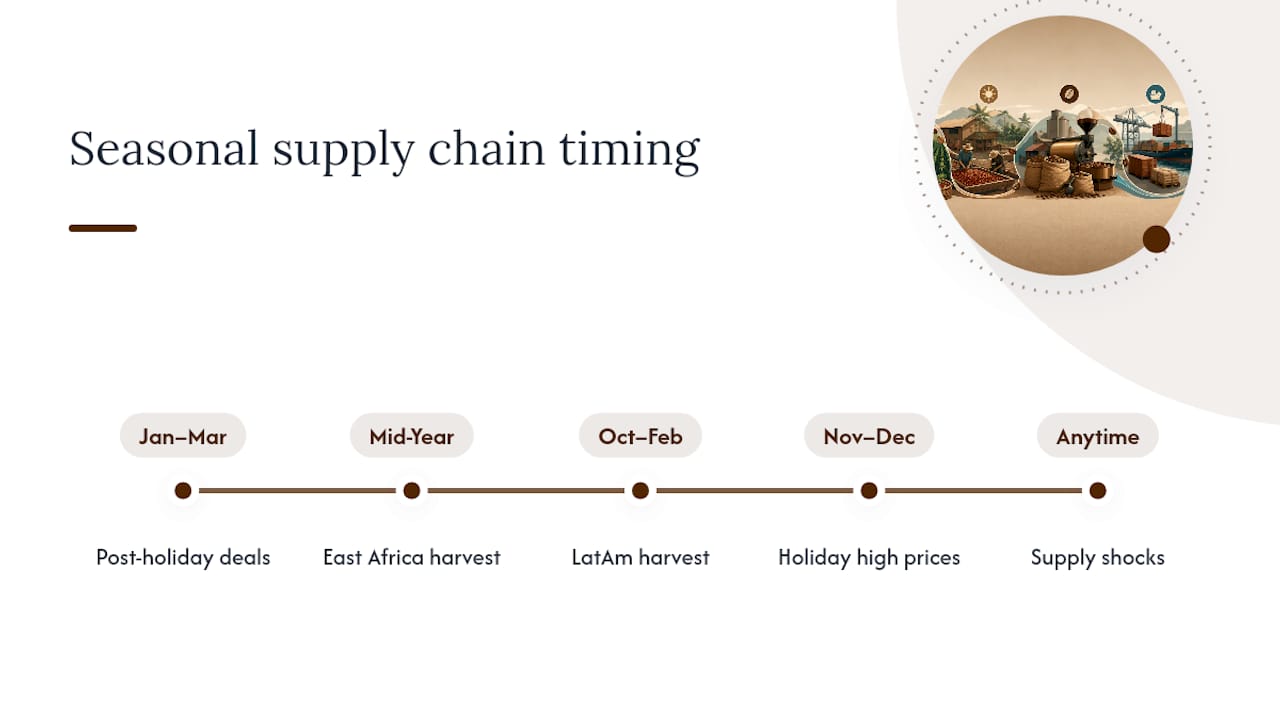
Weather events, currency shifts, and shipping disruptions can also cause short-term spikes that show up as a sudden jump in a roaster’s list price with little warning. If you notice a favorite blend jump a dollar or two seemingly out of nowhere, it’s often catching up to a commodity move that happened months earlier.
A Buyer’s Take: Price Alone Won’t Tell You What You’re Getting
[brand_signal]
Most people assume a higher price per pound means better coffee. It doesn’t, not reliably. It means more labor, smaller batches, pricier origins, or certification costs went into that bag. Sometimes that translates to a better cup. Sometimes it just means you’re paying for scarcity or a nicer label.
The better question isn’t “is this expensive?” It’s “does this roaster tell me what I’m actually paying for?” Look for a roast date, a clear weight in ounces or grams, and honest language about where the beans came from. A roaster who explains their sourcing and pricing openly is usually more trustworthy than one who just slaps “premium” on the bag and charges accordingly.
If you’re new to a brand, start with a sample pack or a single origin rather than committing to a subscription. Figure out what you actually like before optimizing for price per pound.
[author_bio]
— Kristopher
Try D&K Bean and Leaf Before You Commit to a Full Bag
Some roasters offer sample packs sized for discovery, standard 12-ounce bags for everyday use, and subscriptions that provide savings without a long-term commitment.

Offerings may include fresh roasted coffee in blends and single origin, flavored coffees, loose leaf teas, and coffee mugs and cups. Coffee-themed apparel such as sweatshirts, t-shirts, hats, and caps may also be available. Some subscriptions ship on a schedule to provide fresher beans.
If you’ve been comparing prices across a dozen tabs, start simpler. Grab a sample pack from the tea and coffee lineup and see what you actually like before you commit to a full bag or a subscription plan.
Sources
- BLS — Average retail food and energy prices (U.S. city average)
- FRED — Average price: coffee, 100%, ground roast, all sizes (cost per pound) — U.S. city average
- Beaconmon — DTC coffee brand pricing: dataset insights
FAQ
How much should I expect to pay for a pound of coffee beans?
Grocery-channel ground coffee averaged $9.317 per pound in July 2026, but specialty single-origin and small-batch coffee sold online typically runs $16 to $35 per pound depending on the tier.
Why is specialty coffee so much more expensive than grocery store coffee?
Specialty roasters use smaller batches, pay higher premiums for quality green coffee, and absorb more packaging and labor cost per pound than large-scale grocery producers.
Does organic or Fair Trade certification always mean a higher price?
Almost always, typically by $1 to $3 more per pound, since certified farms face lower yields or guaranteed price floors that get built into the final retail cost.
Is it cheaper to buy a subscription instead of one-off bags?
Usually yes.
What’s the best way to compare coffee prices between two websites?
Divide each bag’s price by its weight in pounds to get a true price per pound, then factor in shipping cost before deciding which is the better deal.