

Types of Coffee Beans Worldwide: Your Flavor Guide
Walk into any specialty shop and the question hits fast: which beans do you actually want? The types of coffee beans worldwide span four distinct species, dozens of growing regions, and flavor profiles that range from delicate jasmine to smoky rubber. Knowing the difference changes everything about how you buy, brew, and taste. This guide breaks down Arabica, Robusta, Liberica, and Excelsa with enough detail that you will walk away with real criteria for your next purchase, not just a list of names.
Table of Contents
- Key takeaways
- Types of coffee beans worldwide: how to evaluate what you are buying
- 1. Arabica beans: the world’s most popular coffee
- 2. Robusta beans: misunderstood and underrated
- 3. Liberica beans: the rarest sip you will find
- 4. Excelsa beans: the blend builder’s secret weapon
- 5. How the four bean types compare
- My take on exploring coffee bean varieties
- Explore the world of coffee with Dkbeanleaf
- FAQ
Key takeaways
| Point | Details |
|---|---|
| Four main species exist | Arabica, Robusta, Liberica, and Excelsa each offer distinct flavors, caffeine levels, and growing conditions. |
| Arabica leads global production | Arabica accounts for 65–72% of world output, making it the most widely consumed species. |
| Robusta is more than cheap filler | Robusta delivers higher caffeine and thicker espresso crema, and specialty roasters now prize it for those exact traits. |
| Rare beans add blend complexity | Liberica and Excelsa make up less than 2% of production but bring smoky, tart notes that no other species replicates. |
| Brewing method shapes bean choice | Single-origin beans shine in pour-over and drip; blends typically outperform them in espresso for consistency. |
Types of coffee beans worldwide: how to evaluate what you are buying
Before choosing a bag, you need a framework. Not every bean suits every brewer, and price alone tells you almost nothing about what ends up in your cup.
The most useful criteria fall into five categories:
- Species and subspecies: The four main species differ fundamentally in genetics, not just flavor. Within Arabica alone, varieties like Typica, Bourbon, and Gesha produce dramatically different cups.
- Growing altitude and climate: Altitude affects bean density, acidity, and sugar development. High-altitude beans develop more slowly, producing complex sugars that translate to brighter, more nuanced flavor.
- Caffeine content: Robusta carries roughly twice the caffeine of Arabica, which affects perceived bitterness and body, not just your morning energy.
- Flavor profile: Think in terms of acidity (brightness), body (weight on the palate), sweetness, and finish. These four dimensions let you compare any two coffees objectively.
- Intended use: Espresso rewards density, fat content, and crema production. Pour-over and drip reward clarity and acidity. Match the bean to the method.
Market relevance matters too. Specialty-grade beans command price premiums of 30 to 80% over commodity grades, and the specialty segment is projected to reach 65 to 70% of dollar sales by 2035. Understanding where a bean sits in that spectrum helps you spend smarter.
Pro Tip: If you brew espresso at home, prioritize body and crema production over nuanced acidity. If you use a pour-over or French press, chase brightness and origin character instead.
1. Arabica beans: the world’s most popular coffee
Arabica is where most coffee drinkers start, and for good reason. It accounts for the majority of every cup sold in North America, and its flavor range is genuinely impressive.
Origins and cultivation
Arabica traces its roots to the highlands of Ethiopia, specifically the Kaffa region, where coffee plants still grow wild. Today it is cultivated across Latin America, East Africa, and parts of Asia. The key requirement is altitude. Arabica grows best at elevations above 2,000 feet in cooler temperatures, with lower caffeine and higher sugar content than any other species. That combination produces the sweetness and complexity specialty buyers pay for.
Flavor profile
Arabica cups clean, sweet, and complex. You will find notes like:
- Floral and fruit-forward acidity in Ethiopian and Kenyan origins
- Chocolate, caramel, and nut in Latin American beans like Colombian and Brazilian
- Stone fruit and citrus in high-altitude Guatemalan and Peruvian lots
- Wine-like complexity in Yemeni and some East African naturals
Market dominance
Arabica holds 65 to 72% of global coffee production. Single-origin Arabica is the fastest-growing segment in the U.S. market, expanding at 8 to 12% annually as consumers trade up from blends.
The tradeoff is fragility. Arabica plants are susceptible to coffee leaf rust, frost, and drought. That vulnerability drives up cost and makes sourcing quality lots a competitive sport among roasters. Understanding how roast levels interact with these delicate flavor compounds is the next step once you have found an origin you love.
2. Robusta beans: misunderstood and underrated
Robusta has a reputation problem. Most casual drinkers associate it with cheap instant coffee and harsh bitterness. That narrative is outdated and only partially accurate.
What Robusta actually delivers
Robusta is valued not as a lower-quality filler but as an indispensable ingredient for roasters who need intensity, affordability, and thick, stable crema. Espresso blends from Italian-style roasters have used Robusta for generations, specifically because its higher oil content produces the golden foam that defines a properly pulled shot.
Key traits include:
- Caffeine content roughly double that of Arabica, producing bolder body and natural bitterness
- Disease resistance that allows cultivation at lower altitudes, including humid lowland regions in Vietnam, Brazil, and Central Africa
- Earthy, nutty, chocolatey flavor with less acidity and more punch
- Significantly lower production cost compared to Arabica
The specialty shift
Specialty roasters are now actively selecting high-quality Robusta lots from Uganda and Vietnam. These beans, when processed well, produce cups with dark chocolate, black pepper, and espresso-forward intensity that Arabica simply cannot match at the same price point.
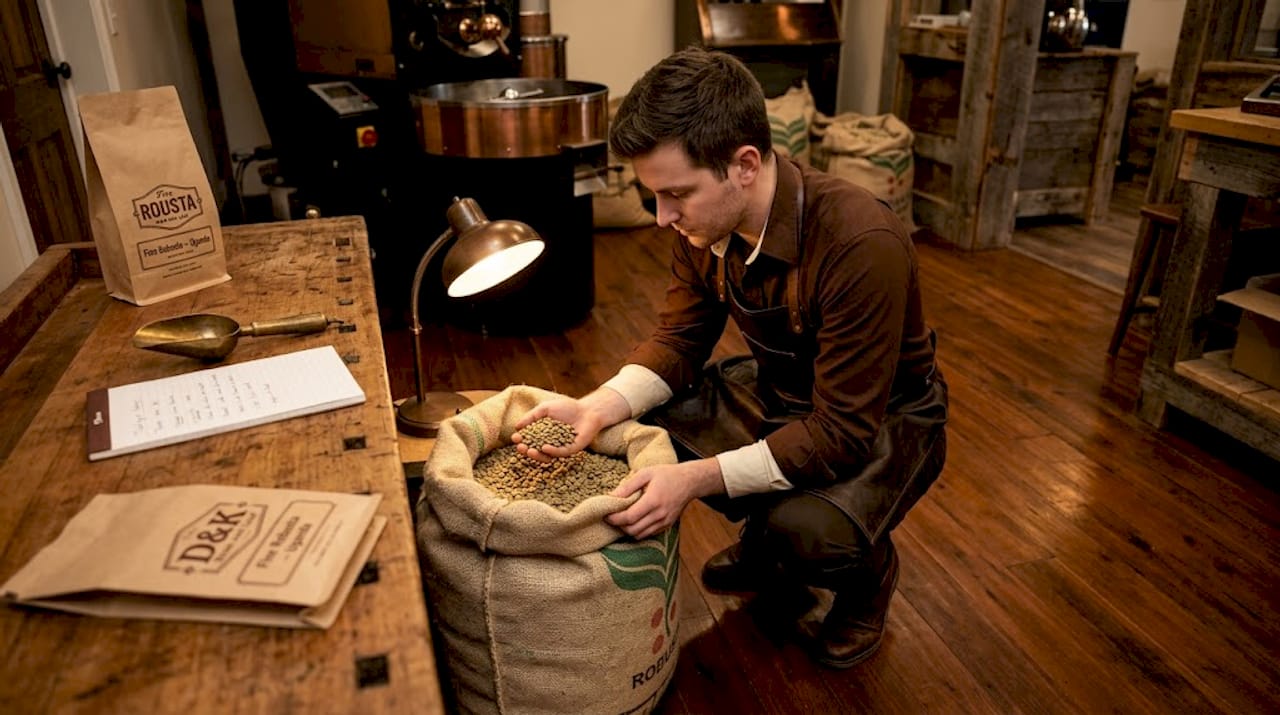
Pro Tip: Look for bags labeled “Fine Robusta” or “Specialty Robusta” from Uganda or India. These lots go through the same rigorous cupping standards as Arabica and offer exceptional value for espresso drinkers.
Robusta holds around 22 to 28% of global market share, making it the clear second species. If you want a high-caffeine espresso blend, the Max Caf Blend is a strong example of how Robusta characteristics get channeled productively.
3. Liberica beans: the rarest sip you will find
Liberica is the outlier. Native to Liberia in West Africa, it now grows primarily in the Philippines, Malaysia, and parts of Southeast Asia. The trees are enormous compared to Arabica and Robusta, producing large, asymmetrical beans with a distinctive shape that looks nothing like the uniform ovals you are used to seeing.
The flavor is polarizing in the best way. Liberica delivers smoky, woody and fruity notes, sometimes described as floral with hints of jackfruit and dark smoke. It is not subtle. Filipino coffee culture has centered on Liberica, called Barako, for over a century, and drinkers there consider it a point of national identity.
Challenges in cultivation and harvesting keep Liberica rare. The larger trees require more land and more manual labor to pick selectively. Combined with limited growing regions, supply stays tight and prices run high for quality lots. Specialty roasters use Liberica strategically, adding it to blends in small percentages to introduce a smoky backbone that nothing else provides.
4. Excelsa beans: the blend builder’s secret weapon
Excelsa was classified as a variety of Liberica for decades and only gained recognition as a separate species recently. That taxonomic history partly explains why most coffee drinkers have never heard of it despite it showing up in many of the blends they enjoy.
Grown primarily in Southeast Asia, Excelsa contributes tart, bright, and fruity notes to blends. Think dark fruits, tamarind, and a lingering brightness on the finish. Where Liberica adds depth and smoke, Excelsa adds lift. Used together in a blend, they create a complexity that Arabica and Robusta alone cannot achieve.
Production is tiny. Liberica and Excelsa combined represent less than 2% of global output, so availability depends heavily on roaster relationships with specific farms in the Philippines and Vietnam. If you see Excelsa listed as a component on a bag, the roaster has done serious sourcing work to get it there.
5. How the four bean types compare
Here is how the four main species stack up across the dimensions that matter most for buyers and brewers:
| Attribute | Arabica | Robusta | Liberica | Excelsa |
|---|---|---|---|---|
| Primary origin | Ethiopia, Latin America | Vietnam, Brazil, Uganda | Philippines, Malaysia | Southeast Asia |
| Caffeine level | Low to medium | High | Medium | Medium |
| Flavor character | Sweet, bright, complex | Bold, earthy, bitter | Smoky, woody, fruity | Tart, dark fruit, bright |
| Growing altitude | High (2,000+ ft) | Low to mid | Low to mid | Low to mid |
| Global market share | 65 to 72% | 22 to 28% | Under 1% | Under 1% |
| Best brewing use | Pour-over, drip, espresso blends | Espresso, instant, blends | Specialty blends, black coffee | Specialty blends |
A few patterns stand out from that comparison:
- Espresso drinkers benefit from Robusta in their blend for crema and body, with Arabica providing sweetness and aroma on top
- Pour-over enthusiasts get the most from single-origin Arabica, where terroir-driven flavors shine without blending interference
- Adventurous buyers chasing complexity should look for blends that incorporate Liberica or Excelsa as named components
- Budget-conscious drinkers can find genuine quality in Robusta-forward blends without sacrificing the cup experience
The 2026 coffee market trend toward premiumization means origin transparency is now printed on packaging. Roasters that name specific farms, processing methods, and species percentages are responding to consumers who want to know exactly what they are drinking.
Specialty green beans cost two to four times more than commodity-grade lots, and variety packs carry additional packaging costs. Knowing which species you prefer lets you spend that premium on the right beans rather than experimenting blindly.
My take on exploring coffee bean varieties
I have tasted a lot of coffee. What I keep coming back to is how confidently people dismiss Robusta and how rarely they have actually tried a quality lot before writing it off. The conventional wisdom that Arabica is superior and Robusta is inferior is a marketing construct as much as a flavor reality.
In my experience, the most interesting cups come from roasters who blend with intention rather than defaulting to 100% Arabica out of habit or status signaling. A well-crafted Arabica and Robusta espresso blend often outperforms a single-origin Arabica in a home espresso setup, particularly when the grinder and machine are mid-range.
What I tell anyone starting to explore different coffee bean varieties: buy a variety pack first. The psychological barrier to trying something unfamiliar drops significantly when you are not committing to a full bag. Variety packs lower that barrier but do carry higher per-unit costs due to packaging and curation, so treat them as an education investment, not your regular supply.
The shift toward traceable, origin-specific coffee is real and worth embracing. But do not let it make you a snob about species. Some of the best value in specialty coffee right now is in Fine Robusta and thoughtfully blended lots that nobody is talking about because Arabica gets all the marketing attention.
— Kristopher
Explore the world of coffee with Dkbeanleaf

At Dkbeanleaf, the coffee selection is built for exactly this kind of curiosity. Whether you want to taste the difference between single-origin Arabica and a Robusta-forward espresso blend, or you are ready to try a sampler that covers multiple origins in one order, the coffee collection has you covered. The Best Sellers Sample Pack puts six distinct roasts in one box, so you can taste the regional and roast-level differences back to back without guessing. Pair your exploration with a travel mug with a handle that keeps your brew at the right temperature from the first sip to the last. Good beans deserve a good vessel.
FAQ
What are the four main types of coffee beans?
The four main species are Arabica, Robusta, Liberica, and Excelsa. Arabica and Robusta together account for over 90% of global production, while Liberica and Excelsa are rare specialty finds.
How do Arabica and Robusta differ in flavor?
Arabica is sweeter, brighter, and more complex, while Robusta is bolder, more bitter, and earthier with higher caffeine. Robusta also produces thicker crema, making it a valued component in espresso blends.
Where do coffee beans come from?
Coffee beans grow in the “Bean Belt,” the tropical zone between the Tropics of Cancer and Capricorn. Major producing countries include Brazil, Colombia, Ethiopia, Vietnam, and Indonesia, each contributing distinct flavor characteristics based on climate and altitude.
Are rare coffee beans worth the higher price?
Liberica and Excelsa offer flavor complexity that Arabica and Robusta cannot replicate, particularly smoky and tart notes. Whether that justifies the price depends on your curiosity level and how much variety you want in your cup.
What is the best way to try different coffee bean varieties?
Start with a variety pack or sample set that includes beans from multiple origins and species. This approach lets you taste differences side by side before committing to a full bag, making it the most efficient path to knowing your preferences.