

Roasters, Compostable Coffee Bags: Ask for Finished Pouch Certificates
Compostable coffee bags can be a credible sustainability upgrade if the finished pouch is fully certified for the intended composting route and you validate barrier performance and shelf life with your own roast. The catch: most compostable pouches need industrial composting infrastructure that a lot of your customers simply don’t have. Before switching, ask for a finished-pouch certificate, request the OTR and MVTR technical sheets, and run a sample batch through real shelf-life testing.
TL;DR:
- Ensure the compostable pouch has third-party certification that explicitly covers the finished product, including valves, zippers, ink, and adhesives.
- Most compostable coffee bags rely on industrial composting environments; verify if your customers have access to such facilities before switching.
- Test the actual shelf life of your roast in samples with the supplier’s technical data sheets to confirm freshness retention over time.
- Remember that certified compostability does not guarantee degradation in a home compost or landfill, so clear disposal instructions are essential.
- Expect a higher cost, longer lead times, and stricter sourcing requirements when choosing a certified compostable pouch supplier.
Table of Contents
- What Does “Compostable” Actually Mean for Coffee Bags?
- Materials and Construction: Where Whole-Bag Claims Break Down
- Do Compostable Bags Protect Freshness as Well as Foil?
- How Do You Vet and Source a Compostable Pouch Supplier?
- What Happens to a Compostable Bag After the Customer Throws It Away?
- D&K Bean and Leaf’s Practical Notes on Packaging Decisions
- When We Chose Packaging: Lessons for Small Roasters
- Sources
What Does “Compostable” Actually Mean for Coffee Bags?
“Compostable” is not a marketing adjective. It’s a technical, testable claim, and the FTC’s Green Guides require competent scientific evidence before a company can put it on a package. That evidence usually takes the form of third-party certification, not a supplier’s word.
Two certification tracks matter, and they are not interchangeable:
- Industrial certification (ASTM D6400, BPI, or OK Compost INDUSTRIAL): the material must hit roughly 90% disintegration and substantial biodegradation within about 180 days, but only under the heat, moisture, and microbial activity of a commercial composting facility.
- Home certification (TÜV OK Compost HOME, or BPI’s home-compostable mark): a stricter, slower standard designed to work in a backyard bin without industrial heat.
A film supplier’s compostability claim covers the film. It does not cover your finished pouch. The Biodegradable Products Institute is explicit that certified compostable products carry a specific product ID and a documented scope, so if your supplier can’t hand you a certificate number tied to the actual bag you’re buying, you don’t have proof, you have a promise.
Materials and Construction: Where Whole-Bag Claims Break Down
Most compostable coffee pouches on the market use one of three structures. Each has trade-offs worth knowing before you commit to a print run.
- Kraft paper with a PLA or PBAT liner: the most common structure, reasonably priced, and widely available, but liner quality varies a lot between suppliers.
- Cellulose-based laminates: strong compostability profile, though sourcing and consistent supply can be harder to lock down.
- PHA-based films: PHA packaging is biodegradable across soil, marine, and home compost environments, and it can approach the barrier performance of conventional laminates, making it one of the more capable options for roasters who need both freshness and a broader end-of-life claim. Expect a cost premium and more limited supplier availability.
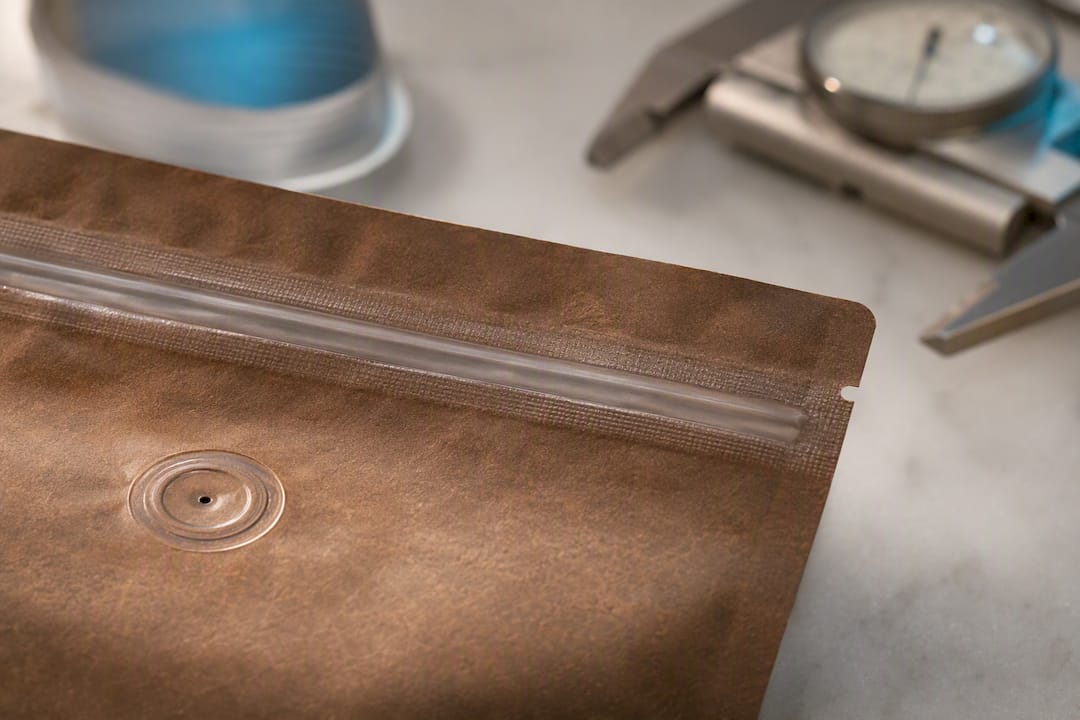
Here’s what actually sinks a lot of “compostable” claims: the accessories. A bag is only as compostable as its weakest part. If the valve, zipper, ink, or adhesive isn’t inside the certified scope, the whole-pack claim is void, even if the film itself is perfectly certified. NEAT Packaging notes that some suppliers require you to remove tin-ties or standard valves entirely because those components simply aren’t compostable and were never tested as part of the pouch. Before you sign off on a design, ask your supplier three things: is the valve certified as part of this exact product code, what ink and adhesive systems are approved for compostable substrates, and can they show you the certificate that covers all of it together.
Pro Tip: Ask your supplier for the certificate’s exact “scope of certification” language, not just the certificate number. Some certifications cover the film only; you want one that names the finished pouch, including valve and zipper.
Do Compostable Bags Protect Freshness as Well as Foil?
Oxygen transmission rate (OTR) and moisture vapor transmission rate (MVTR) are the two numbers that determine whether your coffee tastes fresh on day 30 or stale on day 12. OTR measures how much oxygen sneaks through the bag; MVTR measures moisture. Both directly affect how long your roast holds its flavor, especially for lighter roasts and finer grinds that oxidize faster.
Well-engineered kraft-and-PLA bags can get close to conventional foil laminate performance, but Packaura’s guide for roasters notes that compostable liners tend to be more sensitive to heat and humidity during shipping and storage. That sensitivity is directional, not universal. It matters most if you’re shipping through hot climates or storing inventory in a warehouse without climate control.
Before committing to a full print run, run this sequence:
- Request the OTR and MVTR technical sheets from the supplier in writing.
- Order a small sample batch and pack your actual roast, not a generic test coffee.
- Cup the coffee at intervals (day 1, day 14, day 30) and log flavor degradation.
- Simulate real shipping stress, including a hot-car or warehouse-heat scenario if that’s part of your supply chain.
A number worth remembering: industrial composting standards require materials to hit roughly 90% disintegration within about 180 days under controlled industrial conditions, which is a very different environment than the shipping container your bag sits in for two weeks first.
How Do You Vet and Source a Compostable Pouch Supplier?
Treat this like an RFP, not a casual email exchange. Here’s the checklist:
- Finished-pouch certificate number and its documented scope (film, valve, zipper, ink, adhesive all included)
- OTR and MVTR technical data sheets specific to the product code you’re ordering
- Confirmation the certification covers current PFAS-free requirements, since BPI’s post-2020 process folds that in as part of standard verification
- A physical sample run before you commit to a full print order
- Written artwork and ink limitations for the compostable substrate
On the commercial side, expect a cost premium over conventional foil laminate, sometimes meaningful for small roasters, along with a higher minimum order quantity and a longer lead time while the supplier sources certified film stock. Sampling fees are common and worth paying rather than skipping.
A workable procurement flow looks like this:
- Send your RFP with the questions above spelled out explicitly, not implied.
- Set sample acceptance criteria before you receive the sample (target OTR/MVTR range, minimum shelf life, print quality standard).
- Run your own cupping and storage test on the sample batch.
- Lock in pricing, MOQ, and lead time only after the sample passes your criteria, not before.
If a supplier can’t produce a certificate scope or technical sheets on request, that’s your answer. Move on.
What Happens to a Compostable Bag After the Customer Throws It Away?
This is the part that trips up even well-intentioned roasters: an industrial-certified bag does nothing for the planet if it lands in a customer’s backyard compost bin or, worse, a landfill. Sprudge’s reporting on compostable coffee packaging makes the infrastructure gap plain: industrial facilities run hotter and more controlled than any home setup, and materials certified only for that environment usually won’t break down without it. Cornell’s composting research backs this up. Home piles rarely sustain the temperatures that industrial systems maintain.
Dropping a bag in a curbside recycling bin is arguably worse than the trash, since compostable film can contaminate a recycling stream and cause an entire batch to be rejected. Clear disposal copy prevents that.
Sample on-pack wording that works:
- “Industrially compostable. Check locally for commercial composting access. Do not place in curbside recycling.”
- “Remove valve before composting. Valve is not compostable.” (See our guide to what your bag’s valve does for removal instructions.)
- “No composting access? This bag is safe to dispose of as regular trash.”
Pro Tip: Put the disposal instructions on both the bag and the packing slip. Customers read packing slips at unboxing, when they’re most likely to act on the guidance immediately.
If your customer base mostly lacks industrial composting access, a recyclable structure might serve them better than a compostable claim they can’t actually use.
D&K Bean and Leaf’s Practical Notes on Packaging Decisions
We’ve written about the mechanics behind a few of these decisions elsewhere, and they’re worth a read before you finalize a supplier:
- Recyclable coffee bags: how to tell and where to take them, for roasters weighing recyclable structures against compostable ones
- What a coffee bag valve does and why it matters, essential reading before you certify (or remove) a valve
- How to store roasted coffee the right way, useful context for your own shelf-life testing protocol
For a broader industry comparison of terminology, Tri Crow Coffee’s breakdown of compostable versus biodegradable packaging is a solid outside reference.
When We Chose Packaging: Lessons for Small Roasters
Test with your own roast before you sign anything. A liner that performs beautifully on a supplier’s data sheet can still under-deliver on your specific grind and roast profile. Demand the finished certificate, not a film spec sheet. And never promise home composting unless the certification says so in writing. A clear label change reduced our own return inquiries; a vague one invites confused emails. Run the supplier checklist above before you commit to a print run, and lean on the resources above if you’re new to any of the terms.
— Kristopher
Choosing the right packaging is part of running a roastery you’re proud of, and so is what you put on the shelf next to it. Dkbeanleaf’s organic sweatshirts and hats and caps carry the same badge-style, earthy aesthetic that pairs naturally with a roastery serious about sourcing and sustainability. If you’re stocking a retail counter or building out a team uniform program, our hoodies and sweatshirts collection is worth a look alongside your packaging decisions.
Sources
- Federal Trade Commission — Environmental claims: summary of FTC ‘Green Guides’
- Biodegradable Products Institute (BPI)
- Packaura — Compostable coffee bags: guide for roasters
- NEAT Packaging — Compostable coffee bags