

What a Coffee Bag Valve Does and Why It Matters
A coffee bag valve is a one-way degassing valve that lets carbon dioxide escape while blocking oxygen from getting back in. It matters most in two situations: when you seal coffee soon after roasting, and when you’re packing larger bags or ground coffee that traps more gas than a small whole-bean pack. Valve performance only goes as far as the film around it lets it. A great valve on a weak, oxygen-permeable bag still lets your coffee go stale.
Quick verdict:
- Roasting and bagging within 24 hours? You need a valve.
- Grinding before sealing? You need a valve, and probably a bigger one.
- Single-serve pods or fully rested coffee? You can often skip it.
- Buying a bag with a valve but a thin, low-barrier film? You’re only solving half the problem.
Key Takeaways
A coffee bag valve only protects freshness when it’s correctly sized for your roast-to-pack timeline and paired with a high-barrier film that handles oxygen, light, and moisture.
| Point | Details |
|---|---|
| Valve purpose | Releases built-up CO2 after roasting while blocking oxygen from re-entering the bag. |
| Match valve to timeline | Same-day sealing and ground coffee need higher flow capacity than rested whole bean. |
| Film matters as much as valve | A valve can’t compensate for a low-barrier bag that lets in light and moisture. |
| Test before scaling | Weigh bags at 24, 48, and 72 hours to confirm your valve keeps pace with real degassing. |
| Buy finished valved bags | Retrofitting loose valves onto existing stock usually causes more leaks than it solves. |
| Start with fresh-roasted beans | Dkbeanleaf ships coffee roasted to order, so the freshness clock starts later in the chain. |
Table of Contents
- How Does a One-Way Coffee Bag Valve Work?
- Internal vs. External Valves: What’s the Difference?
- When Do You Actually Need a Coffee Bag Valve?
- How Do You Choose the Right Valve Size?
- How Should You Store and Handle a Valved Coffee Bag?
- Where Should You Buy Valve Bags or Standalone Valves?
- A Simple Test Every Roaster Should Run
- Why Perfect Freshness Isn’t Always the Right Goal
- Get Your Coffee Fresh From the Source
- Sources
How Does a One-Way Coffee Bag Valve Work?
Roasted coffee keeps producing carbon dioxide for days after it comes out of the drum, and that gas has to go somewhere. A one-way degassing valve lets that CO2 push out through a small elastomer disc or membrane while blocking outside air from flowing back in. Think of it as a one-directional door: pressure from inside forces it open a crack, gas escapes, and it snaps shut the second internal pressure drops.
The timing behind this matters more than most buyers realize:
- First 24 hours after roasting — degassing peaks, often releasing the bulk of trapped CO2.
- Days 2 through 5 — gas release slows but continues, which is why bags packed on roast day still look slightly swollen for a few days.
- After about a week — most whole bean coffee has released enough gas that valve demand drops off sharply.
Most coffee valves crack open at a fairly low pressure threshold and reseal almost instantly once that pressure equalizes. That fast reseal is the entire point: it keeps oxygen, the real enemy of flavor, from working its way back into the bag between gas releases. A valve alone doesn’t guarantee freshness, though. It manages the gas exchange, while the bag’s barrier film handles the oxygen, light, and moisture protection the valve was never designed to provide.
Internal vs. External Valves: What’s the Difference?
Walk into any packaging supplier’s catalog and you’ll see valves described as either internal (flush) or external (proud), and the difference shows up the moment you run your finger over the bag.
- Internal valves sit recessed into the film, almost invisible from outside, and tend to show up on premium retail bags where a smooth surface matters for branding.
- External valves protrude slightly, are easier to spot and manufacture, and dominate the mid-market and private-label space.
- Placement rule: valves need to vent into the headspace above the fill line, never directly against the coffee, because grounds or whole beans pressed against the disc clog it fast and kill its performance.
- Stand-up pouches and side-gusset bags typically place the valve on the upper front panel, well clear of the product line.
- Box-bottom bags often move it higher still, since these formats get filled closer to the top.
- Larger bags (five pounds and up) or high-volume commercial packs sometimes use two valves to handle the greater gas volume without one disc doing all the work.
When Do You Actually Need a Coffee Bag Valve?
Not every bag needs one, and buying valved packaging you don’t need just adds cost.
Use a valve when:
- You’re sealing coffee within a day or two of roasting.
- You’re packing ground coffee, which degasses faster and less predictably than whole bean.
- You’re filling large bags (a pound or more) where trapped gas has real volume to push against.
- Shelf life matters when the bag will sit on a shelf or ship for some time before it’s opened.
Skip it when you’re packing single-serve pods, coffee that’s already rested a week or more, or instant coffee, none of which produce enough gas to need an escape route.
Roast level plays a role too. Darker roasts generally degas faster and harder than lighter roasts, which changes how soon you can safely seal.
Pro Tip: If you’re shipping coffee any real distance, factor transit time into your sealing timeline. A bag that’s fine sitting on a shelf might puff up uncomfortably in a hot delivery truck for three days.
How Do You Choose the Right Valve Size?
Valve sizing isn’t guesswork if you match it to your actual roast-to-pack schedule and bag weight.
- Small bags (up to half a pound) generally do fine with a standard small-diameter valve, since there’s less total gas volume to release.
- Medium bags (one to two pounds) usually need a mid-size or higher-flow valve, especially if you’re sealing same-day.
- Large or bulk bags (five pounds and up) often call for larger valves or dual-valve setups to keep pace with gas production.
- Same-day sealing demands more flow capacity than coffee that’s rested 48 hours or more before packaging, since more CO2 is still actively venting.
Get the sizing wrong and you’ll know it. Undersized valves cause back-pressure that can bow bags, weaken seals, or blow them open entirely, while an oversized valve just adds cost without doing anything extra for freshness.
The reliable way to confirm your choice is testing rather than assuming. Seal a batch of bags right after roasting, weigh them immediately, then reweigh at 24, 48, and 72 hours. The weight drop tells you how much gas escaped and whether your valve is keeping pace with your roast profile.
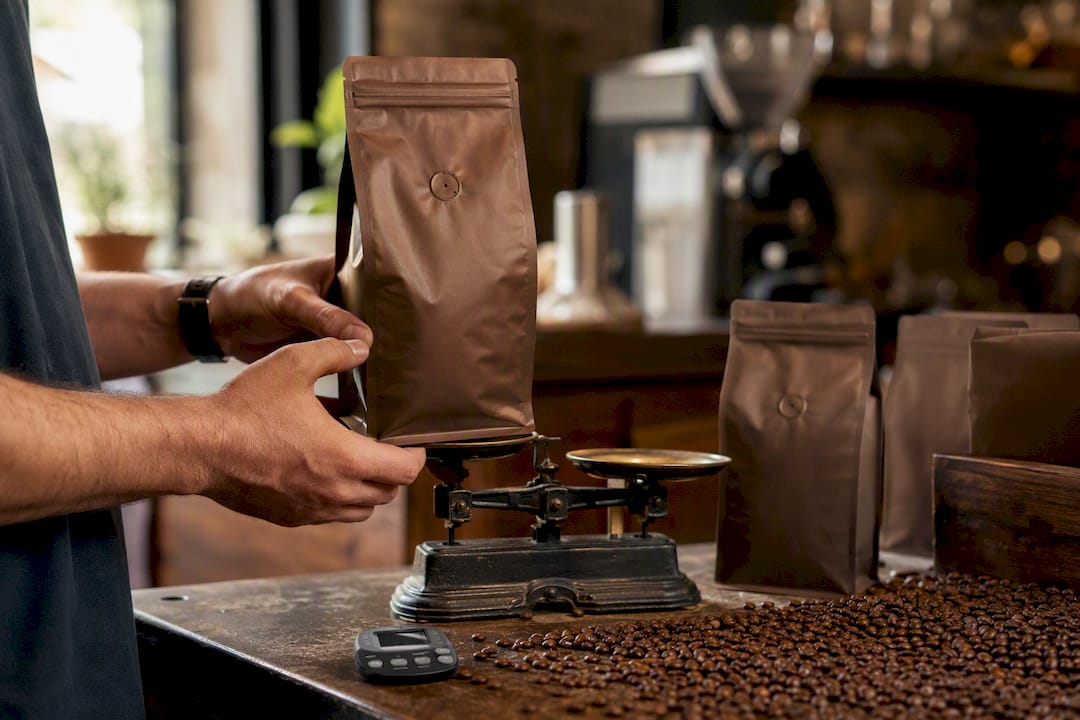
Pro Tip: Run this same weigh-and-reweigh test any time you switch roast profiles or bag sizes. A valve that worked fine for a medium roast might not keep up with a darker, faster-degassing batch.
How Should You Store and Handle a Valved Coffee Bag?
Once a bag is open, the valve’s job is mostly done, and how you handle the bag from there matters more than what’s printed on the label.
- Fold the top down tightly and clip or reseal it after every use to slow oxygen exposure.
- Leftover CO2 inside the bag actually helps push oxygen out as you reseal it, so don’t squeeze all the air out before closing.
- Decanting into an airtight canister works fine for beans you’ll use within a couple of weeks, but it strips away whatever protective gas and barrier properties the original bag still offered.
- Whole beans in a properly sealed valved bag generally hold peak flavor for several weeks past the roast date; ground coffee in the same bag fades faster since grinding exposes far more surface area to oxygen.
For deeper storage habits beyond the bag itself, Dkbeanleaf’s guide to storing coffee beans covers container choices and placement.
Where Should You Buy Valve Bags or Standalone Valves?
Most roasters buy finished bags with the valve already installed rather than sourcing loose valves and retrofitting existing stock, and that’s the right call for almost everyone. Retrofitting requires precise cutting and heat-sealing equipment most small operations don’t have, and a poorly seated valve leaks worse than no valve at all.
Before you order:
- Confirm the valve material. PE, PP, and PLA are the common choices, and PLA and other compostable options exist but need matching compostable film to actually deliver on that end-of-life claim.
- Request physical samples before committing to a production run, not just a spec sheet.
- Check that the bag format is compatible with your existing sealing equipment, especially with box-bottom or gusseted styles.
- Ask about minimum order quantities upfront. Custom valve placement or branded film often carries a higher MOQ than stock bags.
A Simple Test Every Roaster Should Run
Before locking in a valve spec for a new bag size or roast profile, run a small batch through a controlled test: seal a handful of bags right off the roaster, weigh each one, then weigh them again at 24, 48, and 72 hours. The weight loss curve tells you whether your valve is releasing gas fast enough or bottlenecking it.
Weighing bags before and after sealing is one of the few packaging checks you can run with nothing more than a kitchen scale and a notebook, and it tells you more about real-world valve performance than any spec sheet.
For more on what’s actually happening chemically during that window, Dkbeanleaf’s piece on coffee degassing and freshness walks through the science in plain terms.
Why Perfect Freshness Isn’t Always the Right Goal
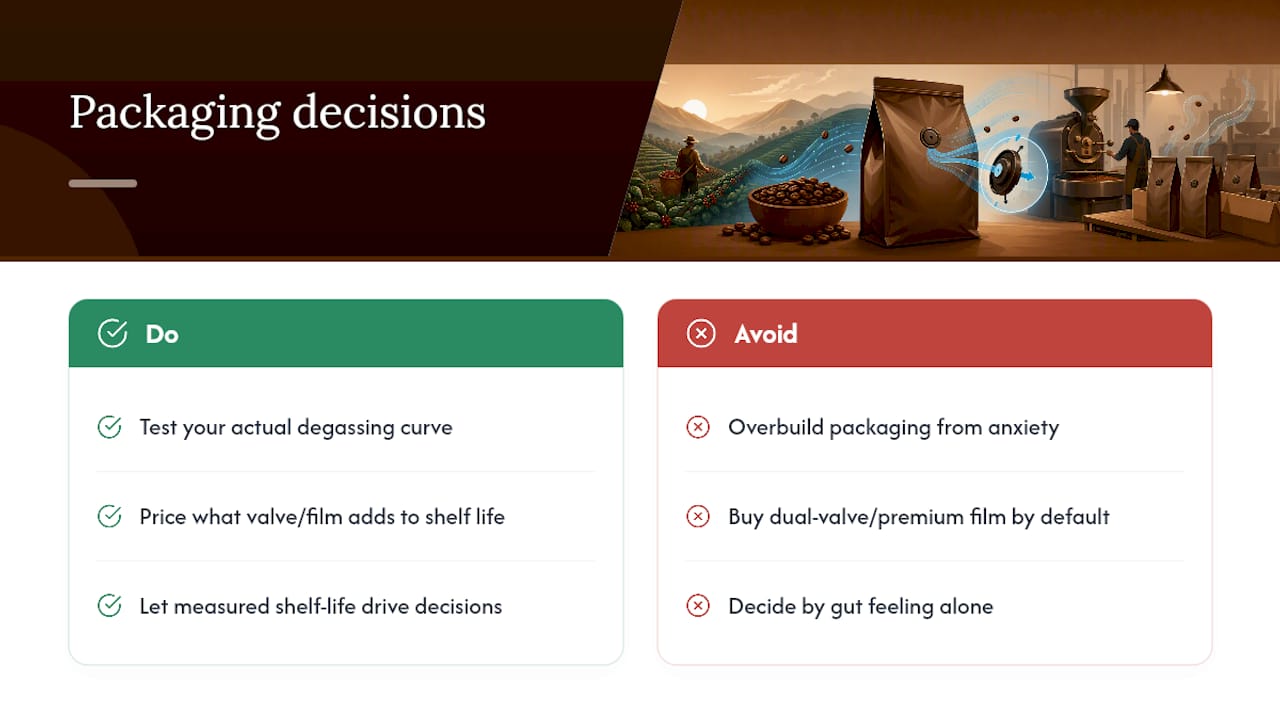
Chasing maximum freshness at any cost usually backfires. A dual-valve bag with premium high-barrier film costs more per unit, and that cost only pays off if your coffee actually needs that level of protection.
Most small roasters overbuild their packaging out of anxiety, not data. Test your actual degassing curve, price out what a bigger valve or better film really buys you in shelf life, and let that number drive the decision instead of a gut feeling about what “good packaging” should look like.
— Kristopher
Get Your Coffee Fresh From the Source
Packaging choices only matter if what’s inside the bag is worth protecting. Dkbeanleaf roasts to order rather than sitting on warehouse inventory, so the freshness conversation starts before the bag ever gets sealed.

If you’re weighing valve specs and barrier films for your own roasting operation, it helps to see how a working roastery handles the same tradeoffs. Dkbeanleaf’s coffee blends and single-origin beans ship soon after roasting, and the loose leaf tea collection rounds out the lineup for shoppers who want more than just coffee in their cart. Pair your next order with a hoodie or a classic tee from the apparel line while you’re at it. Browse the current roasts and place an order today to see freshness handled the way it should be from the start.
Sources
- Why Do Coffee Bags Have Valves? One-Way Degassing Explained | The Bag Broker UK
- What Is That Valve on My Coffee Bean Bag? | America’s Test Kitchen
- Why Coffee Bags Have Vents: The Valve Truth Roasters Miss - PackagingBest