

What Is a Pom Pom Beanie: Definition, History & Care
A pom pom beanie is a knitted winter cap with a rounded tuft of fibrous material, typically yarn, faux fur, or fabric, attached to the crown. The Cambridge English Dictionary traces the word to the French pompon, meaning a small decorative ball. That little ball started as a practical tool, used by sailors and soldiers to cushion blows and signal rank, and today it is almost entirely a style choice. Still, it is one of the most recognizable details in cold-weather fashion.
Table of Contents
- What is a pom pom beanie made of, and what are its parts?
- Where did pom-poms on hats come from?
- What purpose does a pom-pom actually serve?
- What materials are pom-poms and beanies made from?
- Can you remove or replace a pom-pom?
- Who wears pom pom beanies, and how do you style one?
- How do you care for a pom pom beanie?
- Dkbeanleaf’s cuffed beanie is a clean, versatile pick
- Key Takeaways
- The pom pom’s staying power makes sense once you know its history
What is a pom pom beanie made of, and what are its parts?
Every pom pom beanie has three basic components: the crown (the main body of the hat), the cuff or brim, and the pom itself.
- Crown: The rounded upper section that covers the head. Fit and depth vary by style.
- Cuff: A folded-up brim that adds structure and warmth at the forehead. A cuffed beanie has this fold; an uncuffed or slouchy beanie does not.
- Pom-pom: The decorative ball at the top. Also called a bobble in British English or a toorie in Scottish usage. It can be made from wound yarn, faux fur, fabric, or mixed materials.
Common style variants include the classic cuffed beanie, the slouchy beanie (longer crown, relaxed drape), the Tam or Tam-o’-shanter (wide, flat-crowned), and the bobble hat (a UK term for essentially the same thing as a pom pom beanie).
One detail worth knowing: many modern designs feature a detachable pom-pom, secured by a button or snap inside the crown. Australian Beanie Co notes that detachable poms are now common specifically because they give wearers more styling flexibility and simplify washing. A fixed pom is sewn directly to the hat and requires more care during cleaning.
Where did pom-poms on hats come from?
The history is older than most people expect.
- Ancient origins — Viking Scandinavia. Farmer’s Almanac traces bobble-like features on headwear to Viking-era Scandinavia, making the pom one of the oldest surviving hat details in Western dress.
- 18th century — French and European navies. Sailors on low-ceilinged ships wore poms as a soft cushion to protect their heads from overhead beams. The Daily Mail’s feature on beanie origins cites this as one of the most widely repeated historical explanations.
- 18th–19th century — Military and clergy. European armies and religious orders used pom color and size to indicate regiment and rank. A soldier’s pom told you where he stood in the hierarchy before he said a word.
- Early 20th century — Popular fashion. The pom moved from uniform to wardrobe staple, partly driven by home knitting during the Great Depression, when yarn crafts surged and beanies with poms became a common DIY project.
- Late 20th century to present — Global streetwear. The bobble hat became a fixture in ski culture, youth fashion, and eventually high-street retail worldwide.
The word itself: Wikipedia’s pom-pom entry confirms that pom-pom derives from the French pompon, a term for any small decorative ball of fabric or feathers used on hats and uniforms. The spelling varies (pompom, pompon, pom-pom) but the origin is consistent.
What purpose does a pom-pom actually serve?
Historically, the pom had two real jobs: physical cushioning and visual identification. Neither applies much today.
- Padding: Sailors used the soft crown pom to absorb impact from low ship beams. A short video demonstration shows how the pom sits at the highest point of the crown, exactly where a low-ceiling strike would land.
- Rank identification: Military and clergy poms were color-coded to signal role or regiment, functioning like a badge you wore on your head.
- Warmth: A tightly packed wool pom adds a small amount of insulation at the crown, but the effect is negligible compared to the hat itself. A loose yarn pom adds almost none.
- Visibility: A bright or large pom makes a child (or an adult on a ski slope) easier to spot in a crowd. This is the one practical function that still gets used deliberately.
Today, the pom is primarily decorative. It signals personality, not rank.
Pro Tip: If you want a pom that actually adds a touch of warmth, choose a tightly wound wool pom rather than a loosely looped acrylic one. The density matters more than the size.

What materials are pom-poms and beanies made from?
| Material | Best for | Care note |
|---|---|---|
| Wool | Warmth, durability | Hand wash cold, flat dry |
| Cashmere | Softness, luxury feel | Dry clean or gentle hand wash |
| Acrylic | Everyday wear, easy care | Machine wash gentle, low heat dry |
| Cotton | Mild climates, sensitive skin | Machine wash, air dry |
| Faux fur (pom only) | Bold look, vegan option | Spot clean or hand wash; avoid heat |
| Mixed yarn (pom only) | DIY, variety | Follows dominant fiber’s care rules |
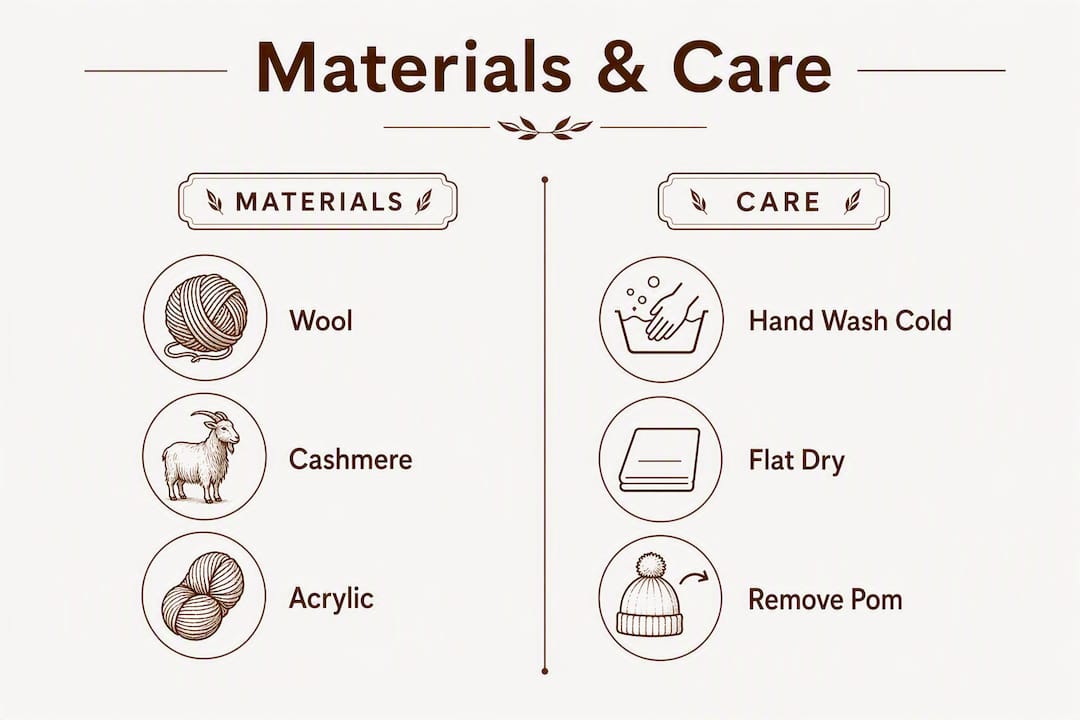
MrBalaclava’s guide to pom-pom beanies makes the trade-off clear: wool and cashmere deliver superior warmth but demand careful handling, while acrylic blends wash easily and resist shrinking. Acrylic is also less likely to irritate skin sensitive to natural fibers.
Attachment methods determine how easy it is to swap or remove the pom:
- Sewn directly: The most common on budget hats. Permanent unless you use a seam ripper.
- Button or snap (detachable): A small button inside the crown holds the pom’s loop. Twist or unsnap to remove.
- Tied loop: A yarn tail from the pom is knotted through the crown. Untie to remove; retie to reattach.
Can you remove or replace a pom-pom?
Yes, and it is usually straightforward. The method depends on how the pom is attached.
- Detachable snap or button: Turn the hat inside out. Locate the small button or snap at the crown. Unsnap or slide the loop off the button. Reattach by reversing the steps.
- Tied loop: Turn the hat inside out. Find the yarn knot at the crown. Untie carefully without pulling the surrounding stitches. To reattach, thread the loop back through the same hole and retie.
- Sewn-on pom: Use a seam ripper to cut the stitches at the base of the pom, working slowly to avoid cutting into the hat’s knit. Once removed, reinforce the crown opening with a few hand stitches using matching yarn before attaching a replacement.
A YouTube demonstration shows the button-removal method clearly: the pom’s inner loop sits on a small button sewn to the inside of the crown, and the whole thing comes off in seconds.
Pro Tip: After removing a sewn pom, always reinforce the crown with 3–4 small stitches before attaching a new one. The knit fabric stretches under tension, and an unfinished hole will grow.
Replacing a pom is just as easy. Craft stores and online retailers sell pre-made faux fur and yarn poms with loops already attached. You can also make a yarn pom at home by winding yarn around a fork or cardboard template, tying the center tightly, and trimming the ends into a sphere.
Who wears pom pom beanies, and how do you style one?
Everyone, essentially. The pom pom beanie works across age groups and dress codes, which is a big part of why it has stayed popular for decades.
- Casual streetwear: A cuffed beanie with a medium yarn pom pairs well with a puffer jacket, jeans, and sneakers. Pull it low over the ears for a relaxed fit.
- Winter sports: A slouchy beanie with a large, bright pom is easy to spot on a ski slope and fits under most helmet liners if you remove the pom first.
- Polished cold-weather looks: Style experts recommend neutral colors and smaller poms for more put-together outfits. A charcoal cuffed beanie with a small wool pom works over a wool coat without looking too casual.
- Playful or festive: Oversized poms in bright colors, pastels, or faux fur read as fun and intentional. These suit casual outings, kids’ wear, and holiday dressing.
- Athleisure: A fitted beanie with a small pom sits cleanly over a zip-up or hoodie without adding bulk.
One practical note: if you plan to wear a helmet (ski, bike, or otherwise), a detachable pom is worth the small extra cost. A fixed pom can prevent the helmet from sitting flush against the crown.
Pair your beanie with a warm drink on a cold morning and you have the full winter ritual covered. Dkbeanleaf’s morning coffee rituals guide is worth a read if you want to build that routine out.
How do you care for a pom pom beanie?
Care depends almost entirely on the fiber. Get this wrong once with a wool beanie and you will end up with a hat sized for a child.
- Wool and cashmere: Hand wash in cold water with a gentle detergent (Woolite works well). Never wring. Lay flat on a clean towel to dry. Keep away from direct heat and sunlight.
- Acrylic: Machine wash on a gentle cycle in cold water. Tumble dry on low or air dry. Acrylic holds its shape better than wool under machine washing.
- Cotton blends: Machine wash cold, air dry or low heat. Cotton can shrink slightly in high heat.
- Faux fur pom: Spot clean when possible. If the pom is detachable, remove it before washing the hat. If it is not, place the hat in a mesh laundry bag and use a gentle cycle. Never put faux fur in a hot dryer.
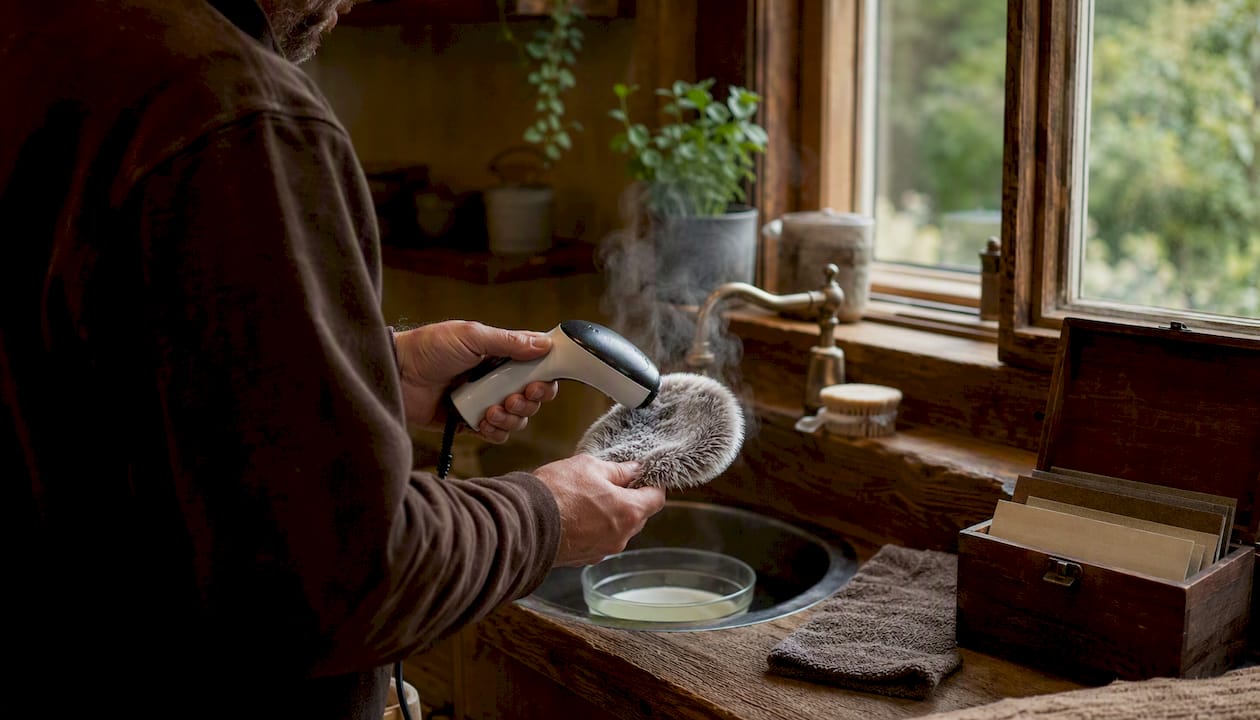
Restoring a flattened pom: Hold a clothes steamer or a kettle’s steam about 6 inches from the pom and gently fluff the fibers with your fingers while the steam loosens them. A hair dryer on the lowest heat setting, held through a thin cloth, also works. Avoid direct high heat on faux fur, which can melt synthetic fibers.
Pro Tip: If your pom-pom is detachable, always remove it before washing the hat. Washing the pom separately, by hand in cool water, keeps both the pom and the hat in better shape longer.
Dkbeanleaf’s cuffed beanie is a clean, versatile pick

Dkbeanleaf carries a cuffed beanie that fits the classic pom pom beanie profile: a structured cuff, a clean crown, and a look that works from a morning coffee run to a weekend hike. It sits in the same hats and caps collection as the brand’s other headwear, so if you want to compare styles before buying, that is the right place to start. Dkbeanleaf is an e-commerce brand built around warm rituals, from fresh-roasted coffee and loose-leaf tea to the apparel that makes those moments feel complete. The cuffed beanie is a straightforward addition to that lineup. Browse the full collection and pick the style that fits your winter wardrobe.
Key Takeaways
A pom pom beanie is a knitted cap with a decorative yarn or faux fur tuft at the crown, rooted in Viking-era headwear and later used by sailors and soldiers for padding and rank identification.
| Point | Details |
|---|---|
| What it is | A knitted cap with a rounded fibrous tuft (pompon) at the crown, derived from the French word pompon. |
| Historical origins | Bobble-like hat features trace to Viking Scandinavia; later used by sailors for cushioning and militaries for rank identification. |
| Common materials | Wool and cashmere for warmth; acrylic for easy care; faux fur poms for a bold, vegan-friendly look. |
| Removable poms | Many modern poms detach via a button or loop; sewn-on poms can be removed carefully with a seam ripper and the crown reinforced. |
| Dkbeanleaf option | The Dkbeanleaf cuffed beanie is a clean, structured pick available in the brand’s hats and caps collection. |
The pom pom’s staying power makes sense once you know its history
Most people assume the pom on a winter hat is purely whimsical, a leftover from children’s fashion that adults tolerate for warmth. The actual story is more interesting. It survived centuries not because it looked cute but because it did something: it protected sailors’ heads, told armies apart at a glance, and gave knitters a satisfying finishing detail that required almost no extra material.
What strikes me about the pom pom beanie is how it managed to outlast every practical reason for its existence and become more popular than ever. The Viking-era bobble was functional. The naval pom was functional. The regimental color-coding was functional. None of those functions apply to someone walking to a coffee shop in January. And yet the pom is everywhere. That is a rare thing in fashion: a detail that earns its place on pure charm after its utility is gone.
If you are choosing a beanie, the pom is worth taking seriously as a style decision rather than an afterthought. Size and material shape the whole look. A small, tightly wound wool pom reads as intentional and polished. A large faux fur pom reads as playful and confident. Neither is wrong. They are just different signals, which is, fittingly, exactly what pom-poms have always been.