

Coffee Strength vs Caffeine Content: What's the Difference?
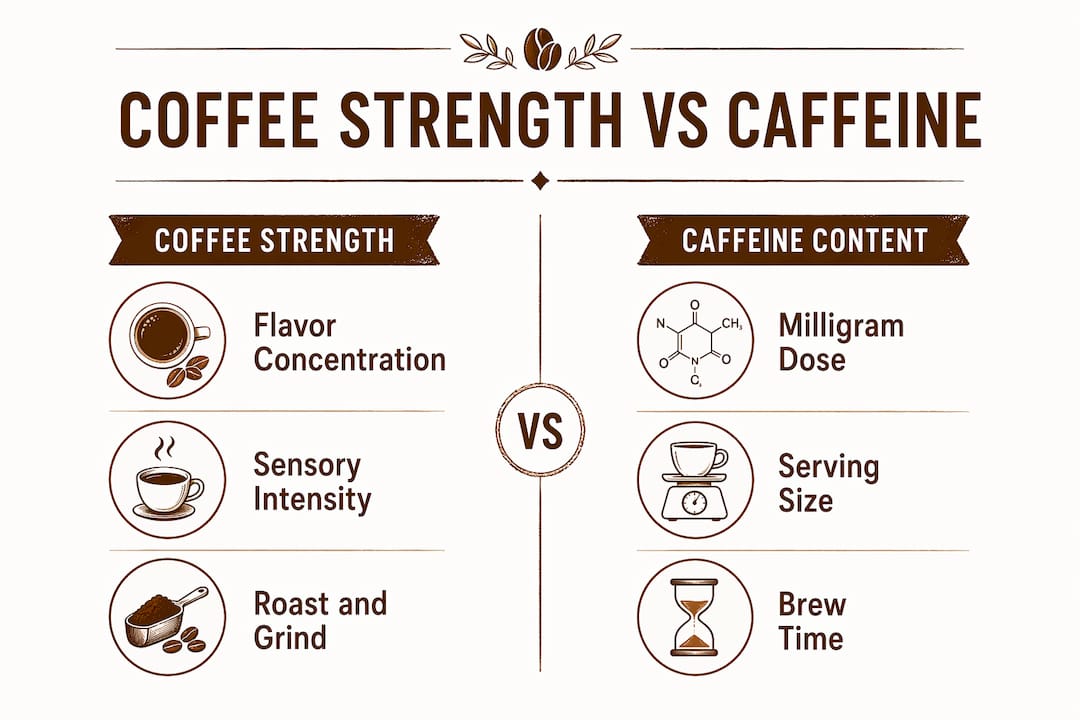
Coffee strength is defined as the flavor concentration of your brew, while caffeine content is the total amount of stimulant extracted from the beans. These two characteristics are independent of each other. A cup can taste bold and intense while delivering less caffeine than a mild, watery brew. Coffee enthusiasts and casual drinkers alike confuse the two constantly, and that confusion leads to poor brewing choices. Understanding the difference gives you real control over both flavor and how much caffeine ends up in your cup.
What is coffee strength vs caffeine content?
Coffee strength refers to flavor concentration and sensory intensity, not the amount of caffeine present. The Specialty Coffee Association defines brew strength as the percentage of dissolved solids in your cup, measured as total dissolved solids (TDS). A higher TDS means a more concentrated, intense flavor. That concentration depends on your brew ratio, grind size, water temperature, and extraction time. None of those variables directly control caffeine in a simple, proportional way.
Caffeine content, by contrast, is the actual milligram amount of the stimulant in your cup. The USDA recognizes that a standard 8 oz brewed coffee contains about 95 mg of caffeine. That number shifts based on bean variety, roast level, brewing method, and serving size. You can have a cup that tastes weak but carries a heavy caffeine load, and vice versa.
Coffee professionals stress that strength and caffeine are independent variables. A bold-tasting dark roast is not automatically higher in caffeine than a lighter, thinner brew. Recognizing this separation is the first step toward brewing coffee that actually matches what you want.
What factors determine coffee strength?
Coffee strength is shaped by four main variables: dose ratio, roast level, grind size, and brewing method. Each one affects how much of the coffee’s soluble compounds end up dissolved in your cup.
- Brew ratio: The ratio of coffee to water is the single biggest lever for strength. More coffee per unit of water produces a more concentrated, intense flavor. Dkbeanleaf’s guide on brew ratio for home brewers explains how increasing dose ratio increases flavor concentration without always raising caffeine per serving proportionally.
- Roast level: Dark roasts taste bolder and more bitter. Light roasts taste brighter and more acidic. Neither is automatically stronger in the TDS sense. Roast level changes flavor character, not necessarily concentration.
- Grind size: A finer grind exposes more surface area to water, which speeds up extraction and pulls more dissolved solids into your cup. Coarser grinds slow extraction and produce a lighter body.
- Brewing method: Espresso produces a very high TDS because a small amount of water passes through a dense puck of finely ground coffee. French press produces a full-bodied cup because of long immersion contact. Pour-over sits in the middle, offering clarity and moderate body.
Sensory descriptors like body, aroma, and acidity all contribute to the perception of strength. A coffee with high acidity and bright aroma can feel “strong” even at a moderate TDS. Body, the weight and texture of the liquid on your palate, often signals strength more than flavor alone.
Pro Tip: Start with a 1:15 coffee-to-water ratio (1 gram of coffee per 15 grams of water) and adjust from there. Increase the ratio for a bolder cup, decrease it for something lighter. This gives you a repeatable baseline before you change any other variable.
What influences caffeine content in your cup?
Caffeine content depends on bean variety, brewing method, and serving size. These three factors interact in ways that often surprise even experienced drinkers.
- Bean variety: Robusta beans contain roughly twice the caffeine of Arabica beans. Most specialty coffee uses Arabica, which is why single-origin pour-overs often carry less caffeine than a gas-station drip blend that uses Robusta.
- Brewing method: Brewing method greatly impacts caffeine extraction. Longer water contact time pulls more caffeine from the grounds. A drip machine running water through grounds for several minutes extracts more total caffeine than a 25-second espresso shot, even though espresso is far more concentrated by volume.
- Serving size: A 1 oz espresso shot contains about 63 mg of caffeine. An 8 oz drip coffee contains about 95 mg. The espresso is more concentrated, but serving size drives total caffeine consumed. A 16 oz drip coffee can deliver close to 190 mg in a single cup.
- Cold brew: Cold brew is the sleeper in this conversation. Cold brew typically contains 200 mg of caffeine per 8 oz due to its long steeping time and high coffee-to-water ratio. It tastes smooth and mild, which masks how much caffeine it actually delivers.
- Roast level: Light roast retains slightly more caffeine than dark roast, but the difference is minimal. Roasting burns off a small amount of caffeine, but not enough to matter for most drinkers.
Pro Tip: If you want to reduce caffeine without sacrificing flavor, switch from cold brew to a standard drip or pour-over. You get a satisfying cup with significantly less caffeine per serving.
How do strength and caffeine relate and differ?
The core confusion comes from concentration versus total dose. Espresso is the clearest example. Espresso is highest in caffeine concentration by volume but typically lower in total caffeine per serving than brewed coffee. A 1 oz shot packs 63 mg into a tiny volume. An 8 oz drip coffee delivers 95 mg across a much larger volume. The espresso tastes far stronger, but the drip coffee gives you more caffeine.
| Brew type | Serving size | Caffeine per serving | Perceived strength |
|---|---|---|---|
| Espresso | 1 oz | ~63 mg | Very high |
| Drip coffee | 8 oz | ~95 mg | Moderate |
| Cold brew | 8 oz | ~200 mg | Low to moderate |
| French press | 8 oz | ~80–100 mg | High |
| Pour-over | 8 oz | ~80–95 mg | Moderate to high |
The table makes the disconnect visible. Cold brew tastes smooth and mild but carries the highest caffeine load. Espresso tastes the most intense but delivers the least total caffeine per serving. French press and pour-over land in a similar caffeine range despite tasting noticeably different.
A common myth holds that dark roast coffee contains more caffeine because it tastes stronger. That is false. Dark roast loses a small amount of caffeine during the longer roasting process. The bold, bitter flavor comes from the breakdown of chlorogenic acids during roasting, not from higher caffeine. Understanding roast levels and their tasting notes helps separate flavor expectations from caffeine assumptions.
Managing caffeine requires balancing brew strength, volume, and roast. You cannot rely on taste alone to estimate how much caffeine you are consuming.
Practical tips to balance flavor and caffeine in your brew
Matching your cup to your preferences requires adjusting variables deliberately rather than guessing by taste.
| Brewing method | Perceived strength | Total caffeine (8 oz) | Best for |
|---|---|---|---|
| Espresso (2 oz double) | Very high | ~126 mg | Flavor intensity, low volume |
| Drip coffee | Moderate | ~95 mg | Balanced daily drinking |
| Cold brew | Low to moderate | ~200 mg | High caffeine, smooth taste |
| French press | High | ~80–100 mg | Full body, rich flavor |
| Pour-over | Moderate to high | ~80–95 mg | Clean flavor, control |
Practical adjustments that actually work:
- Choose your bean variety first. Arabica gives you lower caffeine and more nuanced flavor. Robusta gives you higher caffeine and a harsher, earthier taste. Most blends mix both.
- Control grind size and brew time together. A coarser grind with a shorter brew time reduces both strength and caffeine extraction. A finer grind with longer contact time increases both.
- Watch your serving size. Doubling your cup size roughly doubles your caffeine intake, even if the brew tastes the same. This is the most overlooked variable in daily caffeine management.
- Avoid over-extraction. Brewing too long or too fine makes coffee taste bitter and harsh without a proportional caffeine benefit. It just tastes bad.
Explore the full range of home brewing methods to find the technique that matches both your flavor goals and your caffeine targets. Small adjustments to method and ratio produce measurable differences in both dimensions.
Key Takeaways
Coffee strength measures flavor concentration, while caffeine content measures stimulant dose. These two variables respond to different brewing inputs and require separate adjustments to control.
| Point | Details |
|---|---|
| Strength is not caffeine | Bold flavor does not mean more caffeine; they are independent characteristics. |
| Cold brew is the caffeine outlier | Cold brew delivers roughly 200 mg per 8 oz despite tasting smooth and mild. |
| Serving size drives total caffeine | A 16 oz drip coffee contains far more caffeine than a 1 oz espresso shot. |
| Roast level barely affects caffeine | Dark roast tastes stronger but contains slightly less caffeine than light roast. |
| Brew ratio controls flavor, not caffeine alone | Adjusting dose ratio changes concentration; caffeine also depends on extraction time and method. |
What I’ve learned from years of chasing the perfect cup
Most coffee drinkers I talk to assume their darkest, boldest roast is hitting them hardest with caffeine. I made the same assumption for years. Then I started tracking how I felt after different brews and realized my afternoon cold brew was wrecking my sleep far more than my morning double espresso ever did.
The real lesson is that you need to separate two questions: “How do I want this to taste?” and “How much caffeine do I actually need?” Once you treat those as separate problems, brewing gets a lot more satisfying. I started pulling lighter roast pour-overs in the morning for clean flavor and moderate caffeine, and cutting cold brew entirely after noon.
The other thing most articles skip is that grind size is your most underused tool. Dialing coarser and shortening brew time gives you a gentler cup without losing the flavor character you enjoy. It is a better move than just switching beans entirely. If you are serious about this, spend a week adjusting one variable at a time and taste the difference. You will learn more in seven days than from reading a dozen guides.
— Kristopher
Gear and drinks worth brewing with
Dkbeanleaf carries everything you need to make the most of what you have learned here. Whether you are dialing in a morning pour-over or winding down with something lighter in the evening, the right vessel and the right drink make a real difference.
The tea collection at Dkbeanleaf is worth exploring if you want lower caffeine options that still deliver real flavor complexity. For your daily coffee ritual, a well-made white glossy mug keeps your brew at the right temperature and feels good in your hand. Dkbeanleaf also carries apparel for coffee and tea drinkers who want to wear what they love, from sweatshirts to hats built for everyday wear.
FAQ
Does strong coffee always mean more caffeine?
No. Strong-tasting coffee is not necessarily higher in caffeine. Strength refers to flavor concentration, while caffeine depends on bean type, brew method, and serving size.
Which brewing method has the most caffeine?
Cold brew delivers the highest caffeine per 8 oz serving, at roughly 200 mg, due to its long steeping time and high coffee-to-water ratio. Drip coffee averages about 95 mg per 8 oz.
Does dark roast have more caffeine than light roast?
No. Light roast retains slightly more caffeine than dark roast because longer roasting burns off a small amount of caffeine. The difference is minimal in practice.
Why does espresso taste stronger but have less caffeine than drip coffee?
Espresso has a very high concentration per ounce but a small serving size. A 1 oz shot contains about 63 mg of caffeine, while an 8 oz drip coffee contains about 95 mg. Concentration and total dose are not the same thing.
How do I reduce caffeine without losing flavor?
Switch from cold brew to a pour-over or drip method, and use Arabica beans instead of Robusta. Adjusting to a coarser grind with a shorter brew time also reduces caffeine extraction while preserving the flavor character you enjoy.