

Coffee Dose Ratio Explained for Home Brewers
The coffee dose ratio is the precise relationship between dry coffee grounds and brewing water, expressed as 1:X, where X is the number of grams of water per gram of coffee. Understanding what is coffee dose ratio is the single most important step toward brewing a consistent, flavorful cup every time. A ratio of 1:16, for example, means 1 gram of coffee for every 16 grams of water. This number controls brew strength before you touch grind size, water temperature, or brew time. Tools like a kitchen scale and standards like the SCA Golden Cup give you a reliable starting point for any method.
What is the ideal coffee dose ratio for different brewing methods?
The coffee brew ratio defines concentration directly: 1:15 means 1 gram of coffee per 15 grams of water, producing a stronger cup, while 1:18 produces a lighter one. That single number sets the ceiling for how strong your brew can taste, regardless of how long you steep or how fine you grind.
Filter and pour-over ratios
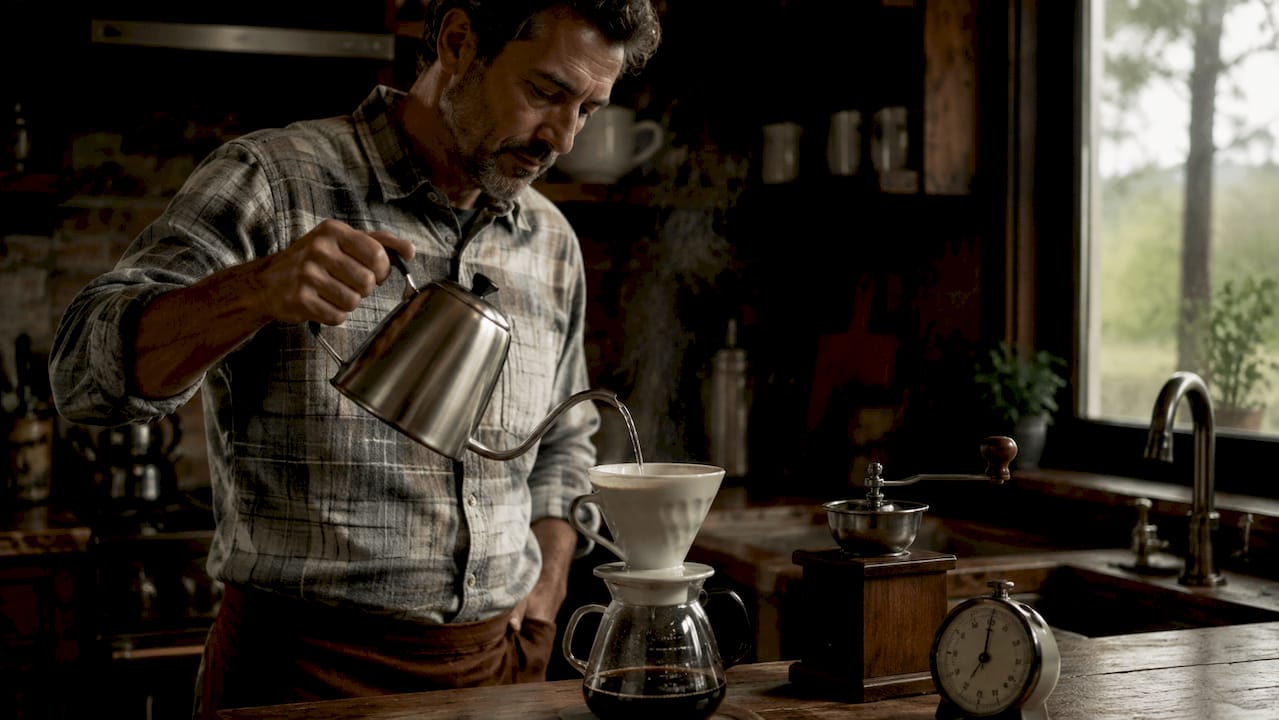
For drip and pour-over brewing, the standard starting range is 1:15 to 1:18. The SCA Golden Cup standard lands near 1:16 to 1:17, which translates to roughly 55–65 grams of coffee per liter of water. That range is a baseline, not a rule. Manual pour-over brewers often find a slightly tighter ratio of 1:15 to 1:16 hits the same strength as an automatic drip machine, because manual technique introduces more variables.
Espresso ratios
Espresso uses a dose-to-yield ratio, not a simple coffee-to-water ratio. A common espresso ratio is 1:2, meaning 18 grams of ground coffee produces 36 grams of liquid espresso by weight. This measurement must be done by weight, not volume, because crema and liquid density make volumetric readings unreliable. A 1:2 ratio produces a concentrated, full-bodied shot. A 1:2.5 or 1:3 ratio pulls a longer, slightly lighter shot called a lungo.
Immersion brewing
French press and AeroPress use immersion, where grounds sit in water for the full brew time. A ratio of 1:12 to 1:15 works well for French press, producing a heavier body. AeroPress allows more flexibility, with ratios ranging from 1:6 for a concentrate to 1:16 for a filter-style cup.
| Brewing Method | Recommended Ratio | Notes |
|---|---|---|
| Drip / Filter | 1:15 to 1:17 | SCA Golden Cup baseline |
| Pour-Over | 1:15 to 1:16 | Tighter for manual technique |
| Espresso | 1:2 to 1:2.5 | Dose-to-yield by weight |
| French Press | 1:12 to 1:15 | Heavier body, full immersion |
| AeroPress | 1:6 to 1:16 | Flexible; method-dependent |
Key ratios to remember:
- Filter brewing: 1:15–1:17 for balanced strength
- Espresso: 1:2 for a standard double shot
- French press: 1:12–1:15 for rich body
- AeroPress: adjust freely based on desired concentration
How do you calculate your coffee dose ratio accurately?
Weight beats volume every time. Spoon measurements vary by up to 30% depending on bean density and grind size. A tablespoon of a light roast whole bean weighs far less than a tablespoon of a finely ground dark roast. That gap alone can throw your brew off significantly before water even touches the grounds.
The math is straightforward. Divide your target water weight by your ratio number to find the coffee dose needed.
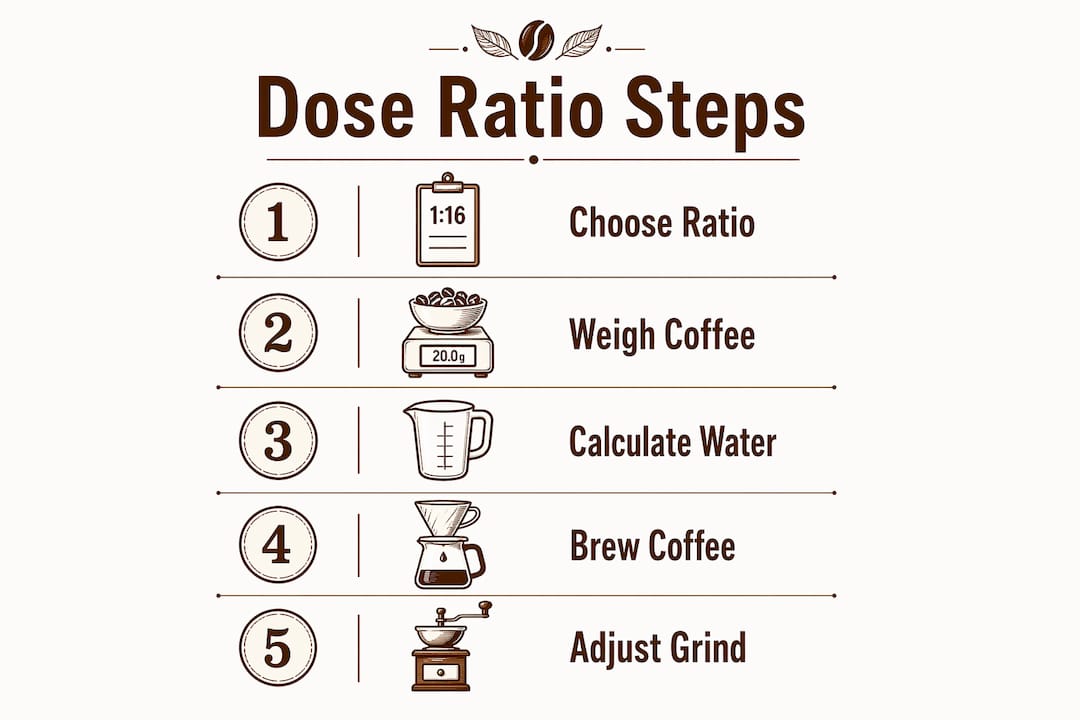
- Choose your target ratio. Start at 1:16 for most filter methods.
- Decide your water volume. A standard 12-ounce mug holds roughly 340 grams of water.
- Divide water by ratio. 340 ÷ 16 = 21.25 grams of coffee.
- Weigh your coffee. Place your portafilter or filter basket on a scale and dose to 21 grams.
- Weigh your water. Use the same scale or a gooseneck kettle with a built-in scale.
A 20-gram dose at a 1:16 ratio requires 320 grams of water. That produces a clean, balanced 340-milliliter cup. Adjust the ratio number up or down to shift strength without changing your dose weight.
Pro Tip: Invest in a kitchen scale with 0.1-gram precision. A precise kitchen scale removes the single biggest source of inconsistency in home brewing. Models from OXO, Acaia, and Hario all offer reliable options at different price points.
Common calculation errors include measuring water by volume in milliliters without accounting for temperature, and forgetting that 1 milliliter of water equals 1 gram only at room temperature. For practical home brewing, the difference is negligible, but knowing it matters when you are dialing in espresso to the gram.
Why does adjusting the brew ratio change the taste?
The coffee dose ratio controls strength, not extraction. That distinction matters. Extraction refers to how much of the coffee’s soluble compounds actually dissolve into your water. Ratio controls how diluted or concentrated those compounds are in your final cup.
A tighter ratio like 1:13 produces a strong, dense brew. A looser ratio like 1:18 produces a lighter, more delicate cup. Both can be either well-extracted or poorly extracted depending on grind size, water temperature, and brew time. Ratio sets the frame; everything else fills it in.
“Ratio controls concentration (strength), while grind and time influence extraction yield. Change one variable at a time for the most accurate dialing-in.”
Here is how ratio changes translate to taste symptoms:
- Sour or sharp cup: Often signals under-extraction. Try a slightly finer grind before tightening the ratio.
- Bitter or harsh cup: Can signal over-extraction or a ratio that is too tight. Loosen to 1:17 or 1:18 and see if it softens.
- Thin or watery cup: The ratio is likely too loose. Move from 1:18 to 1:15 and taste again.
- Flat or dull cup: Ratio may be fine, but grind or water temperature needs attention.
Roast level also interacts with ratio in a way most home brewers overlook. Lighter roasts are denser and less soluble, so they often benefit from a slightly higher water ratio like 1:16 to 1:17 to avoid under-extraction. Darker roasts extract faster and more aggressively, so a looser ratio of 1:17 to 1:18 prevents bitterness from dominating. Adjusting ratio by roast level is one of the fastest ways to improve a cup without changing your grinder settings.
What are the most common coffee dosing mistakes?
Most home brewers make the same set of errors. Recognizing them early saves weeks of frustrating trial and error.
Using volume instead of weight is the most widespread mistake. Volumetric measures like tablespoons introduce inconsistency because bean and grind density vary significantly. Two tablespoons of a coarsely ground Ethiopian natural process coffee weighs far less than two tablespoons of a finely ground Colombian washed roast. Weight removes that variable entirely.
Changing multiple variables at once makes it impossible to know what caused a change in your cup. If you adjust ratio, grind size, and brew time simultaneously, you cannot isolate the cause of improvement or decline. Lock your ratio first, then adjust only grind size or brew time to refine extraction.
Ignoring roast level when setting a ratio leads to consistently flat or bitter results. A ratio that works perfectly for a medium roast may under-extract a light roast or over-extract a dark one.
Failing to recalibrate when switching beans is equally common. A new bag of coffee, even from the same roaster, may have different density, freshness, or grind behavior. Treat every new bag as a fresh dial-in opportunity.
Pro Tip: When starting with a new coffee, set your ratio at 1:16 and brew three cups at different grind sizes before touching the ratio. This isolates extraction from strength and gives you cleaner data on what the coffee actually needs.
The SCA Golden Cup standard is a useful anchor, not a final answer. Personal preference, brewing equipment, and water quality all shift the ideal ratio for your specific setup.
Key takeaways
The coffee dose ratio is the foundational variable in brewing: set it first, hold it steady, and adjust grind size or brew time to refine extraction and flavor.
| Point | Details |
|---|---|
| Ratio defines strength | Coffee dose ratio sets brew concentration before any other variable is adjusted. |
| Weight beats volume | Spoon measurements vary up to 30%; use a 0.1g kitchen scale for consistency. |
| Method determines starting ratio | Filter starts at 1:15–1:17; espresso at 1:2; French press at 1:12–1:15. |
| Roast level shifts the ideal ratio | Light roasts need slightly more water; dark roasts need slightly less to avoid bitterness. |
| Lock ratio before adjusting grind | Changing one variable at a time gives you accurate feedback on what your cup needs. |
Why ratio discipline changed how i brew
I spent two years adjusting grind size, water temperature, and brew time on every new bag of coffee before I understood that I was solving the wrong problem first. My ratio was drifting by 2–3 grams from brew to brew because I was using a scoop. That drift was masking everything else I was trying to fix.
The shift happened when I started treating ratio as a locked constant. I set 1:16 for filter and 1:2 for espresso and held those numbers for an entire month. Within a week, I could actually hear what the grind was doing to my cup. The feedback loop became clear. Sour meant under-extracted, not under-dosed. Bitter meant over-extracted, not too strong.
What surprised me most was how much roast level changed the equation. I had been brewing a light Ethiopian natural at 1:15 and wondering why it tasted flat. Moving to 1:17 opened up the florals immediately. The ratio was suppressing extraction, not the grind. That single adjustment taught me more about coffee than six months of grinder tweaking.
My advice: buy a decent scale before you buy a better grinder. The scale gives you the data. The grinder just gives you more options. And if you want to go deeper on how flavor tasting notes connect to your brewing decisions, that skill compounds fast once your ratio is stable.
— Kristopher
Brew better with the right gear from Dkbeanleaf
Getting your ratio right is only half the equation. The vessel you brew into and drink from shapes the experience just as much as the numbers.

Dkbeanleaf carries a range of mugs and cups built for home brewers who take their coffee seriously. The White Glossy Mug is a clean, neutral option that lets the color and clarity of a well-brewed pour-over speak for itself. For outdoor brewing sessions or camping setups, the Enamel Mug holds heat well and handles real use. Dkbeanleaf also carries specialty teas for days when you want to apply the same ratio discipline to a different brew. Explore the full tea collection and find something worth measuring carefully.
FAQ
What is coffee dose ratio in simple terms?
The coffee dose ratio is the weight of dry coffee grounds compared to the weight of brewing water, expressed as 1:X. A ratio of 1:16 means 1 gram of coffee for every 16 grams of water.
What ratio should i start with as a home brewer?
Start at 1:16 for filter and pour-over methods. The SCA Golden Cup standard recommends 1:16 to 1:17 as a reliable baseline for balanced strength and extraction.
Why does my coffee taste weak even at the right ratio?
A weak cup at the correct ratio usually signals under-extraction, not an incorrect dose. Try a finer grind or slightly hotter water before adjusting the ratio itself.
Is espresso ratio the same as filter coffee ratio?
No. Espresso uses a dose-to-yield ratio measured by weight in versus weight out, commonly 1:2. Filter brewing measures dry coffee against total brew water, typically 1:15 to 1:17.
Does roast level change the ideal coffee ratio?
Yes. Lighter roasts benefit from a slightly looser ratio like 1:16 to 1:17 to improve extraction. Darker roasts extract more aggressively and often taste better at 1:17 to 1:18 to reduce bitterness.