

Keep Coffee Fresh 3–4 Months: Freeze Single Dose Vacuum Sealed Beans
Yes, freezing works: whole roasted beans can hold their flavor for months if you seal single-dose portions airtight and never open the pouch to humid air more than once. This is a long-term storage move, not a fix for the bag you’ll finish next week. Skip pre-ground coffee entirely, and skip refreezing anything you’ve already thawed.
TL;DR:
- Freezing is effective for long-term storage of bulk, rare, or seasonal coffee beans, especially if done within one to two weeks after roasting.
- Proper preparation, including resting beans for one to three weeks after roasting and vacuum-sealing in flat pouches, is essential for preserving flavor.
- Store frozen coffee pouches at the back of the freezer to avoid temperature fluctuations and prevent odor absorption from strong-smelling foods.
- Thaw beans overnight in sealed pouches or grind directly from frozen, depending on your equipment and brewing needs, to maintain consistency.
- Avoid opening frozen pouches in humid environments or refreezing once exposed to air to prevent moisture damage and flavor dulling.
Table of Contents
- When Freezing Coffee Beans Makes Sense (and When It Doesn’t)
- How to Prepare, Portion, and Package Beans for Freezing
- Best Practices for Storing Frozen Coffee Beans
- Thawing vs. Grinding From Frozen: Two Expert Protocols
- Common Risks and Mistakes When Freezing Coffee
- Coffee Shelf Life by Storage Method
- A Practical Checklist From Kristopher
- Freezing Beans as an Advanced Move, Not a Shortcut
- Sources
When Freezing Coffee Beans Makes Sense (and When It Doesn’t)
Freezing earns its place when you’ve bought in bulk, snagged a limited single-origin lot, or want to stretch a subscription order across a longer stretch than usual. It’s a bad fit for the bag sitting on your counter that you’ll polish off within a week or two, because room-temperature storage already handles that window fine, and opening a frozen pouch daily invites the exact moisture problems freezing is supposed to prevent.
Timing matters almost as much as the freezing itself. Serious Eats points out that experts recommend freezing only coffee you won’t touch for several weeks or months, not your everyday drinker.
- Good reasons to freeze: bulk purchases, rare or seasonal lots, building a reserve during a sale
- Bad reasons to freeze: convenience for coffee you’ll finish in under two weeks, or any pre-ground coffee
- Best freeze window: 1 to 2 weeks post-roast for filter coffee, 2 to 3 weeks for espresso, once the beans have hit their flavor peak
If your current bag never lasts more than a week, freezing won’t add much. A proper room-temperature storage routine will do more for your daily cup than a freezer ever could.
How to Prepare, Portion, and Package Beans for Freezing
Rest matters before you even think about the freezer. Coffee releases carbon dioxide for one to three weeks after roasting, and freezing beans too early traps that gas and skews extraction later. Let the beans hit their peak flavor window first, then freeze.
- Weigh out single-brew portions, or at most a one-week supply per pouch.
- Vacuum-seal each portion in a sous-vide style bag or a dedicated vacuum pouch. This is the method JayArr Coffee’s Hoffmann and Gagné protocol recommends as the most reliable path to months of preserved quality.
- Label every pouch with the roast date and freeze date, so you’re never guessing.
- Lay pouches flat in the freezer rather than stacking them upright.
Standard zip-top freezer bags work in a pinch, but they let in far more air than a true vacuum seal, so expect faster staling if that’s your only option. Mason jars can work for short stretches, though the airspace inside them limits how long they actually protect flavor.
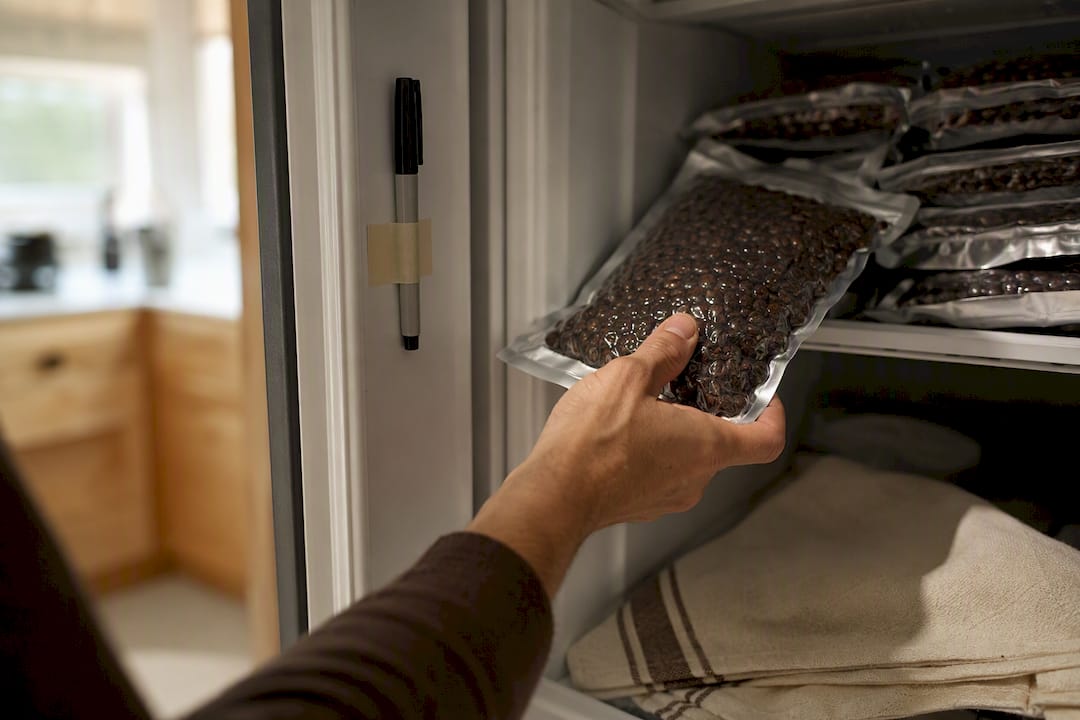
Pro Tip: Keep a permanent marker taped near your coffee storage spot. The habit of dating every pouch the moment you seal it is the single easiest way to stop guessing how long something’s been frozen.
Best Practices for Storing Frozen Coffee Beans
Where you put the pouches inside the freezer changes how well they hold up. The back of the freezer stays colder and more stable than the door, where every open and close cycle causes small temperature swings that speed up degassing and staling.
- Store pouches at the back or bottom of the freezer, never on door shelves
- Stack or lay portions flat so they freeze evenly and take up less space
- Keep coffee away from onions, fish, or other strong-smelling foods, since beans absorb odors easily through anything less than a true vacuum seal
- A standard frost-free home freezer works fine as long as your packaging is genuinely airtight
Home freezers running around -18 degrees Celsius already slow the chemical reactions behind staling considerably compared to a countertop shelf. You don’t need a commercial deep freeze to get real benefit. What you do need is a seal that keeps freezer air and moisture out entirely, because a decent freezer with a bad bag will still let your coffee go flat.
Thawing vs. Grinding From Frozen: Two Expert Protocols
Once you’re ready to brew, you’ve got two credible approaches, and both come from real testing rather than guesswork.
- The Hoffmann method: pull the sealed pouch out and let it thaw overnight in the pouch, unopened. Only open it once it’s back to room temperature. This avoids condensation forming on the beans and works with any grinder you own.
- The Gagné method: grind the beans straight from frozen, no thawing at all. Cold beans are more brittle, which changes how they fracture.
Perfect Daily Grind reports that colder, more brittle beans tend to produce fewer super-fine particles and a tighter grind distribution, which often translates to cleaner extraction in the cup.
The brittleness factor: Industry testing shows beans ground while still frozen fracture more uniformly than room-temperature beans, reducing the fine particles that cause over-extraction and muddy flavor.
Pick Hoffmann if your grinder struggles with hard, cold beans or if you’re brewing for a crowd and need consistent timing. Pick Gagné if you brew solo, own a burr grinder that handles frozen beans well, and want to skip the overnight wait entirely.
Common Risks and Mistakes When Freezing Coffee
Condensation is the biggest threat, and it happens when cold beans meet warm, humid air the moment you open a pouch straight from the freezer. That moisture settles on the beans, degrades the oils, and dulls the aroma fast, which is exactly why Food & Wine’s guidance from a professional roaster warns against opening frozen coffee in humid conditions.
- Never open a cold pouch in a steamy kitchen or humid climate; let it warm sealed, or grind it frozen
- Never refreeze coffee once a pouch has been opened and exposed to air
- Skip roaster bags with one-way valves for frozen storage. Those valves let humid air back in once you break the seal, which defeats the purpose
- Swap thin freezer bags for real vacuum pouches or rigid, airtight jars for anything you plan to freeze short-term
Coffee Shelf Life by Storage Method
The gap between good and mediocre coffee often comes down to nothing more than how it’s stored.
| Storage method | Typical freshness window | Notes |
|---|---|---|
| Room temperature, opened bag | 1 to 3 weeks | Best flavor window; no freezing needed for daily use |
| Refrigerated, opened bag | About 2 weeks | Not generally recommended; fridge odors and humidity are risks |
| Frozen, vacuum sealed, single dose | 3 to 4 months, sometimes longer with strict protocol | Best for bulk or special lots, not daily coffee |
These windows track flavor quality, not food safety. Coffee beans past their freshness window are stale, not dangerous.
A Practical Checklist From Kristopher
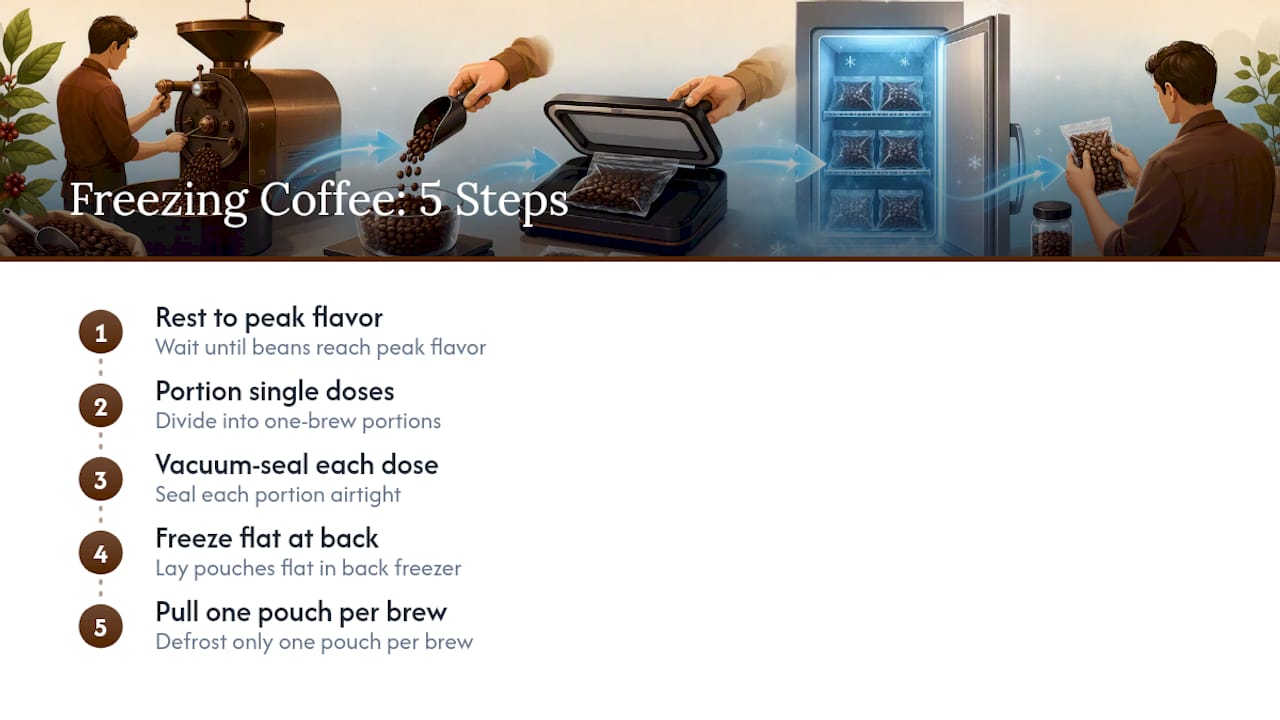
My working rule for freezing coffee comes down to five steps, in order: rest the beans until they hit peak flavor, portion them into single doses, vacuum-seal each one, freeze flat at the back of the freezer, and pull one pouch per brew, never more.
If you’re not ready to commit to single-dose freezing, the simpler fix is buying smaller quantities more often. Coffee roasts meant to be enjoyed fresh, and a smaller bag finished within two or three weeks will usually beat a big bag frozen halfway through its life. Freezing is a tool for the coffee you’re not drinking yet, not a substitute for buying the right amount in the first place.
Freezing Beans as an Advanced Move, Not a Shortcut
Freezing whole beans is one of the more powerful tricks in a coffee drinker’s toolkit, but it rewards precision and punishes shortcuts. Treat your first attempt as a small test batch: one bag, properly rested, vacuum sealed, and tracked from freeze date to first grind. Taste it against a fresh bag of the same coffee and you’ll know within a few brews whether the protocol actually worked for your setup.
For anyone drinking coffee daily, the better long-term habit is simpler: buy less at a time, store it well at room temperature, and let freezing stay a reserve tactic for the beans you genuinely can’t get to for weeks. If you experiment with a batch, pay attention to what changes between the Hoffmann and Gagné approaches in your own kitchen. Small differences in grinder and climate matter more than any single guide can predict.
— Kristopher
Sources
- The Right Way to Store Coffee, According to a Professional Roaster
- I Asked Coffee Experts How to Keep Beans Fresh—They …
- How to Freeze Coffee Beans: The Hoffmann + Gagné Method | JayArr Coffee
- Are we still freezing coffee? - Perfect Daily Grind
Ready to build a freezer stash worth the effort? Start with a smaller, fresher order from our tea collection or grab a mug-worthy layer for chilly mornings from our hoodies and sweatshirts while your test batch rests. And if you’re storing coffee in a humid climate, this Caribbean food storage guide from our partners at TOJ Express has useful notes on managing moisture that apply well beyond the kitchen pantry.