

How Coffee Mugs Are Dishwasher Safe: What You Need to Know
Not every coffee mug belongs in the dishwasher, even if it looks tough enough to handle it. Understanding how coffee mugs are dishwasher safe comes down to specifics: the clay body, the glaze, the decoration method, and how it was fired. Get those factors right, and your mug can run through hundreds of cycles without fading or cracking. Get them wrong, and you’ll watch your favorite mug chip, stain, or lose its design after a few washes. This guide breaks down exactly what separates a mug that holds up from one that doesn’t, so you can make smarter decisions about your drinkware.
Table of Contents
- Key takeaways
- How coffee mugs are dishwasher safe: the science behind it
- Mug types and their dishwasher safety
- DIY and custom mugs: what holds up and what doesn’t
- Cleaning and care tips that actually extend mug life
- Reading dishwasher safety labels and symbols
- My honest take on dishwasher-safe claims
- Dkbeanleaf mugs built for real daily use
- FAQ
Key takeaways
| Point | Details |
|---|---|
| Material and firing matter most | High-fired, vitrified ceramics resist dishwasher heat far better than low-fired, porous alternatives. |
| Decorations are the weak link | Metallic trims, vinyl decals, and poorly bonded pigments degrade faster than the mug body itself. |
| Insulated mugs need hand washing | Dishwasher heat degrades vacuum seals and gaskets, quietly killing insulation performance over time. |
| Top rack placement protects mugs | Lower rack temperatures significantly extend the life of glazes, sealers, and dishwasher-safe decorations. |
| Labels have limits | A dishwasher-safe symbol is a starting point, not a guarantee of long-term durability. |
How coffee mugs are dishwasher safe: the science behind it
Most people assume ceramic mugs are either safe or they’re not. The reality is more specific than that, and it starts with how the mug was made.
Firing temperature and vitrification
Ceramic mugs are fired in a kiln, and the temperature of that firing determines how dense and durable the clay body becomes. High-fired vitrified ceramics absorb significantly less water than low-fired alternatives, which directly reduces the risk of cracking during high-temperature dishwasher cycles. Vitrification closes up the microscopic pores in the clay, so heat and steam have less material to work on.
Low-fired ceramics, like earthenware, retain those pores. Every dishwasher cycle pushes water and heat into those openings, gradually weakening the structure. The mug might look fine for months, then suddenly show hairline cracks or crazing (that spider-web pattern on the glaze surface) after repeated thermal stress.
Glazes as protective barriers
The glaze on your mug isn’t just decorative. It acts as a chemical barrier between the clay body and everything it touches, including dishwasher detergent. Quality glazes are formulated to resist the alkaline chemistry of dishwasher detergents. Cheaper or improperly fired glazes can degrade over time, turning cloudy or developing a rough texture that actually traps coffee stains more easily.
Here’s a quick comparison of how ceramic types perform in the dishwasher:
| Ceramic Type | Firing Temp | Dishwasher Durability | Stain Risk |
|---|---|---|---|
| High-fired stoneware | 2100°F+ | High | Low |
| Porcelain | 2300°F+ | Very high | Very low |
| Earthenware | Under 2000°F | Low | High |
| Low-fire terracotta | Under 1800°F | Very low | Very high |
Decorations and metallic trims
This is where most dishwasher damage actually happens. The mug body may be perfectly durable, but the decoration on top of it often isn’t. Metallic trims, gold or silver rims, and hand-painted designs sit on the glaze surface rather than fusing into it. Dishwasher detergents and heat gradually strip these additions away.
The same applies to decals and poorly fired pigments. If a decoration wasn’t fired into the glaze at high enough temperature, it’s essentially sitting on top of glass. A few dishwasher cycles and it starts to fade, peel, or discolor. That printed logo on a promotional mug? It’s almost always a decal. Treat it accordingly.
Mug types and their dishwasher safety
Different mug materials behave very differently in the dishwasher. Knowing your mug type saves you from preventable damage.
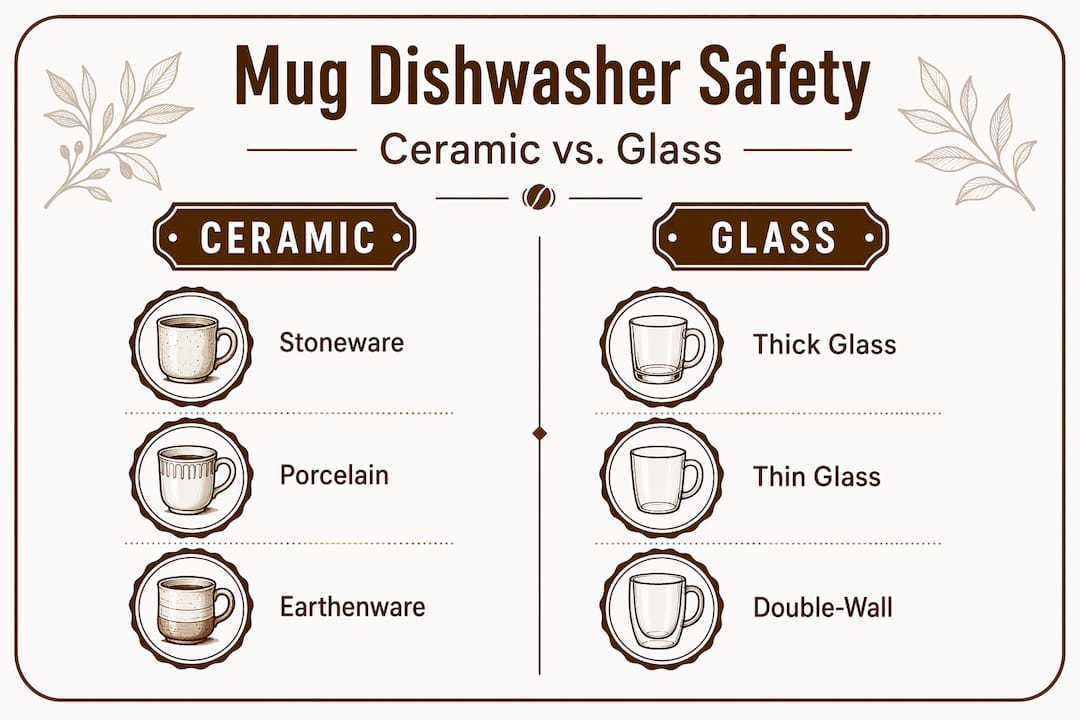
Ceramic mugs are generally the most reliable dishwasher-safe option when they’re well made. Plain stoneware or porcelain mugs without metallic trim or hand-painted decoration can handle regular dishwasher use for years. Watch for any mug labeled “handcrafted” or “artisan” with no care instructions, as these may be low-fired.

Glass mugs perform well in dishwashers when they’re thick enough to handle thermal shock. Thin glass is more vulnerable to cracking from rapid temperature changes during the wash cycle. Borosilicate glass (used in many quality glass mugs) handles heat particularly well.
Insulated and vacuum-sealed mugs are a different story. Dishwasher heat and detergents actively weaken the vacuum seals, silicone gaskets, and exterior coatings that make these mugs work. The damage happens gradually and often invisibly. You won’t notice the insulation is failing until your coffee goes cold in 20 minutes instead of two hours. Dishwasher damage is the top complaint among insulated drinkware customers. Hand wash these, every time.
Metal and vintage mugs carry their own risks. Vintage copper mugs and smart mugs with electronics should never go in the dishwasher. Copper tarnishes permanently under the combination of heat and alkaline detergent. Smart mugs with heating elements are electronic devices. Dishwashing them is just asking for a short circuit.
- Plain stoneware or porcelain: dishwasher safe (avoid metallic decoration)
- Borosilicate glass: dishwasher safe
- Insulated or vacuum-sealed: hand wash only
- Copper or vintage mugs: hand wash only
- Smart mugs with electronics: hand wash only
- Mugs with gold or silver rims: hand wash or top rack only
Pro Tip: When buying a new mug, flip it over and look for a care symbol on the base. A square box with water droplets or a wine glass icon typically indicates dishwasher safety. No symbol at all means you should default to hand washing until you verify with the manufacturer.
DIY and custom mugs: what holds up and what doesn’t
Personalized mugs are popular, and the decoration method determines whether they survive the dishwasher.
- Sublimation printing is the most durable option. The dye is heat-transferred directly into a special polymer coating on the mug surface, fusing with the material rather than sitting on top. Sublimation and Infusible Ink designs remain stable after 20 or more dishwasher cycles, making them the closest thing to a truly washable custom mug. If you want to learn more about how these printing techniques work, the manufacturing process matters as much as the design.
- Infusible Ink works on the same principle as sublimation. The ink bonds with the surface coating under heat and pressure, creating a design that’s part of the mug rather than on top of it.
- Permanent adhesive vinyl can actually hold up surprisingly well. Fully cured permanent vinyl can withstand 20 or more dishwasher cycles when given at least 72 hours to cure before the first wash. The counterintuitive finding here: adding Mod Podge sealer over vinyl sometimes reduces durability rather than improving it, depending on application method.
- Dishwasher-safe sealers like Mod Podge do work when applied correctly, but placement matters enormously. Top rack temperatures of 110 to 140°F are far gentler on adhesives and decorations than the bottom rack, which can hit 160°F or higher.
- Regular craft vinyl or painted designs without sealers fade quickly. Most won’t survive more than a handful of washes. If a design was applied with regular iron-on vinyl or basic paint, treat the mug as hand-wash only.
Pro Tip: Always skip the heated dry cycle for custom mugs. Air drying is gentler on decorations and significantly extends the life of any adhesive-based design.
Cleaning and care tips that actually extend mug life
Whether your mug is dishwasher safe or not, how you clean it determines how long it lasts and how good it looks.
Coffee stains are caused by tannins, the same compounds that stain teeth. Porous ceramics stain more deeply because the tannins work their way into tiny surface openings. High-quality stoneware and porcelain with a smooth, well-fired glaze resist this naturally. You still need to clean them, but the stains don’t penetrate as far.
For stain removal that won’t damage your mug:
- Baking soda paste: A small amount of baking soda mixed with water works as a gentle abrasive. Apply, rub in circles, rinse. It lifts tannin stains without scratching glaze surfaces.
- Vinegar soak: Fill the mug with equal parts white vinegar and warm water, soak for 30 minutes, rinse well. Effective on mineral deposits and light staining.
- Lemon juice: The citric acid in lemon juice breaks down tannins gently. Leave it in the mug for 10 to 15 minutes before rinsing.
- Salt and ice: Add ice and coarse salt to a half-full mug, swirl for 60 seconds. The ice keeps the temperature low while the salt provides gentle abrasion.
For dishwasher loading: place mugs on the top rack whenever possible, give each mug enough space to avoid knocking against others, and use a moderate amount of detergent. Overdoing the detergent doesn’t clean better. It just adds more alkaline chemical contact to your glaze.
When a mug starts showing crazing or visible cracks, retire it. Crazed glaze traps bacteria in ways regular washing can’t reliably address. No amount of cleaning technique fixes a structurally compromised mug.
For a long-lasting mug collection, consistent gentle care beats occasional deep cleaning every time.
Reading dishwasher safety labels and symbols
Knowing what to look for on the bottom of a mug takes the guesswork out of care decisions.
| Symbol or Label | What It Means |
|---|---|
| Square with water droplets | Dishwasher safe (general) |
| Wine glass with water | Dishwasher safe for glassware |
| Hand under water | Hand wash only |
| No symbol present | Care instructions unknown; default to hand wash |
| “Microwave and dishwasher safe” text | Usually reliable for the base mug, but decorations may still be vulnerable |
A few things worth knowing about labels:
- Many handmade, artisan, or imported mugs carry no care symbols at all. Absence of a label is not the same as dishwasher safe.
- Some manufacturers print “dishwasher safe” without specifying top or bottom rack. Top rack is always the safer choice regardless.
- If you bought a mug without documentation, the brand website or a quick email to customer service usually clarifies the care requirements.
- For mugs used in commercial or foodservice settings, sanitation standards often require machine washing, so professional-grade ceramics are specifically tested for this.
Home testing is possible too. Run a mug through two or three cycles alone. Check for fading, glaze changes, or any cloudiness on the surface. If nothing changes after three cycles, the mug is likely safe for regular dishwasher use.
My honest take on dishwasher-safe claims
I’ve tested a lot of mugs, and here’s what I’ve learned that most product descriptions won’t tell you.
The “dishwasher safe” label on a mug often refers only to the ceramic body. The manufacturer ran it through a few cycles, confirmed it didn’t crack or warp, and called it done. Nobody tested whether the printed logo or the gold rim would survive 200 cycles. In my experience, the decoration is almost always what fails first, even on mugs labeled as safe.
Rack placement is the most underestimated variable in mug care. I’ve seen mugs hold up beautifully for years simply because someone always put them on the top rack. Bottom rack heat and detergent spray is significantly more aggressive. If you care about the appearance of your mugs long term, top rack is not optional.
For insulated mugs specifically, hand washing is not overcautious. Microscopic vacuum seal leaks develop from repeated thermal expansion in dishwashers, and you won’t see them until the mug barely holds temperature. By then the damage is permanent. The inconvenience of hand washing is genuinely worth it.
My advice is to think of dishwasher safety as a spectrum rather than a binary. Your plain white stoneware mug? Dishwasher it freely. Your favorite mug with the printed design you love? Top rack, no heated dry, and a little extra attention. Your insulated travel mug? Never.
— Kristopher
Dkbeanleaf mugs built for real daily use

At Dkbeanleaf, mug quality isn’t an afterthought. The mug collection is selected with daily durability in mind, including options specifically suited for regular dishwasher use. The white glossy mug features a smooth, durable glaze that resists staining and holds up through repeated wash cycles, making it a reliable everyday choice. For outdoor use or something more rugged, the enamel mug offers genuine durability without sacrificing style. Every mug comes with clear care information so you’re never guessing. If you travel and want something built for that, the travel mug with a handle is worth a close look. Good coffee deserves a mug that lasts.
FAQ
Are all ceramic mugs dishwasher safe?
No. Only high-fired, vitrified ceramics with well-formulated glazes are reliably dishwasher safe. Low-fired earthenware and mugs with metallic decorations or decals can crack, fade, or degrade with repeated machine washing.
How can I tell if my mug is dishwasher safe?
Check the base of the mug for a dishwasher-safe symbol, usually a square with water droplets or a wine glass icon. If no symbol is present, contact the manufacturer or default to hand washing.
Can I put an insulated coffee mug in the dishwasher?
Most insulated mugs should not go in the dishwasher. Dishwasher heat degrades vacuum seals and silicone gaskets over time, reducing thermal performance even when the mug looks undamaged externally.
What’s the best way to remove coffee stains from mugs?
Baking soda paste and lemon juice are both effective. Baking soda lifts tannin stains through gentle abrasion, while lemon juice’s citric acid breaks down the tannins chemically. Avoid harsh bleach-based cleaners, which can damage glaze.
Does rack placement really matter for dishwasher-safe mugs?
Yes. Top rack temperatures run 110 to 140°F, while the bottom rack can exceed 160°F. Placing mugs on the top rack significantly reduces stress on glazes, decorations, and any adhesive-based designs.