

What is a coffee mug? Your ultimate guide
Most people grab the nearest mug without a second thought, yet the vessel you pour your coffee into genuinely shapes how it tastes, how long it stays hot, and how much you enjoy the ritual. Understanding what is a coffee mug, beyond the obvious answer, opens up a surprisingly rich world of history, materials science, and personal expression. This guide covers where mugs came from, what separates one type from another, and how to choose the right one for your daily routine.
Table of Contents
- The history and evolution of the coffee mug
- Types of coffee mugs and materials: choosing what suits you best
- How your coffee mug choice affects your brewing and drinking experience
- The cultural and personal significance of coffee mugs
- Why modern coffee mug choices challenge tradition and embrace new lifestyles
- Explore and choose your perfect coffee mug at D&K Bean and Leaf
- Frequently asked questions
Key Takeaways
| Point | Details |
|---|---|
| Mug origins | Coffee mugs evolved from ancient vessels to modern insulated designs rooted in wartime needs. |
| Material matters | Ceramic, glass, stainless steel, and stoneware offer distinct heat and taste experiences. |
| Functional design | Mug shape, handle, and lid affect heat retention, convenience, and drinking comfort. |
| Cultural symbols | Mugs express personality and have shifted towards insulated tumblers in corporate gifting. |
| Modern lifestyle | Portable insulated mugs reflect today’s mobile, multi-drink preferences. |
The history and evolution of the coffee mug
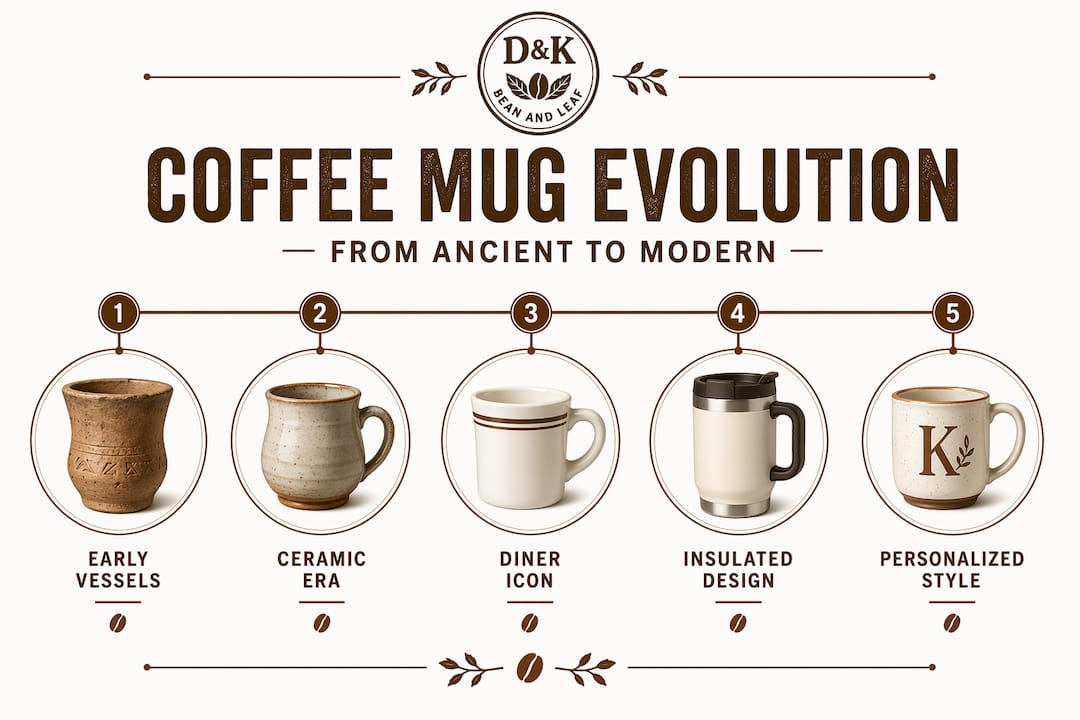
Coffee mugs did not appear out of nowhere. They evolved over thousands of years from basic clay bowls into the handled ceramic vessels most people recognize today. That journey is more interesting than you might expect, and it explains a lot about why modern mugs look and feel the way they do.
Here is how the coffee mug developed across history:
- Ancient clay vessels. Early drinking vessels were simple bowls shaped from clay, fired in open flames, and used without handles. Archaeological finds date pottery drinking vessels back over 10,000 years.
- Handles arrive. Handles were added to protect hands from heat, a design shift that separated mugs from bowls and made hot beverage culture practical.
- Porcelain refinement. Mugs evolved from ancient pottery into porcelain designs with thinner walls, allowing people to drink hot beverages without scorching their fingers.
- Military standardization in 1945. Here is the surprising part most coffee drinkers never hear. The standard coffee mug design was created in 1945 by the Victor Insulator Company specifically for military use aboard ships, prioritizing thick walls, a heavy base, and durability over elegance.
- The diner mug era. That wartime design spread into American diners and households through the 1950s and 1960s, cementing the heavy, stackable ceramic mug as cultural shorthand for “coffee.”
- Travel mugs emerge. On-the-go lifestyles demanded lids and insulation. Travel mugs gained traction in the 1980s as commuter culture grew and people expected hot coffee to survive a car ride.
Even coffee culture itself was subject to political pressure. Sweden actually banned coffee multiple times in the 18th century, briefly suppressing mug culture entirely. That kind of history gives your morning cup a little more weight.
Understanding this arc matters if you want to build a coffee mug collection with real intention. Each mug you own carries design DNA from a specific era and purpose.
Types of coffee mugs and materials: choosing what suits you best
Knowing common mug materials, including ceramic, porcelain, glass, stainless steel, and stoneware, is the first practical step toward choosing the right mug for how you actually drink coffee.
Here is a breakdown of the most common types:
- Ceramic mugs. The everyday standard. Good heat retention, taste-neutral, dishwasher-safe, and available in every shape and size imaginable.
- Porcelain mugs. Thinner walls than ceramic, smoother finish, and a slightly more refined feel. Often used in cafes for espresso-based drinks.
- Glass mugs. Beautiful for lattes and pour-overs because you can watch the coffee. The downside is minimal insulation, so your drink cools faster.
- Stoneware mugs. Heavier and more rustic, with a handmade aesthetic. Heat performance varies by thickness and glaze.
- Stainless steel insulated mugs. The current performance standard for temperature control. Vacuum insulation keeps drinks hot for hours.
- Travel mugs with lids. Built for mobility. Most combine stainless steel with a spill-proof lid and a handle or grip.
| Mug type | Heat retention | Portability | Aesthetic | Best for |
|---|---|---|---|---|
| Ceramic | Moderate | Low | Classic | Home, desk use |
| Porcelain | Moderate | Low | Refined | Espresso, lattes |
| Glass | Low | Low | Visual appeal | Pour-over, display |
| Stoneware | Moderate to high | Low | Rustic, artisan | Home use |
| Stainless steel | High | High | Modern | Travel, work |
| Travel mug | Very high | Very high | Functional | Commuting, outdoors |
If you want to add personality without changing material, color inside mug options let you keep classic ceramic while making a visual statement. For days when you are moving around, travel mugs with handles give you insulation without sacrificing the familiar feel of a standard mug.
Pro Tip: If you drink your coffee slowly over 30 to 45 minutes, prioritize heat retention above everything else. A double-walled ceramic or stainless steel insulated mug will serve you better than a beautiful thin-walled porcelain cup.

How your coffee mug choice affects your brewing and drinking experience
This is where things get genuinely interesting. Most people treat mug selection as an afterthought, but heat retention and convenience vary more by mug construction than most drinkers realize. The right mug does not just hold your coffee; it changes how you experience it.
Here is what actually shifts depending on your mug:
- Temperature. A cold ceramic mug pulled from a cabinet will drop your coffee temperature by 10 to 15 degrees in the first minute. Pre-warming your mug with hot water first is a small fix with a noticeable result.
- Flavor perception. Temperature affects taste. Coffee served too cool loses its sweetness and brightness. A mug that holds heat longer keeps your coffee in its ideal flavor window.
- Rim width. A wide rim encourages you to drink more slowly, letting you smell the coffee as it hits your lips. This is why specialty coffee shops often use wide, open mugs for pour-over and filter coffee.
- Handle design. A comfortable, well-sized handle reduces hand fatigue during longer sipping sessions. Too small and your fingers cramp; too large and the mug feels unwieldy.
- Weight and stability. Heavier stoneware mugs feel grounded and satisfying but can become tiring if you hold them for extended periods. Lighter porcelain is easier to hold but can feel less premium.
- Lid presence. Many users switching from ceramic mugs to insulated tumblers cite the lid as the primary reason. A lid is not just for spill prevention; it also dramatically slows heat loss.
Understanding these differences helps you get more out of your coffee brewing process from start to finish. Brewing a precise pour-over and then drinking it from a cold, thin glass mug undercuts half the effort.
Pro Tip: If you drink your coffee in stages between tasks, a lidded insulated mug will keep your second and third sip as satisfying as your first. Reserve the beautiful open ceramic mugs for when you have the time to sit and drink without interruption.
The cultural and personal significance of coffee mugs
A coffee mug is rarely just a vessel. It is often the first thing someone sees on your desk, and it communicates something about who you are before you say a word.
Mugs frequently express personality through designs, personal quotes, logos, and colors. The mug someone uses at work often signals their humor, their passions, or their affiliations more directly than most other objects around them.
- Identity and belonging. Branded mugs from universities, sports teams, and workplaces function as low-key social signals.
- Personalized mugs. Custom mugs with names, photos, or messages have become a go-to gift because they feel genuinely personal, not generic.
- Collectibles. Many coffee enthusiasts collect mugs the way others collect art. Each piece can reflect a trip, a memory, or a specific aesthetic era.
- Workplace culture. Corporate gifting has long relied on the classic ceramic mug. However, the shift toward branded insulated tumblers reflects changing work habits, with people moving between offices, cars, and remote locations rather than sitting at one desk all day.
“The mug you reach for every morning is a small but consistent choice about how you want to start your day. That is more personal than most people acknowledge.”
Explore the full range at the coffee mugs collection to find something that reflects your taste, routine, and style.
Why modern coffee mug choices challenge tradition and embrace new lifestyles
Here is a perspective most mug guides skip entirely: the “standard” coffee mug you picture in your head is not a neutral design. It is a military artifact.
The Victor Insulator wartime mug design explains exactly why so many mugs share that familiar diner-style profile: thick walls, heavy base, no-frills handle. That design was never meant to be beautiful. It was meant to survive a ship’s galley. The fact that it became the cultural default says more about postwar American manufacturing than about ideal coffee drinking.
That matters because it reframes how you think about mug choice. When you pick a lightweight porcelain cup with a wide rim, you are not deviating from the “real” mug. You are actually choosing a form designed around the actual experience of drinking. When you reach for a stainless steel tumbler, you are reflecting a genuinely different lifestyle, one where mobility and temperature control outrank aesthetics.
The shift to insulated tumblers in both personal use and corporate gifting is not a trend. It is a structural response to how work and daily life have changed. Remote work, long commutes, outdoor lifestyles, and back-to-back schedules have made the fixed, handle-only ceramic mug feel limiting for many people.
That said, there is a real argument for owning multiple mug types rather than converging on one “best” option. The ceramic mug you use on a slow Sunday morning serves a purpose the tumbler cannot: it grounds you. It slows you down. It is not mobile because it is not supposed to be. Start building a mug collection around your actual routines rather than an imaginary ideal, and you will use every mug you own.
Explore and choose your perfect coffee mug at D&K Bean and Leaf
You now understand what separates a great mug from a forgettable one. D&K Bean and Leaf carries a range built around real coffee drinkers, not just shelf appeal.

Whether you want a classic white glossy mug for home use, a handled travel mug for commuting, or something from the full coffee mugs collection to match your style, the options cover every routine and preference. Personalized mugs are available for gifts that actually mean something. Browse the collection and pick the mug that fits how you really drink, not just how you imagine you might.
Frequently asked questions
What exactly defines a coffee mug compared to a coffee cup?
A coffee mug typically holds 8 to 12 ounces, has a handle, and comes without a saucer, while a coffee cup is smaller and traditionally paired with one. A standard mug holds roughly 250 to 350 ml, making it noticeably larger and more casual than a traditional coffee cup.
Why are insulated coffee mugs becoming more popular than ceramic ones?
Insulated mugs hold temperature far longer, include spill-proof lids, and work with both hot and cold drinks. Vacuum-insulated tumblers suit mobile, flexible lifestyles better than ceramic mugs, which is why they have overtaken ceramics in both personal use and corporate gifting.
Can coffee mugs be used for beverages other than coffee?
Absolutely. Coffee mugs work well for tea, hot chocolate, and even soup. Mug shapes and rim geometry vary across these uses, but the vessel itself is multi-purpose by design.
How has the history of coffee mugs influenced their modern design?
The modern ceramic mug descends directly from the 1945 military design by the Victor Insulator Company, built with thick walls and a stable base for use on ships. That wartime mug design is why so many everyday mugs still feel heavier and more durable than strictly necessary for home use.
Recommended
- Build a coffee mug collection you’ll love and care for – D&K Bean and Leaf
- What is coffee bloom: your complete brewing guide – D&K Bean and Leaf
- Coffee roast levels explained: tasting notes and brewing tips – D&K Bean and Leaf
- Explore every coffee roast: types, tastes, and brewing tips – D&K Bean and Leaf