

Exactly How Flavored Coffee Is Made: Gear, Ratios, and Storage
Flavored coffee is made by tumbling warm, roasted beans with concentrated flavor oils or extracts until an even coating forms, then drying and packaging them fast to lock in aroma. There are three main routes: direct spice blending, artificial flavor oils in a carrier solvent, and natural extracts distilled from real ingredients. Every method follows roughly the same arc: roast, cool, apply, dry, seal.
TL;DR:
- Artificial flavor oils are the most common choice for store-bought flavored coffee due to their cost-effectiveness and long shelf stability.
- Flavored beans with oil coatings can cause grinder residue buildup and may influence the flavor of unflavored coffee over multiple brews.
- Flavored coffee made with natural extracts offers a more authentic taste but costs significantly more and has a shorter shelf life.
- Medium roast is ideal for flavor coating as it balances the bean’s natural profile with added flavor without overpowering or losing subtle notes.
- DIY flavoring at home is best achieved through spice mixing or adding extracts directly to brewed coffee, not coating beans with oils.
Table of Contents
- How Flavored Coffee Is Made: Three Methods Compared
- The Step-By-Step Flavored Coffee Production Process
- What Flavorings Are Actually Made From
- Flavored Beans, Your Grinder, and How Long the Flavor Lasts
- DIY Flavored Coffee at Home Without Coating Whole Beans
- About This Guide and Where to Learn More
- Taste a Flavor Before You Commit to a Bag
- What the Flavored Coffee Industry Gets Right, and Wrong
- Sources
How Flavored Coffee Is Made: Three Methods Compared
Roasters choose between three fundamentally different approaches, and the choice comes down to cost, shelf stability, and how honest the label needs to be.
Direct or spice flavoring mixes whole or ground spices right into the beans or grounds, no oil or solvent involved. This is the oldest method by far. Middle Eastern coffee traditions have folded cardamom pods into roasted beans for generations, and some Scandinavian recipes still call for a pinch of salt in the grind. It’s cheap, genuinely natural, and simple to control, but it only works for flavors that exist as actual spices. You can’t make a “crème brûlée” coffee out of cinnamon and nutmeg alone.
Artificially flavored coffee relies on lab-formulated flavor oils, often built from dozens of aroma compounds blended to mimic something like hazelnut, cinnamon roll, or pumpkin spice. These oils get suspended in a solvent and sprayed or tumbled onto the beans after roasting. This is the dominant method in commercial retail, and for good reason: it’s cheap to produce at scale, holds up in warehouse storage, and can replicate flavors that don’t exist in nature as a distillable extract, like “birthday cake.”
Naturally flavored coffee uses extracts distilled or pressed from the actual source ingredient, such as a real vanilla bean distillate rather than a synthetic vanillin compound. It costs more, tends to taste closer to the real thing, and generally carries a shorter shelf life because natural aromatic compounds degrade faster than synthetic ones.
- Direct spice: most authentic, lowest cost, but limited to actual spices
- Artificial flavor oils: cheapest at scale, longest shelf stability, widest flavor range
- Natural extracts: most true to the source ingredient, higher cost, shorter shelf window
Retail shelves lean heavily toward the artificial-oil method because it scales and survives shipping. Specialty roasters chasing a natural-food label tend to pay the premium for extracts instead.
The Step-By-Step Flavored Coffee Production Process
Here’s what actually happens on a production floor, from bean selection to sealed bag.
- Select the beans. Roasters commonly reach for Arabica for flavored lines because its lower acidity and rounder body let added flavors sit on top without a clash. Robusta’s harsher, more bitter profile tends to fight with sweet or dessert-style flavor oils, so it shows up less often in flavored blends.
- Roast to the right level. A medium roast is the usual sweet spot. Go too light and the bean’s own bright acidity competes with the flavor oil; go too dark and the char and roast bitterness can bury a delicate flavor like vanilla or caramel. Roast level shapes how flavor develops well before any oil ever touches the bean.
- Cool the beans. Roasters use air jets or, less commonly, a water quench to drop bean temperature fast. Air cooling is generally preferred for flavored batches because it avoids diluting or washing off the natural oils on the bean’s surface that help the flavor coating adhere.
- Prepare the solvent. Flavor compounds rarely go onto a bean straight. They’re diluted in a carrier such as propylene glycol, food-grade alcohol, fractionated vegetable oil, or water, each chosen for how well it dissolves the flavor compound and how evenly it spreads across the bean’s surface. Propylene glycol shows up often because it’s odorless, doesn’t compete with the added flavor, and helps the coating cling rather than pool.
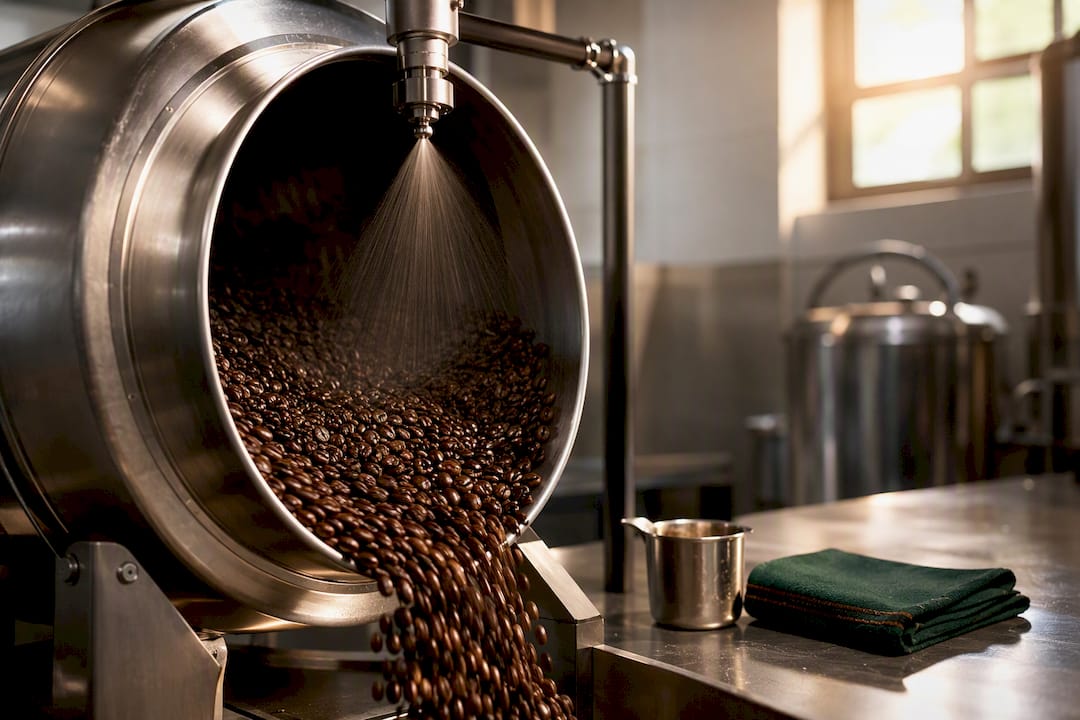
- Apply the flavor. This happens while the beans are still warm, since warmth helps the oil absorb into the bean’s porous surface instead of just sitting on top. Equipment ranges from ribbon blenders and rotating drum tumblers to candy pan coaters borrowed straight from confectionery manufacturing. Larger operations use a pressurized spray system that breaks the flavor oil into micro-droplets for a coating far more even than pouring oil straight onto a tumbling batch.
- Hit the ratio. Industry guidance generally lands around 2 to 4 ounces of flavor oil per 100 pounds of roasted beans, though the exact number shifts with how concentrated the oil is and how bold the target flavor needs to be. Tumbling typically runs 15 to 30 minutes, long enough for full coverage without oversaturating the bean.
- Dry the batch. A properly coated batch develops a light, glossy sheen. Drying needs to happen quickly to prevent the oil from turning sticky or clumping beans together in storage.
- Package immediately. Volatile aroma compounds start evaporating the moment beans hit open air, so commercial packaging flushes the bag with nitrogen to displace oxygen before sealing it airtight. That single step is the difference between a bag that smells vivid at week six and one that smells like cardboard.
Pro Tip: If you’re buying flavored beans rather than roasting your own, check the seal date on the bag, not just the roast date. Flavor oils fade faster than the coffee itself, so a bag sealed three months ago can taste noticeably flatter than one sealed three weeks ago, even from the same roaster.
What Flavorings Are Actually Made From
Behind every “French vanilla” or “Irish cream” bag is a flavorist’s lab, not a kitchen. Recreating a complex, layered flavor profile from scratch is closer to chemistry than cooking.
Flavorists use tools like gas chromatography and spectrophotometry to break down a target flavor into its individual aroma compounds, then rebuild it compound by compound in a lab. A simple flavor like straight vanilla might need only a handful of compounds. Something layered, like caramel macchiato or gingerbread, can require dozens working in combination to nail the exact aroma the flavorist is chasing.
- Single-source natural extracts: vanilla bean distillate, cinnamon oil, orange peel oil, pressed hazelnut oil
- Synthetic multi-compound blends: vanillin-based vanilla substitutes, artificial hazelnut, “cake batter” or “cookie” flavor systems built from scratch in a lab
- Solvent-dependent aroma release: how a flavor smells and how long it lasts both shift depending on whether it’s carried in alcohol, glycol, or oil
A single-ingredient extract, like real vanilla, can often be recreated with far fewer compounds than a composite dessert flavor. Novelty flavors that don’t correspond to any single real-world ingredient, think “cookie dough” or “cotton candy,” almost always require a lab-built compound blend rather than a distillation. That’s part of why flavorists often work in labs rather than starting from whole-food ingredients: the flavor simply doesn’t exist to extract.
Flavored Beans, Your Grinder, and How Long the Flavor Lasts
Flavor oils bring real trade-offs once the beans leave the factory.
Strong flavor coatings mask a bean’s origin character on purpose. That’s fine for a dessert-style blend where nobody’s expecting single-origin nuance, but it’s a poor match for a specialty Ethiopian or Colombian bean whose whole appeal is its own flavor, not a coating over it.
Oil residue is the bigger practical headache. Flavor oils leave a sticky film that clings to grinder burrs and can carry over into your next cup of unflavored coffee, sometimes for several brews after.
- Buy flavored coffee pre-ground if you also grind unflavored beans on the same machine
- If you must grind flavored whole beans, run a handful of raw rice or a grinder-cleaning tablet through afterward
- Store flavored beans in an airtight container, away from light and heat
- Expect peak aroma for a few weeks after opening, not months
- Freeze flavored beans in a sealed bag only if you won’t finish them within that window
Pro Tip: Flavored beans are a smart way to breathe new life into older, lower-grade, or decaf beans where the origin flavor was never the draw. Never use flavored coatings on a specialty single-origin you paid a premium for. You’re paying to cover up the exact thing you bought.
DIY Flavored Coffee at Home Without Coating Whole Beans
You don’t need a tumbler or a spray rig to get real flavor in your cup. A few low-risk methods get you most of the way there.
- Mix ground spices into your grounds. Try a quarter teaspoon of cinnamon, cardamom, or nutmeg per pot, stirred directly into the grounds before brewing.
- Use flavored syrups or extracts. A teaspoon of vanilla or almond extract, or a splash of flavored syrup, added straight to the brewed cup gives clean, adjustable flavor. Alcohol-based extracts are potent, so start with less than you think you need.
- Try cold brew infusion. Steep whole spices like cinnamon sticks or vanilla beans directly in your cold brew grounds during the steeping process, which pulls flavor out slowly without any oil at all.
- Skip whole-bean coating at home. Commercial-style oil coating requires equipment most kitchens don’t have, and an uneven DIY attempt usually means clumped, greasy beans that gum up your grinder for weeks.
About This Guide and Where to Learn More
This breakdown draws on general practices around flavored coffee: freshly roasted beans, clear labeling, and a focus on flavors that hold up in the cup, not just on the bag. Specialty coffee vendors often carry flavored and single-origin coffee, loose leaf tea, and sample packs for customers who want to compare a few flavors before committing to a full bag.
If you want to go deeper on related questions, our guide on whether flavored coffee tastes artificial walks through why some blends taste more “real” than others, and our storage guide covers how to keep flavored beans smelling like day one for as long as possible. Kristopher’s other posts on flavored coffee cover buying guides and taste comparisons for readers weighing their next bag.
Taste a Flavor Before You Commit to a Bag
If everything above makes you want to actually taste the difference between a well-made flavor oil coating and a natural extract, the easiest way is to start small. Dkbeanleaf’s Peach Paradise flavored coffee is a good example of how a natural-leaning flavor profile is meant to read: fruit-forward without tasting like syrup poured over stale beans. Sample packs are the smarter first move if you’re still figuring out which flavor family, dessert, fruit, or spice, actually fits your morning cup. Browse the full flavored coffee lineup to compare options before you buy a full bag.
What the Flavored Coffee Industry Gets Right, and Wrong
The technical process behind flavored coffee is more careful than most drinkers assume. Nitrogen flushing, micro-droplet spray systems, precise tumbling windows. This isn’t some roaster dumping vanilla syrup into a bag and calling it a day. But the industry’s own quiet acknowledgment that flavored coffee has historically served as a way to dress up lower-grade beans deserves more attention than it gets in most marketing copy.
Here’s where the conventional advice falls short: most buying guides treat “natural” and “artificial” as a purity test, when the real question is fit. A synthetic flavor oil on a mediocre bean is a reasonable trade. The same oil on a specialty single-origin is a waste of a good bean.
If you’re new to flavored coffee, prioritize storage and grinder hygiene before you obsess over natural versus synthetic. A great flavor profile ruined by three months in a leaky bag, or muddled by yesterday’s hazelnut residue in your grinder burrs, will taste worse than a merely decent flavor stored and ground properly. Get the fundamentals right first.
— Kristopher
Sources
- How Is Flavored Coffee Made? | Keurig
- How Roasters Add Vanilla, Hazelnut, And Other Flavors To Coffee Beans | Tasting Table
- The dark side of flavored coffee: how flavored coffee is made
- How flavored coffee bean is made - MadeHow