

How Roasting Shapes Coffee Flavor: a Science Guide
Roasting is defined as the heat-driven transformation process that converts raw green coffee beans into the aromatic, flavorful beans you grind and brew every morning. The role of roasting in coffee flavor is not cosmetic. It is the single most decisive step between a tasteless seed and a cup with complexity, body, and aroma. Through a series of chemical reactions triggered by heat, roasting builds hundreds of flavor compounds from scratch. A 2026 study on Arabica coffee detected 30 volatile compounds that varied by roast level, confirming that lighter and medium roasts produce more complex flavor profiles than darker ones. Understanding what happens inside the roaster gives you real power over what ends up in your cup.
How chemical reactions during roasting create coffee flavors
The impact of roasting on coffee starts at the molecular level. Three reactions drive most of what you taste and smell: the Maillard reaction, Strecker degradation, and caramelization. Each one builds different flavor compounds depending on temperature, time, and the raw chemistry of the green bean.
The Maillard reaction and Strecker degradation
The Maillard reaction occurs when amino acids and reducing sugars react under heat, producing hundreds of new compounds including pyrazines, furans, and aldehydes. These are responsible for the toasted, nutty, and caramel-like notes you associate with a well-roasted coffee. Temperatures below 160°C favor dehydration and the release of aldehydes, while above that threshold, Maillard reactions accelerate and produce the sweet, nutty, and toasted character most drinkers recognize. Strecker degradation is a subset of this process. It breaks down amino acids further into smaller, highly aromatic aldehydes that contribute to the overall scent profile.
Caramelization and phenolic transformation
Caramelization converts sucrose and other sugars into caramel-like compounds that add sweetness and body to the cup. Separately, chlorogenic acids present in green beans break down during roasting into phenolic compounds. Guaiacol increases with high-temperature roasting, contributing the smoky and spicy notes that define dark roasts. This is why a dark roast tastes fundamentally different from a light one. It is not just “more roasted.” The actual chemistry of the cup has changed.
The sulfur backbone of coffee aroma
One of the most surprising facts about coffee aroma is that a single sulfur compound carries enormous sensory weight. 2-furfurylthiol is the key volatile responsible for the characteristic roasted coffee smell, and it forms specifically during roasting. Thiols like 2-furfurylthiol have extremely low detection thresholds, meaning your nose picks them up at trace concentrations. The catch is that they are highly unstable. About 84% of 2-furfurylthiol disappears within 60 minutes at serving temperature. That is the chemistry behind why a fresh cup smells better than one that has been sitting on the counter.
Pro Tip: Keep your roasting temperature climb steady and controlled. Rapid temperature spikes above 220°C can scorch the bean surface before interior reactions complete, producing harsh, ashy flavors rather than the clean, complex notes that careful roasting develops.
Key reactions to know:
- Maillard reaction: Amino acids plus sugars produce pyrazines, furans, and aldehydes (toasted, nutty, caramel notes)
- Strecker degradation: Breaks amino acids into aromatic aldehydes (floral, fruity, malty notes)
- Caramelization: Sugar conversion adds sweetness and body
- Phenolic transformation: Chlorogenic acid breakdown creates smoky, spicy compounds in dark roasts
- Sulfur compound formation: 2-furfurylthiol and methanethiol build the core roasted aroma
What do different roast levels taste like?
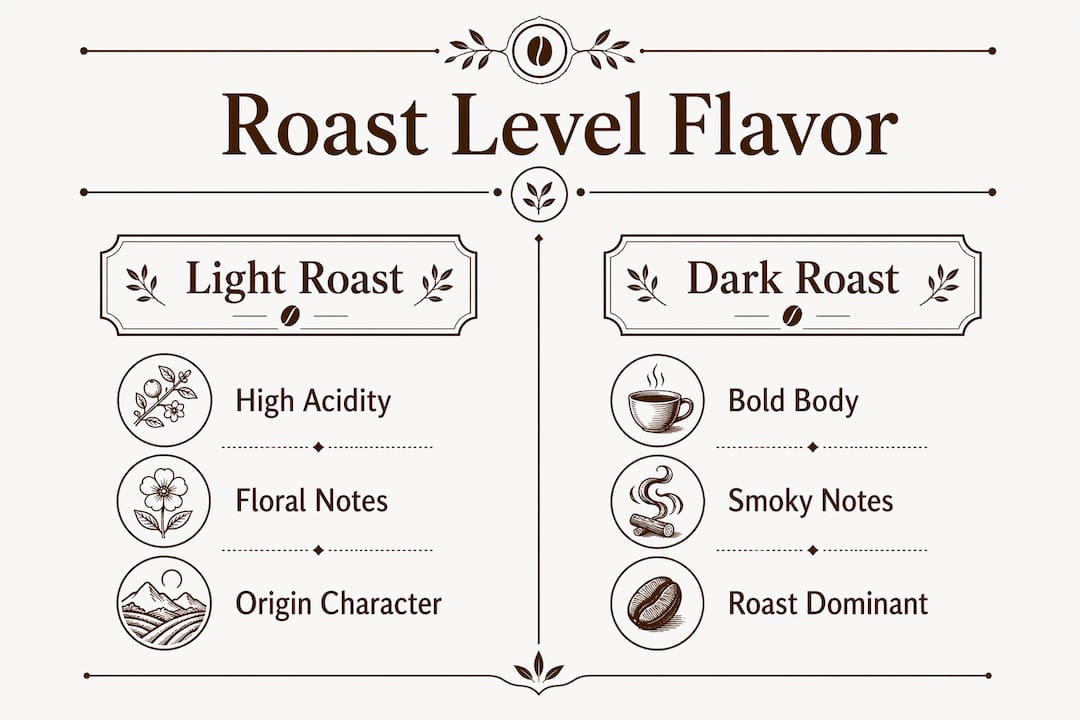
How roasting affects flavor becomes most visible when you compare light, medium, and dark roasts side by side. Each level represents a different stopping point in the roasting process, and each produces a distinct sensory experience. The first crack occurs at 196 to 205°C, marking the point where beans become drinkable. The second crack at 224 to 230°C signals oil migration and structural breakdown, the territory of dark roasts.
| Roast level | Temperature range | Key flavor notes | Acidity | Body |
|---|---|---|---|---|
| Light | 196 to 205°C (first crack) | Floral, fruity, bright, tea-like | High | Light |
| Medium | 210 to 220°C | Nutty, caramel, chocolate, balanced | Medium | Medium |
| Dark | 224°C and above (second crack) | Smoky, bitter, roasty, low origin character | Low | Heavy |
Light roasts stop shortly after the first crack. They retain the most origin character, meaning the terroir of the farm, the variety of the bean, and the processing method all come through clearly. The volatile compound profiles in light and medium roasts are more complex, with a wider range of aromatic molecules contributing to the cup. If you want to taste what makes an Ethiopian Yirgacheffe different from a Colombian Huila, a light roast is where that story lives. You can explore more about tasting notes by roast to build your palate.
Medium roasts balance origin character with roast-driven flavors. The Maillard reaction has had more time to develop, so you get more pronounced caramel and nutty notes. Acidity softens, body increases, and the cup becomes more approachable for a wider range of drinkers. This is the sweet spot for many specialty coffee roasters because it showcases both the bean and the roaster’s craft.
Dark roasts push past the second crack, where oils migrate to the bean surface and roast-driven compounds dominate completely. The original fruit acids have largely degraded. What you taste is primarily the product of intense heat applied to organic matter. That is not a criticism. Many drinkers genuinely prefer the bold, bitter, and smoky profile of a dark roast. But it is worth knowing that origin character is mostly gone at this stage.
Pro Tip: If you find dark roasts taste flat or one-dimensional, try a medium roast from the same origin. The difference often reveals how much flavor the roasting process itself can either build or erase.
How fermentation and roasting technique shape flavor complexity
The flavor complexity in coffee depends not just on roast degree but on the interaction between precursor chemistry and the reaction networks activated during roasting. This is where things get genuinely interesting for enthusiasts who want to go deeper.
Green coffee beans arrive at the roaster with a specific pool of precursors: sugars, amino acids, organic acids, and phenolics. These are the raw ingredients that chemical reactions convert into flavor compounds. The more diverse and abundant the precursor pool, the more complex the resulting flavor can be.
Biomimetic fermentation is a processing technique applied before roasting that deliberately reshapes this precursor pool. Research found a 3.08-fold increase in esterification flux in beans treated with biomimetic fermentation, significantly increasing fruity and nutty aroma compounds after roasting. This means the roaster is not working alone. The decisions made at the farm and processing stage directly influence what the roaster can achieve.
Controlled roasting profiles manage the kinetics of these reactions. A slow, steady temperature rise through the Maillard reaction window produces different results than a fast, aggressive ramp. Roasters who understand this use development time ratios and rate-of-rise curves to guide the bean through each reaction phase deliberately. The result is that two roasters using the same green coffee can produce cups that taste noticeably different.
Key variables that influence flavor beyond roast level:
- Precursor pool: Sugar and amino acid content in the green bean sets the ceiling for flavor complexity
- Fermentation method: Washed, natural, honey, and biomimetic processes each alter precursor availability differently
- Rate of rise: How fast temperature climbs through each reaction phase changes which compounds form
- Development time: The period after first crack determines how far Maillard and caramelization reactions progress
- Roaster type: Drum, fluid bed, and hybrid roasters apply heat differently, affecting surface-to-core temperature gradients
Understanding how flavor tasting notes connect to these variables makes you a sharper taster and a more intentional buyer.
What roast level means for brewing and freshness
The effects of roasting temperature do not stop at the roaster. They follow the bean all the way to your cup and determine how you should brew it. Lighter roasts retain more acids and are denser, which means they are less forgiving during extraction. Under-extract a light roast and you get sour, thin, astringent coffee. To get sweetness and clarity from a light roast, you need a finer grind, hotter water (around 94 to 96°C), and a longer extraction time.
- Light roast brewing: Use a finer grind, water at 94 to 96°C, and extend your brew time to fully extract the sugars and acids that define the cup.
- Medium roast brewing: Standard parameters work well. A medium grind and water at 90 to 93°C deliver balanced extraction without over-developing bitterness.
- Dark roast brewing: Use a coarser grind and slightly cooler water (88 to 91°C) to avoid amplifying the bitterness that dark roasting has already built into the bean.
- Freshness window: Brew within two to four weeks of the roast date. Volatile aroma compounds, especially thiols, degrade rapidly after roasting and even faster after grinding.
- Cooling effect: As your coffee cools, volatile compounds escape and perceived acidity increases. This is why a light roast that tastes balanced at 70°C can taste sharp at 50°C.
The aroma volatility of freshly brewed coffee is a direct result of roasting chemistry. Grinding just before brewing preserves more of those compounds than pre-ground coffee stored in a bag.
Pro Tip: Store whole beans in an airtight, opaque container away from heat and light. Avoid the freezer unless you are storing beans for more than a month. Repeated freeze-thaw cycles introduce moisture that accelerates stale flavors.
Key takeaways
Roasting is the decisive chemical event that builds every flavor, aroma, and texture in your cup, and roast level combined with precursor chemistry determines the full range of what is possible.
| Point | Details |
|---|---|
| Roasting drives flavor chemistry | Maillard, Strecker, and caramelization reactions create the aroma and taste compounds in every cup. |
| Roast level changes the flavor profile | Light roasts preserve origin character; dark roasts replace it with roast-driven bitter and smoky notes. |
| Freshness is a roasting consequence | Key aroma compounds like 2-furfurylthiol degrade within 60 minutes of brewing, making freshness non-negotiable. |
| Fermentation shapes roasting outcomes | Biomimetic fermentation can increase ester compounds by over three times, proving that flavor starts before the roaster. |
| Brewing parameters must match roast level | Lighter roasts need finer grinds and hotter water; darker roasts need coarser grinds and cooler water. |
Why roasting knowledge changed how I drink coffee
Most coffee drinkers pick a roast level by habit or by what the grocery store stocks. I did the same thing for years. What shifted my thinking was realizing that the best roast for coffee flavor is not a fixed answer. It depends entirely on what you want the cup to do.
When I started paying attention to roast dates and brewing parameters together, the difference was immediate. A medium roast Ethiopian bean brewed at 95°C with a fine-medium grind tasted like stone fruit and brown sugar. The same bean brewed at 88°C with a coarse grind tasted flat and forgettable. The roast had not changed. My approach had.
The chemistry covered in this article is not academic trivia. It is a practical map. Once you understand that light roasts are dense and acid-rich and need more extraction energy, you stop blaming the bean when the cup tastes sour. Once you know that dark roasts have already degraded their origin acids and oils have surfaced, you stop expecting floral notes from a French roast.
The most underrated insight here is the fermentation angle. Most enthusiasts focus entirely on roast level, but the processing method applied at the farm sets the precursor ceiling that the roaster works within. A naturally processed bean arrives with more residual sugars and esters than a washed bean. That head start shows up in the cup regardless of roast level. Buying from roasters who communicate processing method alongside roast level gives you far more information to work with.
Experiment deliberately. Buy the same origin in two different roast levels from the same roaster. Brew them identically. The difference you taste is pure roasting chemistry, and it will tell you more about your own preferences than any flavor wheel ever could.
— Kristopher
Explore Dkbeanleaf’s coffee mugs and gear
At Dkbeanleaf, we believe the right vessel is part of the flavor experience. A cup that holds heat well keeps your volatile aroma compounds active longer, which means you taste more of what the roaster worked to create.
Whether you are brewing a bright light roast or a bold dark roast, the right mug matters. Our white glossy mug is a clean, classic choice for home brewing, and our travel mug with a handle keeps your coffee at the right temperature on the go so you catch those aroma peaks before they fade. Browse the full Dkbeanleaf range and find the gear that fits how you drink.
FAQ
What is the role of roasting in coffee flavor?
Roasting transforms green coffee beans through heat-driven chemical reactions including the Maillard reaction, Strecker degradation, and caramelization, producing the hundreds of aroma and flavor compounds that define coffee’s taste and scent.
How does roast level affect flavor?
Light roasts retain origin character with high acidity and complex volatile profiles, medium roasts balance origin and roast-driven notes, and dark roasts replace origin flavors with bitter, smoky, and phenolic compounds produced by intense heat.
Why does fresh coffee taste better than stale coffee?
Key aroma compounds like 2-furfurylthiol degrade rapidly after roasting and brewing. About 84% of this compound disappears within 60 minutes at serving temperature, which is why freshly roasted and freshly brewed coffee has a noticeably stronger and more complex aroma.
Does fermentation before roasting affect coffee flavor?
Yes. Biomimetic fermentation reshapes the precursor chemistry of green beans before they reach the roaster, with research showing a 3.08-fold increase in esterification flux that significantly boosts fruity and nutty aroma compounds in the final cup.
What brewing changes should I make for different roast levels?
Light roasts need a finer grind, hotter water around 94 to 96°C, and longer extraction to draw out their sugars and acids. Dark roasts benefit from a coarser grind and slightly cooler water around 88 to 91°C to avoid amplifying bitterness that roasting has already built into the bean.
Recommended
- Explore every coffee roast: types, tastes, and brewing tips – D&K Bean and Leaf
- Why coffee smells better than it tastes: a sensory guide – D&K Bean and Leaf
- Coffee roast levels explained: tasting notes and brewing tips – D&K Bean and Leaf
- How to Create Coffee Flavor Tasting Notes Like a Pro – D&K Bean and Leaf