

Why coffee smells better than it tastes: a sensory guide
You pour a cup, lean in, and breathe deep. Something close to perfect reaches your nose. Then you take a sip, and it’s good, but it’s not that. This small moment of disappointment is something nearly every coffee drinker experiences, and the reason why coffee smells better than it tastes is not a flaw in your beans or your brewer. It is a fundamental feature of how your brain processes sensation. Understanding it will not ruin the magic. It will deepen it.
Table of Contents
- How aroma shapes coffee flavor perception
- The chemistry of coffee aroma versus taste
- Why bitterness and taste complexity can disappoint
- Contextual and sensory factors influencing coffee flavor enjoyment
- Why the coffee aroma-taste gap is a uniquely human sensory experience
- Enhance your coffee experience with the right gear from D&K Bean and Leaf
- Frequently asked questions
Key Takeaways
| Point | Details |
|---|---|
| Flavor is mostly aroma | Around 80% of what you perceive as coffee flavor comes from its aroma, not just taste. |
| Aroma compounds degrade fast | Key aroma chemicals in coffee degrade quickly after brewing, reducing flavor intensity. |
| Bitterness impacts taste | Bitterness from roasting and caffeine can overshadow aromatic flavors and affect taste enjoyment. |
| Context influences perception | Time of day, cup material, and drinking habits all affect how you perceive coffee’s flavor. |
| Sensory processing matters | Your brain’s emotional response to coffee aroma makes the smell seem stronger than its taste. |
How aroma shapes coffee flavor perception
Flavor is not really a thing your tongue does alone. It is a story your brain assembles from several inputs at once, and aroma carries most of the narrative. Up to 80% of what we perceive as flavor in coffee comes from aroma, specifically through a process called retronasal olfaction. That is the aroma that travels from the back of your mouth up into your nasal cavity while you drink, rather than the direct smell you get when you sniff the grounds.
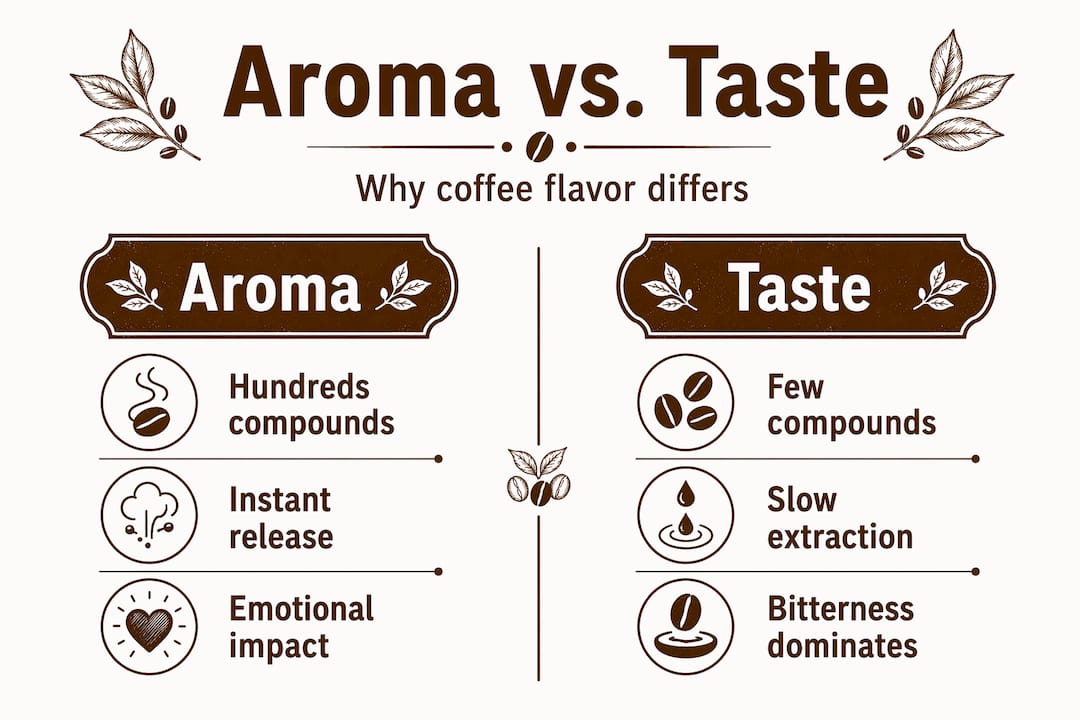
Here is the distinction that changes everything. When you hold your nose over freshly ground coffee and inhale, that is orthonasal olfaction. You are getting direct, full-volume aromatic signal. It is intense. It is vivid. Your olfactory receptors are catching hundreds of volatile compounds all at once with almost no interference.
Retronasal olfaction is different. The aroma reaches your nose indirectly, through the back of your throat, mixed with saliva and modified by temperature. The signal is weaker, more filtered. Your taste buds are also running at the same time, detecting bitterness, sourness, a touch of sweetness. The brain blends all of this into what you experience as coffee flavor, and because so much of the aromatic signal gets lost in transit, the final flavor rarely matches what your nose promised.

What this means for coffee aroma vs taste is straightforward: you are comparing two different sensory modes. Smelling is a direct transmission. Tasting is a reconstruction.
Here is what your sensory system is actually working with:
- Taste buds detect five basic tastes: sweet, sour, salty, bitter, and umami
- Olfactory receptors can detect over 800 volatile compounds in roasted coffee
- The brain merges retronasal aroma with tongue signals into perceived flavor
- Orthonasal smell bypasses this merging and delivers pure aromatic impact
- Temperature affects volatile release, meaning hotter coffee produces more aroma but also more bitterness
Understanding the coffee bloom process is one practical way to maximize that aromatic release from the start of your brew.
Pro Tip: Slurp your coffee deliberately when tasting. It aerates the liquid and forces more volatile compounds up into your nasal passage, giving retronasal olfaction a better chance to deliver the full aromatic profile.
The chemistry of coffee aroma versus taste
With the key role of aroma established, now let’s explore why coffee’s aroma often outshines its taste. The short answer is that the very compounds responsible for making coffee smell so good are fragile, and many of them are already degrading before you take your first sip.
Roasting is where coffee’s aroma is born. The heat of the roast drives the Maillard reaction and a cascade of chemical changes that produce over 800 to 1,000 volatile organic compounds. These are the molecules responsible for the caramel, floral, nutty, and smoky notes you detect when you smell freshly roasted beans. They exist in a state of chemical tension, wanting to escape into the air. That is exactly what they do.
One of the most important is 2-furfurylthiol, the sulfur compound most responsible for that classic roasted coffee smell. Research shows it loses 84% of its concentration within just 60 minutes of brewing, even when coffee is kept hot. The mug sitting on your desk at the end of a meeting smells and tastes noticeably flatter than it did when you first poured it. That is not perception. That is chemistry.
| Compound | Role in coffee scent | Stability during brewing |
|---|---|---|
| 2-furfurylthiol | Primary roasted/sulfurous note | Degrades rapidly, 84% loss in 60 min |
| Guaiacol | Smoky, spicy aroma | Moderate stability |
| Furaneol | Caramel, sweet character | Relatively stable |
| Melanoidins | Brown color, mouthfeel | Stable but suppresses other aromas |
Ground coffee stales dramatically faster than whole beans. The grinding process multiplies the surface area exposed to oxygen and heat, accelerating volatile loss. Melanoidins, the brown polymers formed during roasting, also bind to other aromatic compounds during brewing and prevent them from reaching your sensory receptors. Coffee’s complexity gets locked in its own molecular structure on the way to your cup.
The insight on coffee roast levels matters here because darker roasts produce more of these binding melanoidins, which partially explains why dark roast coffee can smell more intense than it tastes.
Pro Tip: Grind your beans immediately before brewing, every single time. Pre-ground coffee sitting in a bag for even a week has already lost a significant portion of its volatile aromatics. No brewing technique rescues that.
Why bitterness and taste complexity can disappoint
Understanding the chemistry behind coffee’s aroma loss during brewing helps explain why taste may disappoint after the initial smell. But chemistry alone is not the full picture. Your tongue’s role in this disconnect deserves direct attention.
Bitterness in coffee is more complicated than most people realize. Caffeine is the obvious culprit, but it is actually a minor contributor at only 10 to 30% of total bitterness. The rest comes from roasting byproducts including chlorogenic acid lactones and phenylindanes, compounds that increase with roast intensity and with water temperature during extraction.
Factors that push bitterness higher in brewed coffee:
- Brewing water above 205°F extracts more bitter-tasting compounds
- Darker roasts increase phenylindane concentration significantly
- Over-extraction from too-fine a grind or too-long a brew time
- Holding brewed coffee on heat for extended periods
- Robusta beans carry roughly twice the caffeine and bitterness of Arabica
Your nose does not detect bitterness. Aroma doesn’t carry a bitter signal. So when you smell coffee, you’re getting the caramel and the fruit and the wood and the smoke, none of the bitterness. The moment you drink, bitter compounds land on your tongue and the aromatic expectation collides with a more complicated reality. This is the core of coffee flavor vs smell as a sensory experience.
Cold brew reduces this gap meaningfully because cool water extraction limits bitter compound release, which explains why cold brew often tastes closer to how it smells. It doesn’t eliminate the aroma-taste difference, but it narrows it. Understanding roast types and taste helps you choose roasts that minimize harsh bitterness and better align the aroma-to-taste journey.
Contextual and sensory factors influencing coffee flavor enjoyment
Having explored the chemical and taste factors, let’s consider other factors affecting coffee flavor perception and enjoyment. Science increasingly confirms that where, when, and how you drink coffee shapes what you taste as much as what’s in the cup.
A large multi-country citizen-science study found that coffee liking is highest when consumed black, in the morning, during spring, from ceramic cups, and at a rate of four to five cups per day. These are not small effects. They represent measurable differences in how people rated the same beverage under different conditions.
Conditions that improve coffee flavor perception:
- Morning consumption, when sensory alertness is higher and taste fatigue is minimal
- Drinking black, which allows full aromatic complexity without masking from dairy or sweeteners
- Using ceramic cups, which retain heat and don’t transfer any taste-altering materials
- Buying fresher, higher-priced coffee, which correlates with more intact volatile compounds
- Drinking in a comfortable, familiar environment where emotional state is positive
| Factor | Effect on flavor experience | Why it matters |
|---|---|---|
| Ceramic cup | Improves aroma retention, no off-flavors | Material doesn’t interact with coffee |
| Paper cup | Slight cardboard flavor, faster heat loss | Weakens aroma delivery |
| Stainless steel | Temperature retention varies, metallic edge | Can suppress delicate flavor notes |
| Plastic cup | Can release subtle flavor compounds | Distorts natural coffee character |
The vessel truly matters. Ceramic is the gold standard for coffee tasting notes explained in detail, because it gives you the aroma and nothing else. Building a coffee mug collection with intention is not an aesthetic choice. It is a sensory one.
Pro Tip: When you want your coffee to taste its closest to how it smells, drink it black from a ceramic mug, in the morning, within five minutes of brewing. All four factors align in your favor.
Why the coffee aroma-taste gap is a uniquely human sensory experience
Here is where it gets genuinely interesting, and where most coffee conversations stop too early.
The reason why coffee smells better than it tastes is not simply chemistry or biology. It is neurological. Smell and taste are processed in completely different parts of your brain, and that separation creates a gap that is not accidental. Aroma is processed via the limbic system, the emotional and memory-linked region of your brain, while taste signals travel to the cerebral cortex, where rational processing happens. When you smell coffee, your brain does not just analyze it. It feels it. It connects it to memories of warmth, morning rituals, and comfort.
Taste, by contrast, gets evaluated. Your cortex is more critical. It compares incoming signals against expectations. It weighs bitterness. It notices when something is slightly off.
This is why coffee’s aroma-taste discrepancy often feels like a letdown even when the coffee is objectively excellent. You set an emotional standard with your nose, then ask your rational brain to judge what actually arrives. That is a structural mismatch, not a brewing failure.
Your brain connects coffee smell directly to your emotional center, making aroma feel stronger and more satisfying than taste.
The practical takeaway here isn’t to be disappointed. It is to be more deliberate. Pause on the aroma. Smell the grounds. Smell the bloom. Smell the first pour. Give your limbic system the full experience it is wired for, and then drink with lower cognitive expectations and more sensory presence. The cup becomes richer not by changing what’s in it, but by changing how you meet it.
Coffee aroma is not a preview of taste. It is its own experience. Treating it that way fundamentally shifts how satisfying your daily ritual becomes. Explore fresh coffee and quality gear through our coffee aroma and memory guide for a practical starting point.
Enhance your coffee experience with the right gear from D&K Bean and Leaf
Now that you know why coffee smells better than it tastes and how to enhance your sensory experience, here are some practical tools to get started.
The science is clear: the right vessel and the freshest coffee make a measurable difference. At D&K Bean and Leaf, we’ve built our coffee mugs collection around exactly that idea. Ceramic mugs that retain heat, preserve aroma, and add zero interference between you and your cup. Whether you’re a daily drinker or a weekend ritualist, the mug matters.

Pair that with our fresh coffee selection, chosen for aromatic intensity and roast quality, and you start your morning with every advantage the sensory science points to. Our coffee mug tips blog walks through exactly how to choose a mug that works with your coffee, not against it.
Frequently asked questions
Why does coffee smell much stronger than it tastes?
Coffee’s aroma is detected via scent receptors that pick up hundreds of volatile compounds simultaneously, while taste only processes five basic flavors, which is why 80% of perceived flavor comes from aroma rather than the tongue alone.
How does coffee’s bitterness affect its flavor perception?
Bitterness from roasting compounds and caffeine often dominates what the tongue detects, and since aroma carries no bitter signal, the bitterness contribution from caffeine alone is just 10 to 30%, meaning roast level and temperature drive most of the gap between aroma and taste.
Can coffee flavor be improved to match its aroma?
Grinding immediately before brewing and using proper water temperatures can preserve more volatile aromatic compounds, since 2-furfurylthiol degrades 84% within an hour, meaning freshness is the single biggest lever you have.
Why does coffee from ceramic cups taste better?
Ceramic retains heat without imparting any off-flavors, keeping volatile aroma compounds active longer in your cup, and multi-country research confirms higher coffee enjoyment ratings specifically when drinking from ceramic versus other materials.
Recommended
- What is coffee bloom: your complete brewing guide – D&K Bean and Leaf
- Explore every coffee roast: types, tastes, and brewing tips – D&K Bean and Leaf
- Coffee roast levels explained: tasting notes and brewing tips – D&K Bean and Leaf
- Build a coffee mug collection you’ll love and care for – D&K Bean and Leaf