

White Tea Varieties Explained: A Practical Buyer's Guide
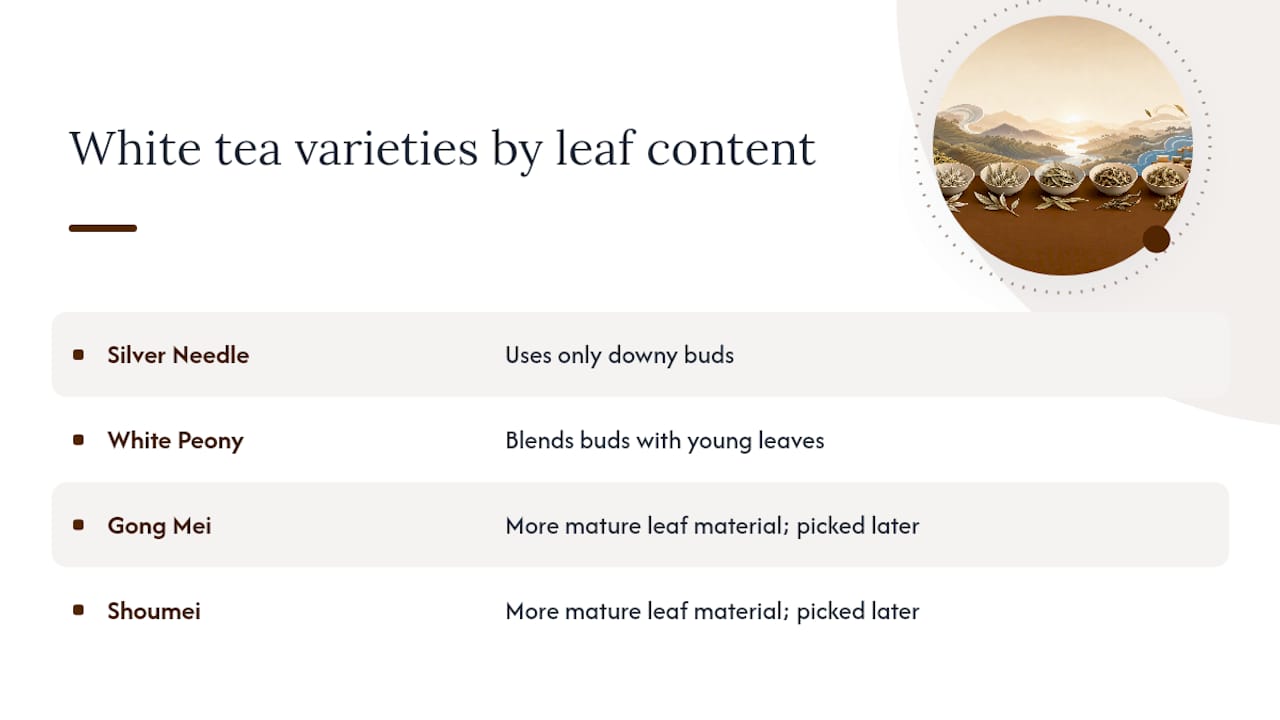
Silver Needle, White Peony, Gong Mei, and Shoumei are the four core white tea varieties, and what separates them comes down to one thing: how much of the plant went into the cup. Silver Needle uses only downy buds; White Peony blends buds with young leaves; Gong Mei and Shoumei come from more mature leaf material picked later in the season. A 2023 review tied regular tea drinking to a 21% lower risk of heart disease, with catechins like EGCG doing much of the work, and white tea’s minimal handling helps preserve those compounds. Dkbeanleaf carries several of these varieties as loose leaf, and the rest of this guide covers how they’re processed, how they taste, how to brew them, and what to look for when you buy.
Key Takeaways
White tea varieties differ mainly by leaf composition and harvest timing, and minimal processing is what preserves their catechin content and delicate flavor.
| Point | Details |
|---|---|
| Grade hierarchy | Silver Needle (buds only) ranks above White Peony (buds and leaves), with Gong Mei and Shoumei using more mature leaf. |
| Processing stays minimal | Only withering and drying shape white tea, which helps retain catechins like EGCG. |
| Brew it gently | Use 175 to 185°F water, a 2 to 4 minute steep, and about 2 grams of leaf per 8-ounce cup. |
| Buy by season and origin | Spring harvest, named origin, and visible bud or leaf integrity signal higher quality. |
| Try before committing | Dkbeanleaf’s white tea sample pack lets you compare Silver Needle, White Peony, and a regional variety in one order. |
Table of Contents
- What Makes a Tea “White” in the First Place?
- What Are the Main White Tea Varieties?
- What Regional White Teas Exist Beyond the Chinese Classics?
- How Do Flavor and Chemistry Differ Between White Tea Varieties?
- How Do You Brew White Tea for the Best Flavor?
- What Should You Look for When Buying White Tea?
- Is Silver Needle Really Worth the Premium Over White Peony?
- Try Dkbeanleaf’s White Tea Sample Pack
- Frequently Asked Questions
- Sources
What Makes a Tea “White” in the First Place?
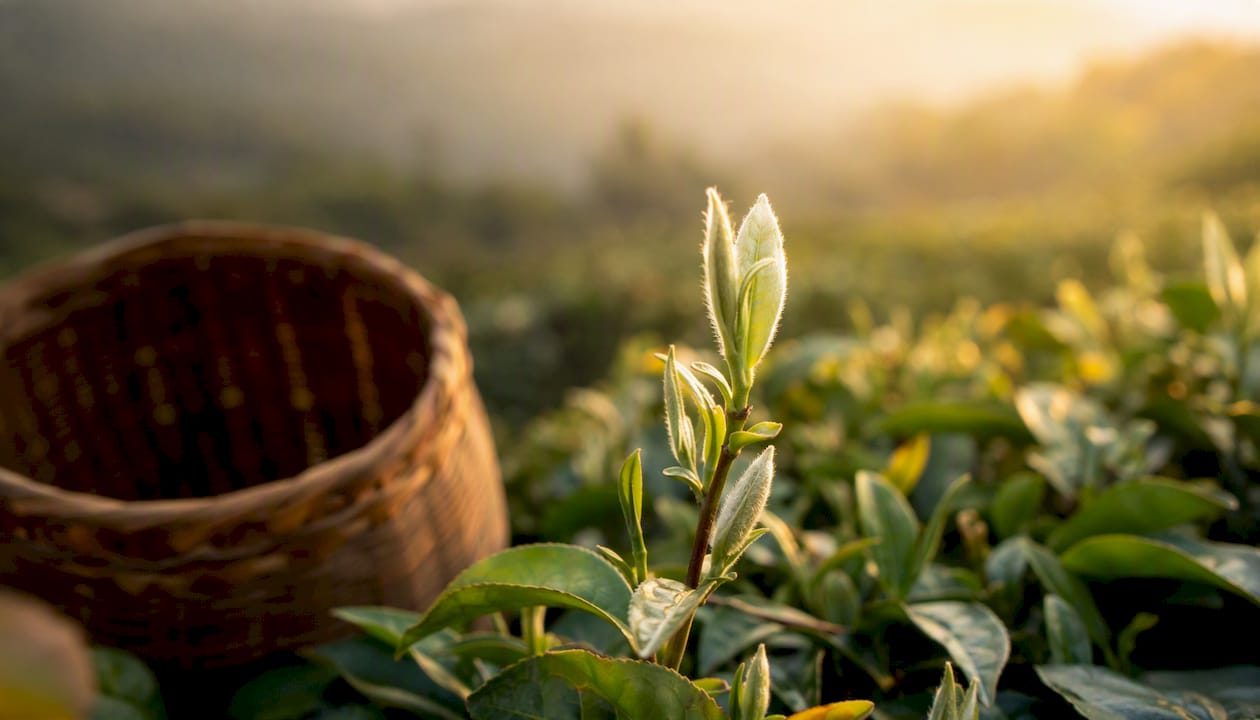
White tea is the least processed style made from Camellia sinensis, the same plant behind green, oolong, and black tea. There’s no rolling, no roasting, and no deliberate oxidation step. That absence of intervention is the entire point.
The process breaks down into three moves:
- Plucking — Workers harvest buds or very young leaves, often by hand, during a narrow spring window.
- Withering — Leaves rest in filtered sunlight or ventilated indoor racks for hours to days, losing moisture slowly.
- Drying and sorting — Final drying locks in the leaf’s shape and chemistry, then leaves get sorted by grade.
That’s largely it. No pan-firing, no bruising to trigger oxidation the way black tea production does.
The chemistry angle matters here. Because the leaf isn’t manipulated the way other teas are, white tea holds onto a higher share of its original catechin content, including EGCG, which researchers link to much of tea’s antioxidant activity. Fujian Province in southeastern China is the traditional home of this style, particularly the Fuding and Zhenghe counties, and harvest happens once a year, concentrated in early spring when the plant pushes out its tenderest new growth.
What Are the Main White Tea Varieties?
Quality in white tea tracks pretty closely with how young and intact the leaf material is. Silver Needle sits at the top of the hierarchy, White Peony comes next, and Gong Mei and Shoumei occupy the more affordable, fuller-bodied end of the spectrum.
- Silver Needle (Bai Hao Yinzhen): Made entirely from plump, unopened buds covered in fine white down. Expect a pale, almost champagne-colored liquor with delicate honey and melon notes and a light, silky mouthfeel. Caffeine tends to run on the lower end for white tea, though buds aren’t automatically low-caffeine the way some marketing implies. Look for uniform, silvery buds with minimal broken pieces or leaf fragments mixed in.
- White Peony (Bai Mu Dan): A “one bud, two leaves” pluck, meaning each piece includes a bud plus two young leaves. Flavor shifts toward fuller floral and slightly grassy notes with more body than Silver Needle. This is often the best entry point if you’re new to the category.
- Gong Mei: Made from more mature leaves picked later in the season, sometimes after the primary Silver Needle and White Peony harvests. Expect a deeper amber cup, fruitier and woodier notes, and noticeably lower prices.
- Shoumei: The most mature grade, using larger leaves and sometimes small twigs. It brews darker and stronger than the other three, closer in weight to a light black tea, and it’s also the variety most commonly aged intentionally, similar to how pu-erh ages over time.
Grading conventions like “one bud” versus “one bud, two leaves” aren’t just tasting notes. They’re the main driver of price, since bud-only harvests require more hand labor per pound of finished tea. Single-origin Silver Needle from Fujian remains the reference point most tea drinkers use to calibrate what a “true” white tea should taste like.
What Regional White Teas Exist Beyond the Chinese Classics?
Fujian isn’t the only place growing white-style teas, and the category’s definitions have loosened enough that several regions now produce their own distinctive versions worth seeking out.
- Yabao: Made from large, tough buds of a wild or semi-wild tea plant, often brewing into a thick, almost woody cup unlike delicate Silver Needle.
- Darjeeling white: Grown in the same high-altitude gardens as Darjeeling’s famous black teas, carrying a similar muscatel note but in a much lighter body.
- Ceylon white: Sri Lanka’s version, typically hand-rolled into tight twists, with a brighter, slightly citrusy profile shaped by the island’s climate.
- White pu-erh: A Yunnan specialty that skips pu-erh’s usual fermentation, giving you the mineral backbone of Yunnan leaf without the earthy aged character.
- Moonlight White: Also from Yunnan, dried slowly under moonlight (or shade) rather than direct sun, producing a two-toned leaf and a smoother, sweeter cup.
Cultivar and terroir shift these teas as much as processing does. A Darjeeling garden’s altitude and cool nights push toward that muscatel character, while Yunnan’s older tea trees give white pu-erh its heavier mineral note.
How Do Flavor and Chemistry Differ Between White Tea Varieties?
Less processing plus younger leaf material equals a lighter body, floral-to-sweet flavor, and stronger retention of certain catechins compared to more heavily processed teas. That’s the short version, and it holds across nearly every variety discussed above.
Compared to green tea, white tea generally lands in a similar or slightly lower caffeine range since both skip full oxidation, though bud-heavy teas like Silver Needle can occasionally test higher than expected because caffeine concentrates in young growth. Black tea, having gone through full oxidation and often more mechanical processing, tends to carry a bolder, heavier profile and comparable or greater caffeine, though brewing strength affects this more than the tea type alone. If you’re used to gauging strength by coffee’s caffeine content, think of white tea as sitting well below coffee across the board, regardless of variety.
A 2025 review found that white tea’s minimal processing helps preserve flavonoids and catechins, including EGCG, and pointed to seven clinical studies examining uses ranging from anti-obesity effects to periodontal health.
The heart-health data is genuinely encouraging: that 21% lower cardiovascular risk tied to regular tea drinking. But researchers are careful to note that a lot of white tea’s specific benefits still rest on animal or lab studies rather than large human trials, and consistent long-term consumption likely matters more than any single cup. If you want a broader look at where antioxidants show up across the beverage aisle, this rundown of antioxidant-rich drinks is a useful companion read.
How Do You Brew White Tea for the Best Flavor?
Water at 175 to 185°F, a steep time of 2 to 4 minutes, and roughly 2 grams of leaf per 8-ounce cup covers most white teas well. Bud-heavy styles like Silver Needle do better on the cooler, longer end; leafier Gong Mei and Shoumei can handle slightly hotter water and shorter steeps.
- Warm your vessel with a splash of hot water, then discard it, so the leaf doesn’t cool the water on contact.
- Add leaf first, then pour water over it rather than dropping leaves into already-full water.
- Steep, then taste at the low end of the time range before deciding to push it longer.
- Re-steep two to four times, adding 30 to 60 seconds to each subsequent infusion since the leaf opens up gradually.
A gaiwan or a clear glass pot works better than a metal ball infuser here, since white tea’s large buds and leaves need room to unfurl fully.
Pro Tip: If your cup tastes flat or grassy-bitter, your water is probably too hot. Drop it 10 degrees before blaming the tea.
Dkbeanleaf’s sample packs are built around these exact parameters, so you can dial in temperature and time across a few varieties without committing to a full bag of one you haven’t tried.
What Should You Look for When Buying White Tea?
Check the harvest season, leaf description, origin, grade, and packaging date before you check the price. A bag labeled simply “white tea” with no harvest year or origin is a lower-confidence buy than one naming Fuding, spring harvest, and a specific grade.
- Harvest timing: Spring-only harvests, especially single-bud pickings for Silver Needle, cost more because the labor-to-yield ratio is steep.
- Leaf appearance: Look for intact buds or leaves with visible silvery down, not crushed fragments or dust.
- Origin transparency: Reputable sellers name a region, not just a country.
- Packaging date: Freshness matters more for white tea than for aged pu-erh, so a recent date is a good sign.
Store white tea in an airtight container, away from light, heat, and anything aromatic that could bleed into the leaf. It holds peak aroma for 6 to 12 months; kept very dry and sealed, it can last considerably longer, though the delicate top notes fade first. For a deeper dive into sorting good tea from filler on a shelf, this buying guide walks through the same red flags in more detail.
Is Silver Needle Really Worth the Premium Over White Peony?
Most guides treat Silver Needle as the automatic best choice because it sits at the top of the grade hierarchy, and that’s true if what you want is maximum delicacy and a subtle cup. But I think that framing undersells White Peony, and it’s worth saying plainly: for most casual drinkers, White Peony is the better everyday tea.
Silver Needle rewards patience and a quiet room. Its flavor is so light that background noise, a strong breakfast, or brewing it even slightly wrong will flatten the experience entirely. White Peony, with its bud-and-leaf blend, carries enough body and floral weight to hold up on a Tuesday morning next to actual food, and it forgives a slightly hot kettle or a slightly long steep in a way Silver Needle simply doesn’t.
The bigger gap in most people’s white tea knowledge isn’t grade, it’s origin diversity. Everyone learns the Fujian classics and stops there, missing how differently a Darjeeling white or a white pu-erh can taste from the same rough leaf category. If you’ve only ever tried one white tea and decided you didn’t like it, the variety you tried is probably the reason, not the category itself.
Try Dkbeanleaf’s White Tea Sample Pack
You don’t have to guess which grade suits your taste. Dkbeanleaf’s white tea sample pack lets you brew Silver Needle, White Peony, and a regional pick side by side, using the exact temperature and steep-time ranges covered above, so you can compare them in your own kitchen instead of relying on someone else’s tasting notes.

Each pack ships pre-portioned, so you’re not stuck buying a full bag of a variety before you know if you like it. Browse the full tea collection to see current white tea offerings, or pair your order with a tea and coffee bundle if your household drinks both. Add a sample pack to your cart today and start brewing your comparison this week.
Frequently Asked Questions
What’s the actual difference between white tea varieties? The main differences come down to which part of the plant gets picked. Silver Needle uses only buds, White Peony adds young leaves, and Gong Mei and Shoumei rely on more mature leaf material harvested later in the season.
Which white tea variety has the most caffeine? It varies more by brewing strength than by variety, but bud-heavy teas like Silver Needle can sometimes test higher than expected since caffeine concentrates in new growth, while leafier styles like Shoumei brew stronger overall due to leaf volume.
Is white tea healthier than green tea? Both are minimally processed and rich in catechins, so neither has a clear health edge established in human research. White tea’s EGCG content is well-documented, but most benefit claims for either tea come from smaller or preclinical studies.
How long does white tea stay fresh? Expect peak aroma for 6 to 12 months in an airtight, cool, dark container. Very dry, well-sealed leaf can last longer, though the lightest floral notes fade first.
Can you re-steep white tea leaves? Yes, most white teas hold up for two to four infusions, with each steep needing slightly more time than the last as the leaf gradually unfurls.
This article is general information, not a substitute for advice from a qualified doctor. Consult a qualified healthcare professional about your own circumstances before acting on anything here.
Sources
- 10 Impressive Benefits of White Tea
- An overview of the processing, chemical constituents, pharmacological properties, and clinical studies of white tea
- Therapeutic benefits of white tea: a review of its multifaceted role
Much of the clinical picture here is still developing, so treat these reviews as a starting point rather than a final word, and check the primary studies if you want the underlying trial details.