Why Espresso Has Crema: The Science Behind the Foam
What is espresso crema and why does it form?
Espresso has crema because pressurized water forces carbon dioxide out of freshly roasted coffee grounds, and that CO2 escapes as millions of tiny bubbles the moment pressure drops at the portafilter exit. Those bubbles get coated and stabilized by emulsified coffee oils, forming the reddish-brown foam layer you see crowning a well-pulled shot.
Three things must come together for crema to appear:
- Fresh beans with available CO2 trapped from the roasting process
- Sufficient pressure (above 7 bar) to dissolve that CO2 into the brewing water
- The right extraction chemistry, including surface-active compounds like melanoidins and proteins that stabilize the foam
Crema is not just decorative. It signals bean freshness, confirms adequate machine pressure, concentrates volatile aromatic compounds above the cup, and adds a creamy texture to the espresso body. Thin or absent crema reliably points to stale beans or a pressure problem. Thick crema, on the other hand, does not automatically mean better flavor. Understanding what crema actually tells you separates a home barista who chases aesthetics from one who pulls consistently great shots.
How crema forms during espresso extraction
The physics here are straightforward once you know what to look for. Standard espresso extraction uses approximately 6.5 ± 1.5 grams of finely ground coffee, water at 89 ± 5°C, pressure above 7 bar, and a brew time of around 30 ± 5 seconds. Every one of those parameters plays a direct role in crema formation.
The CO2 pressure cycle
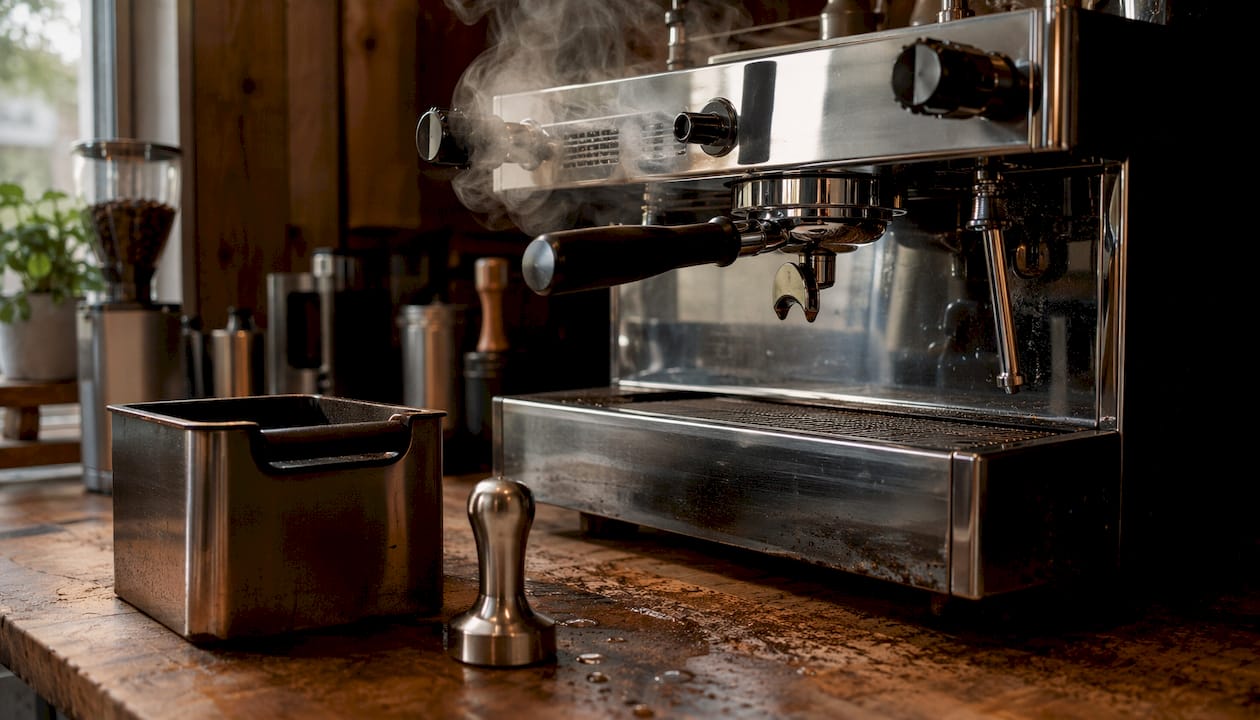
When hot water contacts the coffee puck under pressure, it dissolves CO2 that has been trapped inside the bean’s cell structure since roasting. This follows Henry’s Law: gases dissolve more readily in liquid under higher pressure. The moment that pressurized liquid exits the portafilter and returns to atmospheric pressure, it can no longer hold all that dissolved gas. CO2 rapidly comes out of solution, nucleating around emulsified oil droplets and forming the foam matrix you see in the cup.
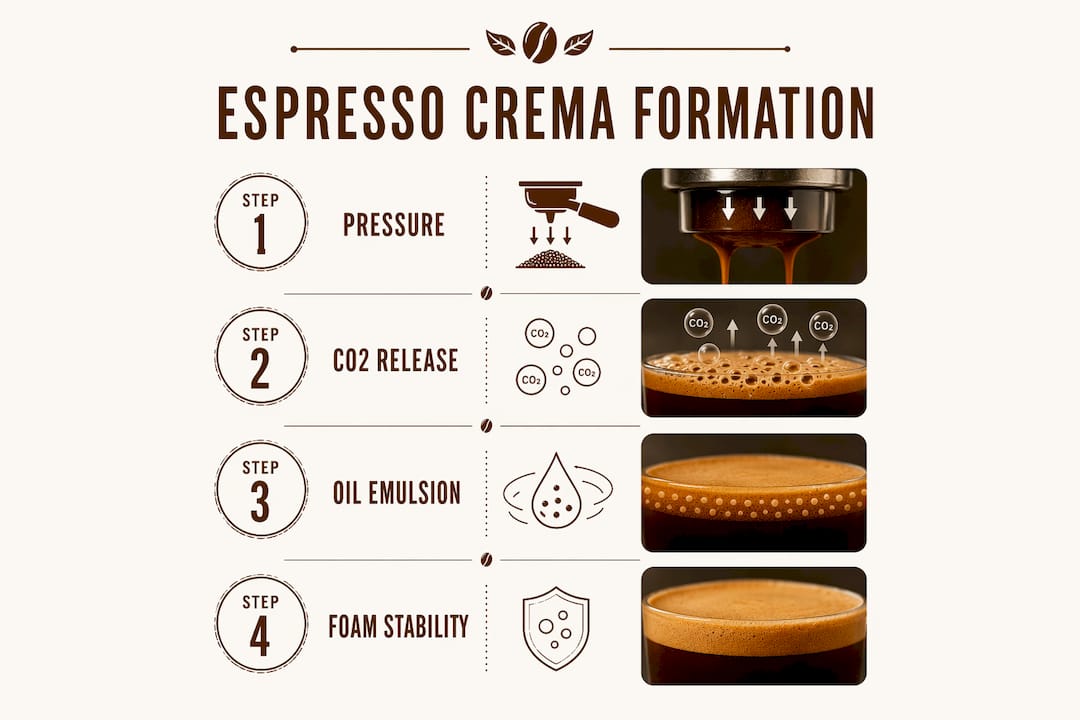
Carbon dioxide is the dominant gas produced during roasting, accounting for 87% of gases released from roasted coffee. It forms through Maillard reactions, Strecker degradation, and pyrolysis of carbohydrates at temperatures above 200°C. The initial CO2 content measured immediately after grinding ranges from 4.0 to 8.6 mg/g of coffee, with an overall average of 5.7 mg/g.
The role of coffee oils and stabilizing compounds
CO2 alone would produce foam that collapses within seconds. What makes crema persist is the emulsified oil-in-water structure of the espresso liquid itself. The continuous phase of espresso is an oil-in-water emulsion, with microscopic oil droplets under 10 micrometers suspended in an aqueous solution. Coffee oils coat the CO2 bubbles, and surface-active compounds extracted during brewing form an interfacial film that resists bubble coalescence.
Crema stability depends on proteins, melanoidins, polysaccharides (particularly galactomannans and arabinogalactan), and lipids working together. Melanoidins and proteins initiate foam formation. Polysaccharides provide the viscoelastic properties that keep the lamellar films between bubbles intact. Lipids interact with melanoidins to reinforce the interfacial film. Pull a shot that under-extracts and you dissolve fewer of these stabilizing compounds, which is why under-extracted espresso produces thin, quickly dissipating crema.
Pro Tip: Warm your cup before pulling a shot. A cold cup accelerates liquid drainage from the crema’s lamellar structure, shortening its life noticeably.
Why crema is unique to espresso
No other common brewing method produces true crema. Pour-over, French press, and AeroPress all lack the sustained pressure needed to dissolve CO2 into solution and then release it rapidly. The moka pot gets close but operates at roughly 1.5 bar, far below the threshold for proper crema formation. What you occasionally see on a moka pot shot is surface foam that dissipates within seconds, not the structured colloidal emulsion of genuine crema.
Crema in a standard 25–30 mL espresso cup represents at least 10% of the total volume. It starts as a liquid bubbly foam and gradually transitions to a drier polyhedral structure as drainage occurs. The practical window before crema thins noticeably is 1–3 minutes after extraction.
What crema reveals about coffee freshness, quality, and extraction
Crema is a freshness indicator first. Beans within roughly 1–4 weeks of roast contain abundant CO2. As beans age, that CO2 slowly degasses through the bean’s cell walls, and by the time beans are stale, there simply is not enough gas left to form meaningful crema regardless of machine quality. Thin, pale, rapidly vanishing crema is the clearest sign your beans are past their prime.
Bean variety shapes crema volume and persistence in ways that surprise many home baristas. Robusta beans produce more voluminous crema than Arabica because they contain significantly more CO2. Measured immediately after grinding, pure Arabica averages 4.6 mg/g of CO2 compared to 6.9 mg/g for pure Robusta. Traditional Italian espresso blends include Robusta specifically for this reason, often at 10–30% of the blend. The tradeoff is that Arabica beans produce more stable crema despite lower volume, because their higher lipid content strengthens the interfacial film.
Roast level matters too. Both Arabica and Robusta contain more CO2 in a dark roast than at medium roast, which is why dark-roasted blends tend to produce thick, impressive crema. Lightly roasted single-origin Arabica beans pull shots with noticeably thinner crema. That thinner layer says nothing negative about flavor quality. It reflects the bean’s chemistry, not a brewing failure.
Crema also plays a real role in the sensory experience. The volatile aromatic compounds responsible for espresso’s distinctive scent concentrate heavily in the crema layer. Caramel, roasted nut, stone fruit, and floral notes all accumulate there before you take your first sip. Research suggests crema acts as a protective layer that retains volatile aroma compounds while also speeding the release of certain hydrophobic compounds that dissolve readily in oil. Coffee connoisseurs expect crema to occupy at least 10% of espresso volume and to last 1–3 minutes before breaking up.
Pro Tip: Check your freshly roasted beans for the roast date before anything else. No technique adjustment compensates for beans that have been sitting on a shelf for two months.
Common myths and misconceptions about espresso crema
The biggest myth in espresso culture is that thicker crema equals better coffee. It does not. A dark-roasted Robusta-heavy commercial blend will produce thick, persistent, visually impressive crema while delivering a flat, bitter cup. A specialty-grade washed Ethiopian Yirgacheffe pulled at light roast may show 2mm of crema and taste extraordinary. Crema thickness is a roast and variety characteristic, not a quality ranking.
The “sugar test” myth deserves a direct correction. The idea that quality crema should hold a spoonful of sugar on its surface for a set number of seconds is a marketing invention, not a barista standard. It originated when early commercial espresso producers needed to justify dark-roasted, Robusta-heavy blends that produced dense foam precisely because the beans were cheap and over-roasted. Professional baristas rely on tasting and textural cues, not visual stunts like the sugar test.
Crema also influences how consumers perceive espresso before they taste it. A 2015 study by Nespresso and the Nestlé Research Center found that crema creates an expectation of higher quality, smoother, and more premium coffee. Seven espressos with varying crema qualities were evaluated, and participants consistently rated crema-topped shots as superior before tasting. That psychological effect is real, but it operates independently of actual flavor quality.
Tiger stripes, the marbled pattern that sometimes appears in crema, look beautiful and get photographed constantly. They reflect uneven CO2 distribution across the coffee puck during extraction, not perfect technique. Chasing tiger stripes as a quality signal sends you in the wrong direction.
Crema isolated and tasted on its own is predominantly bitter and slightly astringent. Melanoidins and other roasted compounds concentrate at the gas-liquid interface of the bubbles, which is why crema carries the harshest notes of the shot. Integrated into the espresso by stirring, that bitterness balances with the sweeter, more syrupy liquid beneath. The combination works. The crema alone does not.
Home barista tips for using crema as a diagnostic tool
Crema gives you a quick pre-taste read on your shot before you evaluate it on the palate. Here is what each visual cue actually tells you:
- Pale, thin, fast-disappearing crema points to under-extraction, stale beans, too-coarse a grind, or insufficient machine pressure.
- Dark, uneven, large-bubbled crema suggests over-extraction, too-fine a grind, too much coffee, or water that is too hot.
- Absent crema on a machine you know is working correctly almost always means the beans are too old or too lightly roasted.
- Thick, persistent crema on a flat-tasting shot is the clearest sign you are working with a dark-roasted, Robusta-heavy blend where the foam chemistry and the flavor chemistry are pulling in opposite directions.
Grinding and brewing timing matters more than most home baristas realize. Over 70% of CO2 is released when coffee is ground into 500-micrometer particles. The window between grinding and brewing should stay within 0–30 minutes to preserve crema quality. Grind fresh, brew immediately.
Stirring crema into the shot before drinking is worth making a habit. Experts recommend integrating crema by stirring to balance the bitter concentration of the foam with the sweeter espresso body beneath. The aromatic complexity stays intact; the harshness softens. You get a more harmonious cup than leaving the layers separate.
For home espresso brewing, treat crema as a secondary checkpoint, not the primary goal. Pull the shot, glance at the crema for obvious red flags (very pale, absent, or extremely dark and uneven), then taste. Let the palate make the final call every time.
Pro Tip: If your crema disappears in under a minute, check bean age first, grind size second, and machine pressure third. Work through that order before adjusting anything else.
What recent research tells us about crema and brewing parameters
The scientific literature on espresso crema has grown considerably in recent years, moving from anecdotal barista knowledge toward measurable, reproducible findings.
A key study investigating the factors that affect crema volume and stability found that crema volume was mainly affected by coffee variety and freshness, with Robusta producing larger volume than Arabica and fresher beans producing greater volume across both varieties. Crema stability, however, told a different story: Arabica beans produced more stable crema than Robusta, attributable to Arabica’s higher lipid content strengthening the interfacial film. Basket size also affected stability, with double and triple-shot baskets producing more stable crema than single-shot baskets.
| Factor | Effect on crema volume | Effect on crema stability |
|---|---|---|
| Robusta vs. Arabica | Robusta higher | Arabica higher |
| Bean freshness | Fresher = more volume | Less studied |
| Roast level (dark vs. medium) | Dark = more CO2, more volume | Variable |
| Basket size | Less impact | Double/triple more stable |
| Lipid content | Indirect | Higher lipids = more stable |
The foam science behind crema lifetime is equally instructive. Crema is classified as a metastable foam that degrades through two primary mechanisms: drainage, where liquid flows downward under gravity and thins the lamellar films between bubbles, and Ostwald ripening, where larger bubbles grow at the expense of smaller ones. Temperature accelerates both processes. The thermal gradient the crema experiences as the cup cools from roughly 70°C to room temperature changes the viscosity of the continuous phase, which in turn affects how long the foam holds together.
Research on foam microstructure confirms that crema bubble size distribution in pure Arabica espresso follows an essentially monomodal distribution ranging from 10 to 150 micrometers. Robusta crema has characteristically larger bubbles than Arabica crema, which partly explains why Arabica crema looks finer and more velvety despite lower volume. Smaller bubbles increase surface area relative to volume, which slows drainage and produces a more stable, visually appealing foam.
The specialty coffee world has also pushed back on the idea that crema is always necessary. Modern specialty approaches may produce espresso with little crema but exceptional flavor, particularly with light-roast, single-origin Arabica. Crema functions as a mouthfeel and aromatic enhancer, not a strict requirement for a great shot. The research supports treating it as a diagnostic signal of freshness and pressure consistency rather than a definitive quality marker.
Key Takeaways
Espresso produces crema because pressurized water dissolves CO2 from fresh roasted beans, and that gas escapes as stabilized foam when pressure drops at the portafilter exit.
| Point | Details |
|---|---|
| CO2 drives crema formation | Pressurized water above 7 bar dissolves CO2 from fresh beans; pressure drop releases it as foam. |
| Freshness is the top variable | Beans within 1–4 weeks of roast contain the CO2 needed for crema; stale beans produce thin or no foam. |
| Robusta vs. Arabica | Robusta yields more crema volume; Arabica produces more stable crema due to higher lipid content. |
| Thick crema ≠ great flavor | Dark roasts and Robusta-heavy blends produce dense crema but often less flavor complexity. |
| Stir before you sip | Integrating crema into the espresso body balances bitterness and preserves aromatic complexity. |
At Dkbeanleaf, the craft of coffee runs through everything we make. If you spend your mornings pulling shots and thinking about what’s in the cup, you might as well wear that passion. Browse the Dkbeanleaf hoodie collection for coffee-culture apparel built to last as long as your morning ritual.