

Why Green Tea Stays Unoxidized: The Science Explained
Green tea is called “unoxidized” because producers rapidly inactivate the enzyme responsible for leaf browning, usually within hours of picking, before it can convert the leaf’s natural compounds into darker pigments. That enzyme is polyphenol oxidase, and stopping it early is what keeps green tea green and rich in catechins like EGCG.
Here’s the honest caveat, though: no tea leaf goes from bush to basket with zero chemical activity. The moment you pick a leaf, it starts to change. What separates green tea from oolong or black tea isn’t the total absence of oxidation. It’s how fast and how thoroughly the maker shuts that process down. According to Science Learning Hub, tea processing is really the art of managing enzymatic browning on purpose, and green tea represents the earliest possible stop.
Key Takeaways
Green tea earns its unoxidized label because producers heat leaves fast enough to disable polyphenol oxidase before enzymatic browning can meaningfully alter color or chemistry.
| Point | Details |
|---|---|
| Enzyme, not fermentation | Polyphenol oxidase drives tea browning through oxidation, not microbial fermentation, despite common industry language. |
| Kill-green is the key step | Steaming (Japan) or pan-firing (China) rapidly denatures the enzyme, locking in green color and catechins. |
| Chemistry stays or shifts | Catechins, chlorophyll, and L-theanine are preserved; theaflavins and thearubigins form only when oxidation runs unchecked. |
| Brewing and storage matter | Cooler water (160 to 175°F), shorter steeps, and airtight, light-free storage protect the delicate compounds fixation preserved. |
Table of Contents
- Why Green Tea Is Unoxidized: The Enzymatic Browning Behind It
- How Do Producers Stop Tea From Oxidizing?
- What Compounds Does Stopping Oxidation Actually Preserve?
- What Does Halted Oxidation Taste Like In the Cup?
- Brewing and Storing Green Tea to Protect Its Chemistry
- Is Green Tea Really 100% Unoxidized?
- Why Processing Style Should Guide What You Brew Next
- Frequently Asked Questions
- Sources
Why Green Tea Is Unoxidized: The Enzymatic Browning Behind It
Think about a sliced apple left on the counter. Within minutes, the flesh turns brown. That’s oxidation at work, and tea leaves run on the same basic chemistry, just with different starting ingredients.
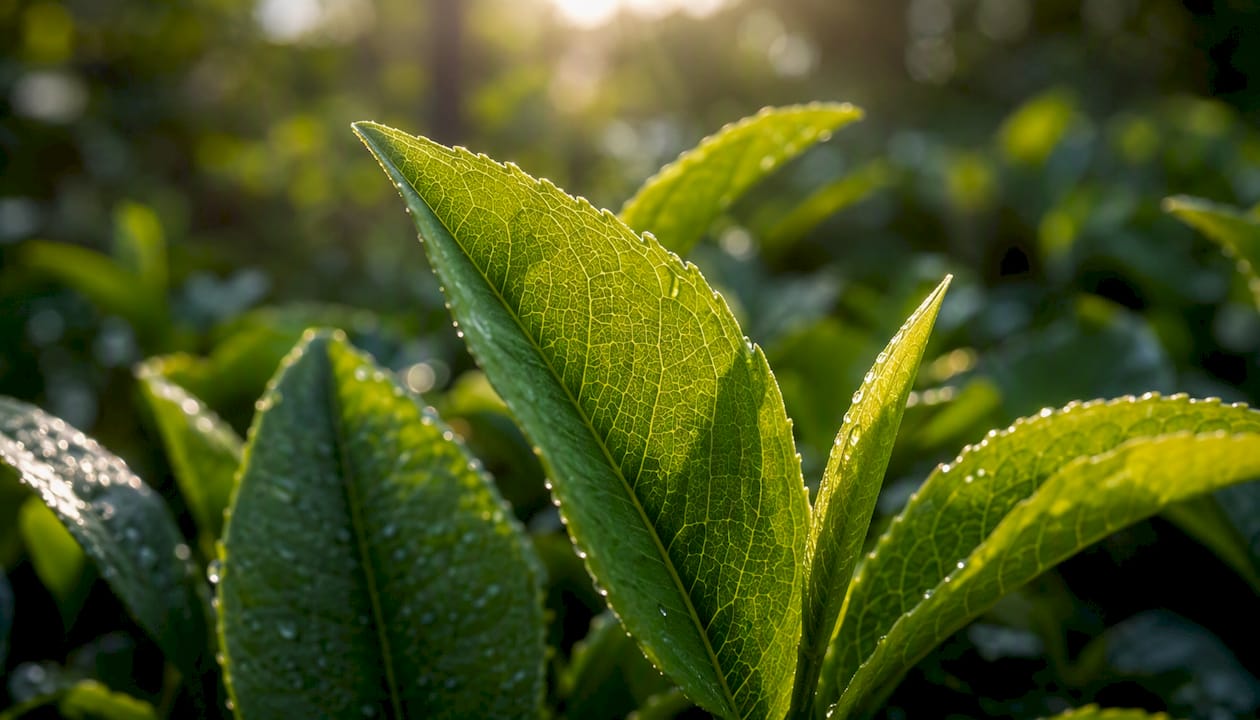
Inside a fresh tea leaf, catechins (a group of flavan-3-ols) sit in one part of the cell, while polyphenol oxidase and a related enzyme called peroxidase sit in another. As long as the leaf stays intact, they never touch. Bruise or crush the leaf, though, and the walls separating them break down. Enzyme meets substrate, oxygen gets involved, and the reaction produces new compounds called theaflavins and thearubigins, the same class of pigments that turn a black tea liquor deep amber or copper.
You’ll often hear tea sellers call this step “fermentation.” That’s a holdover from old trade language, and it’s technically wrong. True fermentation involves microorganisms, like the bacteria that turn cabbage into sauerkraut. What’s happening in a tea leaf has nothing to do with microbes. It’s a straight enzymatic reaction, and calling it oxidation is more accurate, even if the industry term won’t disappear anytime soon.
At the cellular level, the sequence runs in a predictable order:
- Cell walls rupture from bruising, rolling, or prolonged handling.
- Polyphenol oxidase and peroxidase come into contact with catechins.
- Oxygen drives the conversion of catechins into theaflavins and thearubigins.
- The leaf darkens, the liquor deepens in color, and the flavor shifts toward malty, fruity, or brisk notes depending on how far oxidation goes.
The practical upshot: the longer this reaction runs, the darker the cup and the further the flavor drifts from anything grassy or vegetal. Black tea lets it run to completion. Oolong stops it partway. Green tea tries to stop it almost before it starts.
How Do Producers Stop Tea From Oxidizing?
The technical name for this intervention is “kill-green,” a direct translation of the Chinese term shaqing. It means exactly what it sounds like: applying heat fast enough and hot enough to denature polyphenol oxidase before it can do meaningful damage. Once the enzyme’s protein structure breaks down from heat, it can’t catalyze anything anymore, oxidation halts, and the leaf’s green color and catechin profile lock in place.
Two traditions dominate how this heat gets applied, and each leaves a distinct fingerprint on the finished tea.
| Method | How it works | Common tradition | Effect on leaf and flavor |
|---|---|---|---|
| Steaming | Leaves pass through hot steam for roughly 30 seconds | Japanese production (sencha, gyokuro) | Vivid green color, strong vegetal and grassy notes, higher retained chlorophyll |
| Pan-firing or roasting | Leaves are tossed in a heated wok or drum, sometimes for several minutes | Chinese production (Dragon Well, gunpowder) | Slightly duller green with olive or golden tones, toasted and nutty character |
Steaming works fast and penetrates evenly, which is part of why Japanese greens tend toward a brighter, almost seaweed-like intensity. Pan-firing takes longer and involves direct contact with a hot surface, which drives off more moisture up front and introduces subtle roasted, chestnut-like flavors that steaming rarely produces. Neither method is objectively superior. They’re just different levers on the same chemistry, and Wikipedia’s technical overview of tea oxidation) confirms both approaches remain the two dominant fixation styles worldwide.
Timing matters just as much as method. The window between plucking and fixation is when uncontrolled oxidation sneaks in. A batch of leaves left sitting in a warm truck bed for three hours before reaching the fixation drum will show more browning at the leaf edges and a rougher, more astringent cup than a batch fixed within 30 minutes of harvest. That’s not a flaw in the tea plant. It’s a processing shortcut that shows up later in your teacup.
Pro Tip: If a green tea tastes more astringent or dull than you’d expect, it’s often a sign that fixation happened too slowly or unevenly, not that the leaf itself was low quality.
What Compounds Does Stopping Oxidation Actually Preserve?
Halting polyphenol oxidase early keeps a specific set of compounds intact that would otherwise convert into something else entirely.
Preserved compounds include catechins (EGCG, EGC, ECG, and catechin itself), chlorophyll, L-theanine, and free amino acids. These are the molecules responsible for green tea’s color, its umami depth, and much of its reputed antioxidant activity. Medical News Today reports that polyphenols, catechins chief among them, make up roughly 90% of green tea’s antioxidant content, and that share stays high specifically because rapid heating prevents those polyphenols from converting into oxidation byproducts.
Compounds formed by oxidation, by contrast, are theaflavins and thearubigins. These don’t exist in significant amounts in green tea because the reaction that creates them gets shut down before it can run. They’re what gives black tea its coppery color and its heavier, more tannic mouthfeel.
| Compound | Present in green tea? | Formed by |
|---|---|---|
| Catechins (EGCG, EGC, ECG) | Yes, in high concentration | Naturally present in fresh leaf, preserved by fixation |
| Chlorophyll | Yes | Naturally present, retained when heat stops browning |
| L-theanine | Yes | Naturally present, largely unaffected by fixation |
| Theaflavins | Minimal to none | Enzymatic oxidation of catechins |
| Thearubigins | Minimal to none | Further oxidation of theaflavins |
Fixation doesn’t come free of tradeoffs. A peer-reviewed review of tea processing notes that withering before fixation can cost a tea roughly 30% of its catechin content in some processing conditions, and the drying step that follows fixation can thermally degrade catechins further even though it isn’t causing enzymatic oxidation. Stopping the enzyme and protecting every last milligram of catechin are two separate goals, and processors are constantly balancing heat intensity against how much of the leaf’s original chemistry survives to the cup. Dried green tea leaf typically finishes at around 3 to 4% moisture, a target that Britannica’s tea processing overview ties directly to both shelf stability and final flavor.
What Does Halted Oxidation Taste Like In the Cup?
All that enzyme chemistry translates into something you can actually taste, and once you know what to look for, the differences between processing methods become obvious.
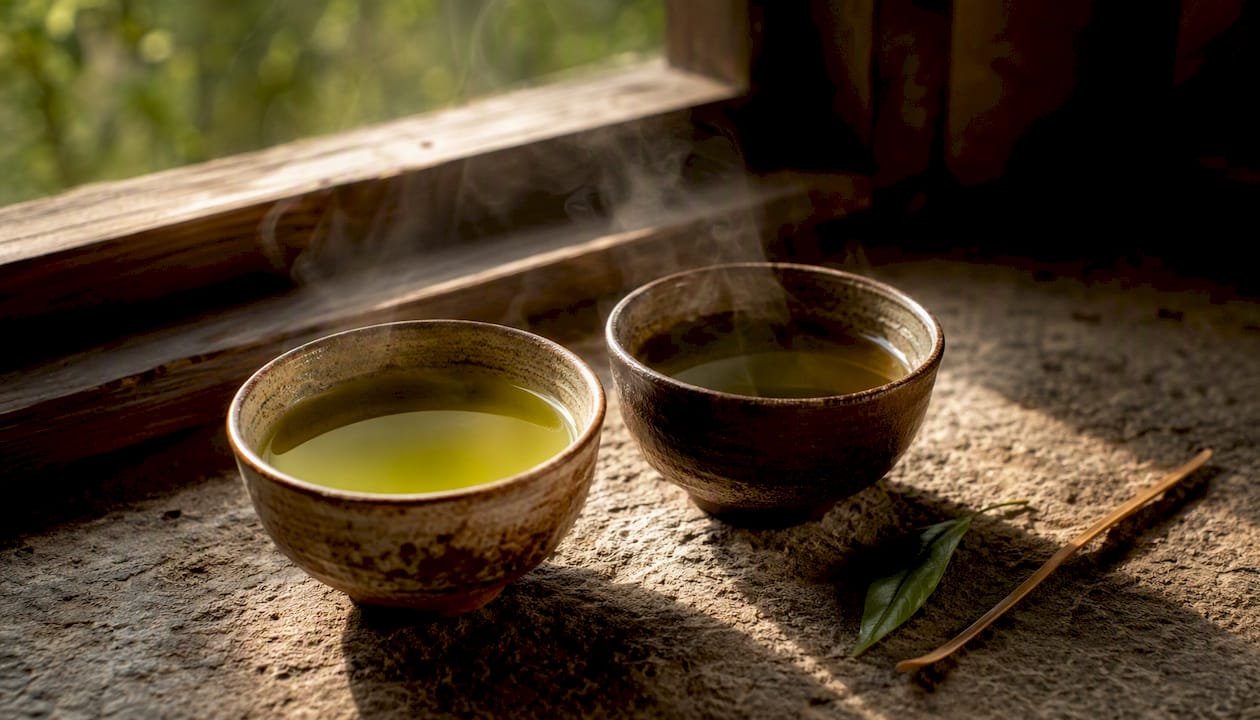
Unoxidized green teas tend to share a family resemblance: greenish to pale yellow liquor, a grassy or vegetal aroma, and a brisk astringency that comes directly from unconverted catechins. Depending on the cultivar and whether the plant was shaded before harvest, you might pick up seaweed or umami notes layered underneath the vegetal core. None of that comes from theaflavins or thearubigins, because there simply aren’t enough of them present to darken the color or round out the mouthfeel the way they would in an oxidized tea.
Compare a steamed Japanese-style green against a pan-fired Chinese-style green side by side, and the fixation method practically announces itself. The steamed cup runs brighter and greener, with an intensity that borders on marine or spinach-like. The pan-fired cup shifts toward toasted rice, chestnut, or light roast notes, a direct result of the dry heat contact during fixation. Push oxidation further and you land somewhere like hojicha, which involves roasting green tea leaves at high heat after fixation, a step that browns the leaf through pure thermal reaction rather than enzymatic activity and produces a completely different, caramel-like flavor profile. That’s a useful reminder that heat alone, applied differently, can mimic some oxidative color changes without any enzyme involvement at all.
Brewing and Storing Green Tea to Protect Its Chemistry
Everything you’ve just read about preserved catechins and delicate chlorophyll has a direct payoff at the kettle. Treat green tea like you’d treat black tea, and you’ll extract more bitterness and astringency than the leaf was ever meant to deliver.
- Brew steamed Japanese greens at 160 to 175°F for 60 to 90 seconds; water this cool draws out sweetness and umami without dragging out excess catechin bitterness.
- Brew pan-fired Chinese greens at a somewhat higher temperature for a few minutes, since the sturdier leaf structure needs a bit more heat to open up.
- Store green tea in an airtight, opaque container away from light, heat, and moisture; oxygen exposure and warmth can trigger slow non-enzymatic degradation of catechins and chlorophyll even after fixation has stopped enzymatic browning for good.
- Buy in smaller quantities and use tea within a few months of the harvest date printed on the package, since flavor fades gradually even under good storage.
If you’re comparing leaf form and how it affects extraction more broadly, the differences between tea bags and loose leaf matter here too, since surface area changes how fast those preserved compounds release into the water.
Pro Tip: Smell the dry leaf before you brew. A fresh, unoxidized green tea should smell grassy or marine, never musty or flat. If the aroma has gone dull, the tea has likely picked up moisture or oxidized further during storage, not during original processing.
Choosing a good green tea starts with reading the cues on the package. Look for whether it’s labeled steamed or pan-fired, check for a harvest date rather than just a packed date, and examine the leaf itself. Vivid, intact green leaves suggest careful, fast fixation. Dull, broken, or brownish-edged leaves suggest the opposite.
Is Green Tea Really 100% Unoxidized?
No tea achieves zero oxidation, and green tea is no exception. The moment a leaf is separated from the plant, some enzymatic activity begins, and it continues until fixation heat shuts it down. Wikipedia’s overview of tea oxidation makes this point directly: “unoxidized” functions as a practical marketplace label rather than an absolute chemical state, and maker skill in minimizing that early window is a real quality factor, not a marketing footnote.
This is where two related categories often get lumped in with green tea, sometimes inaccurately. White tea undergoes even less processing than green tea; it typically skips a dedicated kill-green step altogether and relies mainly on withering and slow drying, which allows a bit more natural oxidation to occur than in most green teas, even though the final result still reads as very lightly oxidized. Matcha, on the other hand, is made from shade-grown leaves that are steamed using the same kill-green logic as sencha, then dried and ground into powder rather than rolled into whole leaves. It’s chemically closer to a standard steamed green tea than to white tea, just processed into a different final form.
Thermal fixation itself isn’t chemically neutral, either. Heat stops the enzyme, but that same heat can also degrade certain volatile aroma compounds and, as noted earlier, reduce catechin levels somewhat during drying. Producers are managing a tradeoff, not flipping an on/off switch. And when fixation is delayed or uneven, whether from a slow harvest, a backed-up processing line, or inconsistent equipment, you get a leaf that’s noticeably less “green” in character and more astringent in the cup, exactly the kind of quality gap that separates a mediocre green tea from an excellent one.
Why Processing Style Should Guide What You Brew Next
Once you understand what kill-green actually does, tasting tea stops being guesswork and starts being detective work. You can smell a cup and have a reasonable guess about whether it was steamed or pan-fired before you even check the label.
My honest recommendation: try a steamed green and a pan-fired green back to back, ideally in the same sitting, using the same water and roughly the same steep time. Note the color difference in the dry leaf, the aroma the moment hot water hits it, and how the aftertaste lingers, vegetal and bright versus toasty and rounded. That single comparison teaches you more about tea chemistry than any amount of reading.
If you want to run that experiment yourself, Dkbeanleaf’s tea collection includes loose-leaf greens processed different ways, along with sample packs sized for exactly this kind of side-by-side tasting.
Frequently Asked Questions
Why is green tea unoxidized while black tea is fully oxidized? Green tea producers apply heat within hours of picking to deactivate polyphenol oxidase, while black tea producers deliberately let that same enzyme run for hours to build theaflavins and thearubigins.
What is unoxidized tea, exactly? It’s tea processed so quickly after harvest that enzymatic browning barely gets started, preserving catechins, chlorophyll, and the fresh, grassy character of the raw leaf.
How is green tea processed differently from oolong or black tea? Green tea goes through fixation almost immediately after plucking, skipping the extended withering and rolling period that oolong and black tea use to encourage oxidation.
Does steaming or pan-firing make a healthier green tea? Both methods stop the same enzyme and preserve similar catechin levels; the real difference is flavor, with steaming producing a grassier cup and pan-firing a toastier one.
Can green tea oxidize after it’s been processed? Slightly, yes. Poor storage involving heat, light, or moisture can cause slow non-enzymatic degradation over time, which is why airtight, cool storage matters even after fixation is complete.
Sources
- Green tea: Health benefits, side effects, and research
- Green tea — Britannica
- The science of tea — Science Learning Hub
- Review of tea processing effects on bioactive compounds — PMC