

Why Mugs Keep Drinks Warm: The Science Explained
Mugs keep drinks warm by slowing heat loss through three physical mechanisms: conduction, convection, and radiation. Every material, wall thickness, and lid design either accelerates or reduces how fast heat escapes from your beverage. Understanding why mugs keep drinks warm means understanding which of those three mechanisms your mug is actually fighting. The answer depends on what your mug is made of, how it is built, and whether it has a lid. Ceramic, stainless steel, glass, and vacuum-insulated vessels each handle heat loss differently, and the gap in performance between them is larger than most people expect.
Why mugs keep drinks warm: heat loss and material science
Heat leaves your drink in three ways. Conduction moves heat directly through the mug walls into the surrounding air. Convection carries heat away through air currents rising off the liquid surface. Radiation sends infrared energy outward from the mug walls without needing any physical contact.
Mug materials determine how fast conduction happens. Ceramic has lower thermal conductivity than metal, which means it transfers heat to the outside air more slowly. This is called thermal buffering. Ceramic absorbs some of the initial heat from your drink to bring its own walls up to temperature, which causes a faster initial temperature drop. After that, it releases heat slowly and steadily, giving you a more stable drinking experience over time.

Ceramic mugs have thermal conductivity of about 1.1–1.5 W/m·K, while glass sits at 0.8–1.1 W/m·K. Thicker ceramic walls increase total heat capacity, meaning the mug stores more thermal energy and releases it gradually. High-fired ceramic is denser and less porous than low-fired ceramic, which reduces heat loss through the material structure itself.
Metal conducts heat far faster than ceramic. A bare stainless steel mug with no insulation will cool your drink quickly because heat races through the walls. That is why stainless steel mugs almost always rely on vacuum insulation rather than the material itself to retain warmth.
- Ceramic: Low conductivity, high thermal mass, acts as a buffer
- Glass: Very low conductivity but thin walls limit heat capacity
- Stainless steel (uninsulated): High conductivity, rapid heat loss without added insulation
- Stainless steel (vacuum-insulated): Conductivity is irrelevant because the vacuum eliminates the conduction pathway
Pro Tip: If you use a ceramic mug, choose one with thick, dense walls. A heavier mug holds more thermal mass and keeps your drink warmer for longer without any added technology.
How does vacuum insulation actually stop heat loss?
Vacuum insulation is the most effective heat retention technology in consumer drinkware. A double-wall vacuum flask removes the air between two stainless steel walls, eliminating the medium through which conduction and convection operate. No air molecules means no pathway for those two heat transfer modes.
Here is how the process works step by step:
- Outer wall: Faces the environment and stays close to room temperature.
- Vacuum layer: The gap between walls contains no air. Heat cannot conduct or convect across a vacuum.
- Inner wall: Holds the liquid and stays hot because heat has nowhere to go.
- Reflective coating: Premium mugs add a copper coating to the inner walls to reflect infrared radiation back into the liquid.
Vacuum flasks lose heat at rates roughly 1,000 times slower than uninsulated vessels, keeping drinks hot for 12–24 hours. That figure explains why a quality insulated travel mug outperforms a ceramic mug by several hours of warmth.
Copper coatings on inner walls reflect infrared radiation back into the liquid, addressing the one heat transfer mode the vacuum cannot stop on its own. This is sometimes called triple-wall performance because it handles all three heat loss mechanisms without adding physical bulk.
“Radiation is the last heat transfer hurdle in vacuum-insulated mugs. Once conduction and convection are eliminated by the vacuum, reflective coatings handle the remaining infrared energy loss.” — Thermainsider
Lid design matters just as much as the vacuum itself. A poor lid can undermine vacuum insulation effectiveness because heat escapes rapidly through plastic lids that lack internal insulation. Deep-threaded, airtight lids improve retention more than mug material alone. A vacuum mug with a loose or poorly designed lid loses much of its thermal advantage within the first 30 minutes.
Does mug shape affect how long drinks stay hot?
Mug shape has a direct and measurable effect on heat retention. The two biggest physical factors are opening size and wall thickness.
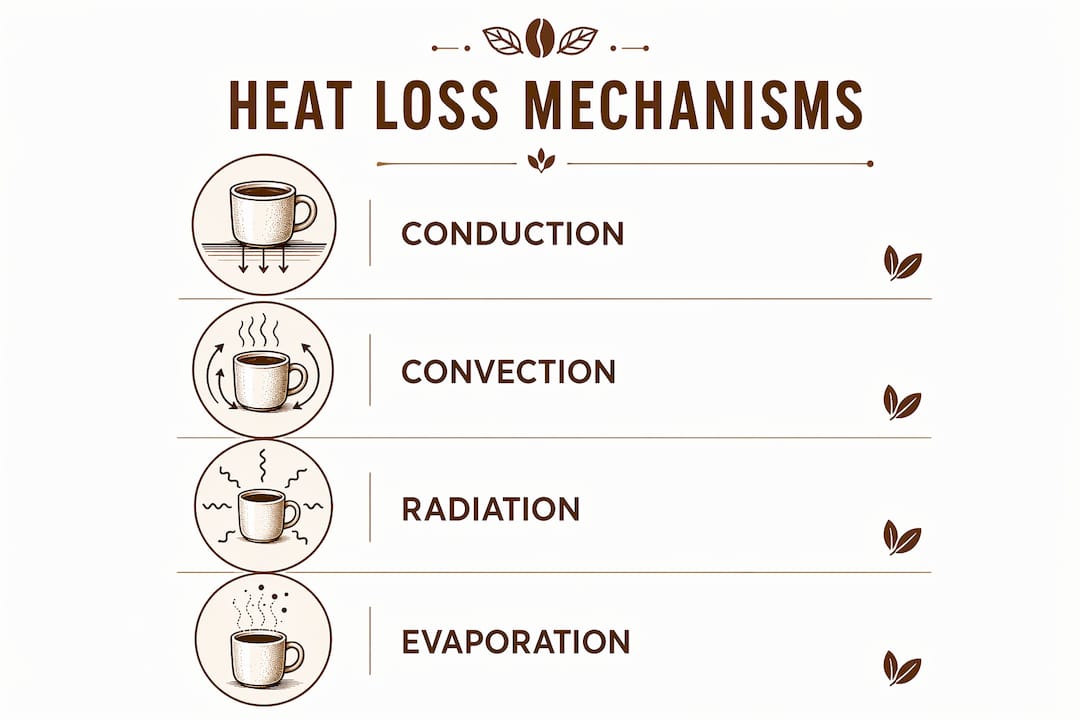
Wide mouth mugs expose more liquid surface area, which increases evaporation and heat loss. Evaporation from the open surface is often the single biggest factor in heat loss from any mug. When water molecules escape as vapor, they carry thermal energy with them. A narrow opening reduces the surface area exposed to air, cutting evaporation losses significantly.
Wall thickness controls heat capacity. Thicker walls store more thermal energy and release it more slowly. A thin-walled espresso cup loses heat far faster than a thick-walled ceramic mug holding the same volume of liquid, even if both are made from the same material.
Larger liquid volumes stay hot longer because of a lower surface-area-to-volume ratio. A full mug cools more slowly than a half-full one. This is basic physics: more liquid means more stored thermal energy relative to the surface through which heat escapes.
Temperature stability also protects flavor. Insulated mugs keep beverages fresh and flavorful longer by preventing rapid cooling and oxidation. A coffee or tea that drops below 140°F quickly starts to taste flat and bitter. Steady temperature control preserves the aromatic compounds that define the character of a well-brewed cup.
- Narrow opening: Reduces evaporation, the dominant heat loss mode in open mugs
- Thick walls: Higher heat capacity, slower release of stored thermal energy
- Full volume: Lower surface-area-to-volume ratio, slower overall cooling
- Lid present: Blocks convection currents and stops evaporation almost entirely
Pro Tip: Always fill your mug as close to the top as practical. A fuller mug loses heat more slowly than a half-empty one because the ratio of liquid mass to exposed surface area is more favorable.
Ceramic vs. insulated metal mugs: which retains heat better?
The comparison between ceramic and vacuum-insulated stainless steel is not close in raw performance, but the right choice depends on what you actually want from your drink.
| Mug type | Heat retention | Insulation method | Best use case |
|---|---|---|---|
| Ceramic (standard) | 30–60 minutes | Thermal mass, wall thickness | Home use, flavor-focused drinking |
| Glass (single wall) | 15–30 minutes | Low conductivity only | Aesthetic preference, short sessions |
| Stainless steel (uninsulated) | 15–25 minutes | None | Not recommended for warmth |
| Stainless steel (vacuum-insulated) | 6–12 hours | Vacuum + reflective coating | Travel, long sessions, maximum retention |
| Travel mug (vacuum, with lid) | 8–24 hours | Vacuum + airtight lid | Commuting, outdoor use |
Ceramic provides a more stable drinking experience due to its thermal buffering effect. It cools your drink to a drinkable temperature faster than a vacuum flask, then holds it there steadily. That is actually a feature for many coffee and tea drinkers who do not want to wait 10 minutes before their first sip.
Users often misunderstand ceramic mugs as inferior because they do not hold heat for hours. Ceramic buffers temperature rather than acting like a vacuum bottle. For a 20-minute morning coffee ritual at home, a quality ceramic mug from Dkbeanleaf performs exactly as intended. For a three-hour road trip, a vacuum-insulated travel mug is the correct tool.
For outdoor use, camp mugs combine durability with reasonable heat retention, making them a practical middle ground between fragile ceramic and premium vacuum flasks.
Key takeaways
Mugs retain heat by reducing conduction, convection, and radiation through material choice, vacuum insulation, wall thickness, and lid design, with vacuum-insulated stainless steel outperforming all other materials for long-duration retention.
| Point | Details |
|---|---|
| Ceramic acts as a thermal buffer | It stabilizes temperature for 30–60 minutes rather than preventing all heat loss. |
| Vacuum insulation eliminates two heat modes | Removing air stops both conduction and convection, leaving only radiation to address. |
| Lid design is critical | A poor lid undermines vacuum insulation and accelerates heat loss faster than material choice. |
| Evaporation is the biggest open-mug loss | Narrow openings and lids cut evaporation, the dominant heat loss factor in lidless mugs. |
| Fill level changes retention time | A full mug cools more slowly because it has a lower surface-area-to-volume ratio. |
What I have learned from years of drinking from every mug type
I have used ceramic mugs, enamel camp mugs, glass cups, and vacuum-insulated travel flasks long enough to have strong opinions about all of them. The single most underrated habit for better heat retention is pre-heating. Pre-heating a mug with boiling water for 5–10 minutes can add 30–60 minutes of extra warmth to your beverage. Most people skip this step entirely and then wonder why their coffee is cold in 20 minutes.
The second thing I have noticed is that people obsess over mug material and ignore the lid. Lid design has greater impact on retaining heat than the material of the mug itself, especially in vacuum-insulated mugs. A great vacuum flask with a cheap, poorly fitting lid is a mediocre performer. A decent vacuum flask with a deep-threaded, airtight lid is excellent.
My honest take on ceramic versus vacuum-insulated: they solve different problems. Ceramic gives you a sensory experience. The weight, the warmth in your hands, the way it cools your drink to exactly the right temperature before you take that first sip. Vacuum insulation gives you time. If your morning routine is unhurried and you drink your coffee at a table, ceramic is the right choice. If you are commuting or working through a long session, vacuum insulation wins without argument.
The flavor angle is real too. Thermal mugs preserve aroma and flavor by maintaining stable heat and preventing rapid cooling and oxidation. I notice this most with delicate teas. A green tea that cools too fast loses its character quickly. A wide mouth mug with a lid keeps the aromatics concentrated and the temperature steady, which changes the experience noticeably.
— Kristopher
Explore Dkbeanleaf mugs and teas built for warmth
The science behind heat retention is only useful when your mug actually delivers on it. Dkbeanleaf carries mugs designed with the material properties and build quality that make a real difference in how long your drink stays at the right temperature.

The white glossy ceramic mug from Dkbeanleaf is built with the thick, dense walls that maximize thermal mass for home use. Pair it with a selection from the Dkbeanleaf tea collection to get the full benefit of stable temperature and preserved aroma. Whether you are a ceramic loyalist or looking to upgrade to a vacuum-insulated option, the right mug changes how your drink tastes from the first sip to the last.
FAQ
Why do mugs keep drinks warm longer than regular cups?
Mugs have thicker walls and greater thermal mass than standard cups, which slows conduction and stores more heat energy. Ceramic mugs also act as thermal buffers, absorbing and releasing heat gradually rather than losing it all at once.
Does a lid really make that much difference to heat retention?
A lid is one of the most effective heat retention tools available because it stops both evaporation and convection, the two dominant heat loss modes in open vessels. Research confirms that a poor lid can undermine even high-quality vacuum insulation.
How long does a ceramic mug keep coffee hot?
A ceramic mug typically keeps coffee at a drinkable temperature for 30–60 minutes, depending on wall thickness, fill level, and whether a lid is used. Vacuum-insulated mugs extend that range to 6–24 hours.
What is the best mug material for heat retention?
Vacuum-insulated stainless steel is the best material for maximum heat retention, keeping drinks hot for 12–24 hours by eliminating conduction and convection through a vacuum layer. Ceramic is the best choice for shorter sessions where thermal buffering and flavor stability matter more.
Does pre-heating a mug actually work?
Pre-heating a mug with boiling water for 5–10 minutes reduces the heat absorbed by cold mug walls when you pour your drink, which can add 30–60 minutes of extra warmth to your beverage.