

Why Japanese Green Tea Is Steamed: Science and Flavor Explained
Japanese green tea is steamed immediately after harvest to stop oxidation, a step called “fixing” or kill-green (mushi in Japanese). That single application of heat deactivates the polyphenol oxidase enzymes in the leaf before they can break down chlorophyll and amino acids, which is why your sencha brews bright green instead of brown and tastes of umami and fresh grass rather than something flat and oxidized.
The practical consequences show up in every cup:
- Enzyme deactivation: Steam at roughly 100°C shuts down oxidase activity within seconds, locking the leaf in its fresh state.
- Amino acid retention: Free amino acids, especially theanine, survive the process largely intact, delivering that characteristic savory, round mouthfeel.
- Chlorophyll preservation: Moist heat fixes the green pigment, producing the vivid jade liquor Japanese teas are known for.
- Cell-wall softening: Steam partially ruptures leaf cells, increasing how readily compounds extract into hot water.
- Flavor profile set: The result is a vegetal, sometimes marine or seaweed-like character that pan-fired teas simply cannot replicate.
Key Takeaways
Steaming is the single step that defines Japanese green tea: it stops oxidation, locks in amino acids and chlorophyll, and sets the flavor before any other process begins.
| Point | Details |
|---|---|
| Steaming stops oxidation | Heat deactivates polyphenol oxidase enzymes within seconds, preventing the leaf from browning. |
| Biggest chemical effect | Steaming triggers the largest shift in non-volatile metabolites, increasing free amino acids that drive umami. |
| Steaming grade matters | Asamushi (light) produces delicate, clear brews; fukamushi (deep) produces fuller, cloudier liquor with shorter steep times. |
| Brew cooler than you think | Gyokuro and fukamushi sencha need 50–70°C water to highlight umami and avoid bitterness. |
| Steamed vs pan-fired | Steamed teas taste vegetal and savory; pan-fired teas taste nutty and toasted — a direct result of moist vs dry heat. |
Table of Contents
- Why Japanese green tea is steamed: the fixing step explained
- How steaming reshapes leaf chemistry and flavor
- Steamed vs pan-fired: what actually changes in your cup
- The main steamed Japanese teas and what steaming does to each
- How to brew steamed Japanese green teas well
- What I listen for when tasting steamed teas
- Sources
Why Japanese green tea is steamed: the fixing step explained
Steaming sits at the very start of processing, right after the fresh leaf is harvested. The sequence runs: harvest → steaming (fixing) → cooling → rolling/shaping → drying. According to the Global Japanese Tea Association, steaming typically lasts 30–120 seconds, making it the shortest step in the entire production chain, yet the most consequential.
Three steaming grades define most Japanese green teas:
Asamushi (light steam, ~15–30 seconds): The leaf retains more of its original structure. The resulting tea tends toward a lighter, more delicate flavor with a clearer liquor.
Chūmushi (medium steam, ~30–60 seconds): A middle path. Leaf integrity is partially maintained, and the flavor sits between the crispness of asamushi and the depth of fukamushi.
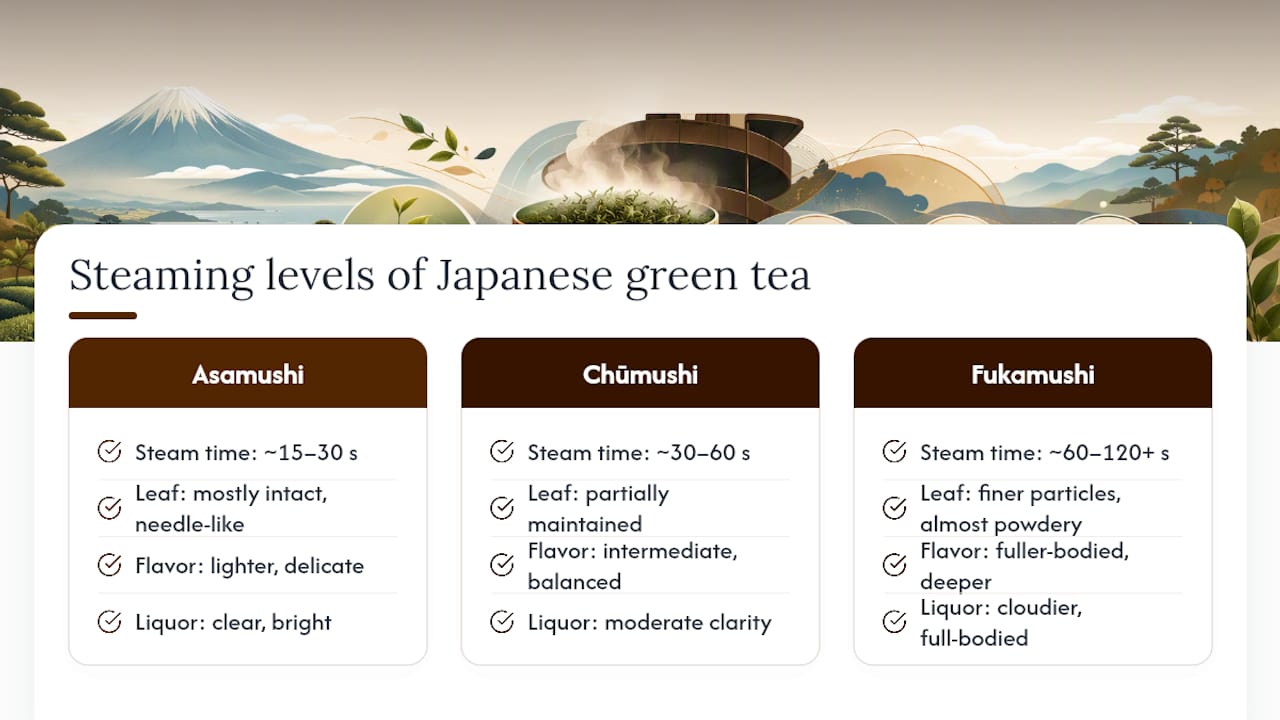
Fukamushi (deep steam, 60–120+ seconds): Extended steaming breaks more cell walls, producing finer leaf particles and a cloudier, fuller-bodied brew. Suntory’s processing documentation notes that after steaming, leaves must be cooled promptly to prevent a “steamed” or cooked off-flavor from developing. Skip that cooling step and even a perfectly timed steam can leave the tea tasting flat.
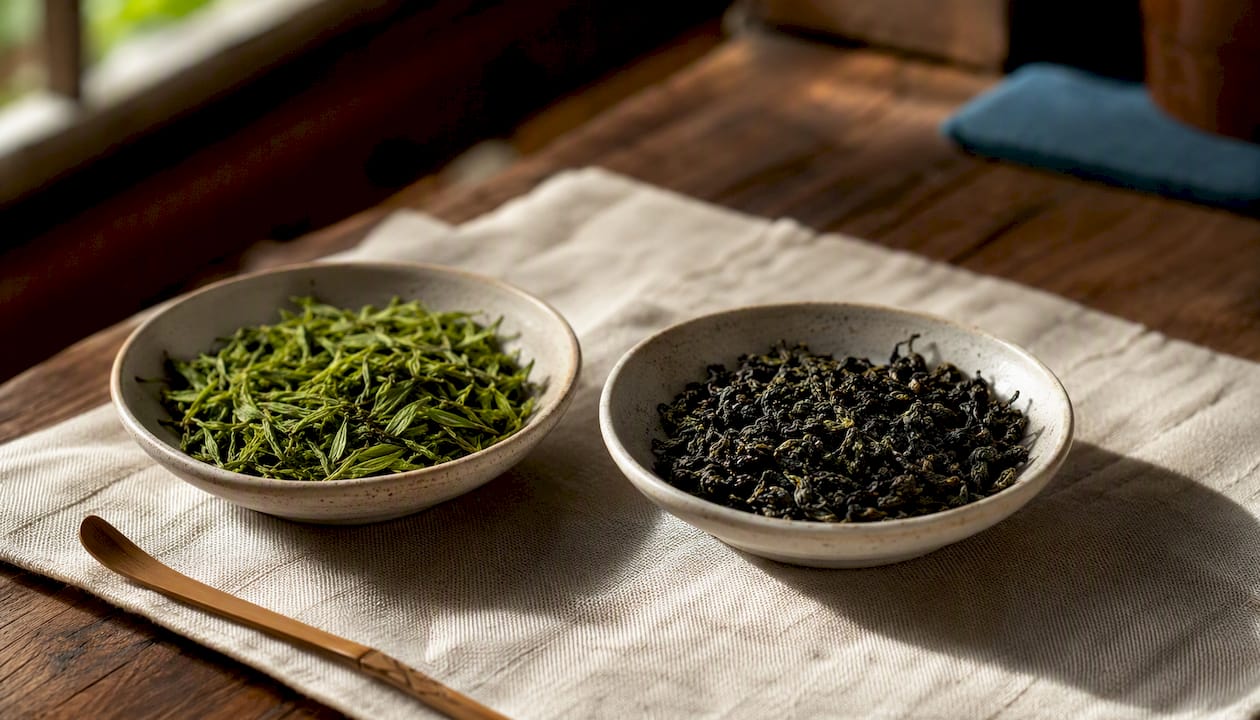
Pro Tip: You can often identify a tea’s steaming level before you brew it. Fukamushi sencha looks almost powdery, with lots of fine broken leaf; asamushi leaves are longer, intact, and needle-like. The cloudier your brew, the deeper the steam.
How steaming reshapes leaf chemistry and flavor
The science here is more specific than most tea guides let on. A metabolomic study published in Foods (MDPI) identified 735 non-volatile compounds in green tea leaves and found that steaming triggered the most significant alterations of any processing step, with 256 compounds changing significantly across the full production sequence. Shaping and drying moved the needle far less.
What that means for flavor: steaming is not just a preservation step. It actively reshapes the leaf’s chemical makeup before a single other process touches it.
Here is how the key compound groups shift:
- Free amino acids (including theanine) increase during steaming, which directly drives the umami and sweetness you taste in a well-made sencha or gyokuro.
- Chlorophyll is fixed by the rapid moist heat, explaining the bright green color in both the dry leaf and the brewed liquor.
- Some lipids decrease, which reduces grassy or raw-leaf odors and smooths the aroma profile.
- Phenolic acids and nucleotides shift, contributing to the overall flavor complexity that distinguishes steamed teas from their pan-fired counterparts.
The conceptual flow looks like this: steaming (enzyme deactivation) → amino acids preserved and increased → umami/sweetness in the cup. Steaming (chlorophyll fixation) → bright green pigment retained → vivid jade liquor. Steaming (cell-wall rupture) → higher extractability → fuller, sometimes cloudier brew.
Steamed vs pan-fired: what actually changes in your cup
The defining difference between Japanese and most Chinese green teas comes down to one choice: moist heat versus dry heat. Kotoba Interactive’s tea explainer frames it plainly: steam preserves chlorophyll and amino acids, creating vegetal and marine notes, while pan-firing in a wok develops roasted, nutty flavors through dry heat.
| Attribute | Steamed (Japanese style) | Pan-fired (Chinese style) |
|---|---|---|
| Flavor profile | Vegetal, grassy, marine, umami | Nutty, toasty, roasted, sometimes floral |
| Non-volatile compounds | Amino acids and chlorophyll preserved | Maillard-like roast compounds develop; catechin profile shifts |
| Aroma volatiles | Fresh green, seaweed-like | Roasted, chestnut-like |
| Processing intensity | 30–120+ seconds of steam at ~100°C | Brief, intense wok heat (seconds to minutes) |
| Liquor color | Bright jade to deep green | Yellow-green to golden |
| Leaf texture | Pliable, softened; finer in fukamushi | Drier, more intact, sometimes twisted or flat |
A practical identification test: pour a small amount of each tea and hold the cup up to light. Steamed Japanese teas glow green. Pan-fired teas lean golden or yellow. Smell the dry leaf before brewing: steamed teas smell fresh and grassy; pan-fired teas carry a faint roasted warmth even dry.
The main steamed Japanese teas and what steaming does to each
Understanding the steaming grades becomes much more useful when you connect them to specific teas you can actually buy and taste.
-
Sencha: Japan’s most common green tea, typically processed at chūmushi or asamushi levels. The result is a clean, bright vegetal flavor with moderate umami. Sencha is steamed immediately after picking at around 100°C for 15–120 seconds depending on the producer’s target style, then rolled and dried. Most of what you encounter in loose-leaf form is sencha.
-
Gyokuro: Shade-grown for roughly three weeks before harvest, which causes the plant to accumulate significantly more theanine. When steamed, that elevated amino acid content is locked in, producing an intensely savory, almost sweet cup with very low astringency. Brew it cool (around 50–60°C) and the umami is almost broth-like.
-
Tencha and matcha: Tencha is the steamed, de-stemmed, and de-veined leaf that gets stone-ground into matcha powder. The steaming step is the same as sencha, but the leaf is not rolled. Instead, it is dried flat, then ground. Because you consume the whole leaf as powder, every compound steaming preserved goes directly into your cup.
-
Fukamushi sencha: Deep-steamed sencha produces a cloudier, more full-bodied liquor with a shorter ideal steep time. The extended steam breaks more cell walls, releasing more fine particles into the brew. It is forgiving to brew but sensitive to over-steeping.
-
Kamairicha: The Japanese exception. This tea is pan-fired in a wok rather than steamed, producing a flavor profile closer to Chinese green teas: lighter, slightly toasty, with less of the marine umami character. If you want to understand what steaming actually contributes, brewing kamairicha alongside a sencha is the clearest side-by-side comparison you can do at home.
How to brew steamed Japanese green teas well
Temperature and time matter more with steamed teas than with almost any other category, because the preserved amino acids that create umami extract at lower temperatures while the catechins that create bitterness extract faster at higher ones. Get the balance right and you get sweetness and depth; push it too hot or too long and astringency takes over.
A few adjustments worth knowing: fukamushi leaves release fine particles that can clog a standard infuser basket. A fine-mesh strainer or a dedicated kyusu teapot with a built-in filter works far better. For gyokuro, the low temperature is not optional if you want the umami to come forward. Brewing it at 80°C produces a noticeably more bitter, less interesting cup.
Pro Tip: Try the same sencha brewed at 70°C and again at 85°C, side by side. The cooler cup will taste rounder and sweeter; the hotter one will be sharper and more astringent. That single experiment teaches you more about steaming’s chemical effects than any description can.
Multiple steeps work well with asamushi and chūmushi sencha. The first steep at lower temperature captures umami; a second steep at slightly higher temperature pulls more catechins and brightness. Fukamushi tends to give its best in one or two steeps before the fine particles make the brew muddy.
For water quality, soft or filtered water lets the tea’s natural flavors come through cleanly. Hard tap water can dull the green character and make the liquor look less vivid. If you want to go deeper on avoiding bitterness in any hot brew, the same principles that apply to bitter coffee extraction apply here: temperature, contact time, and grind (or leaf size) all interact.
What I listen for when tasting steamed teas
When I walk a customer through a steamed tea comparison, the first thing I ask them to do is smell the dry leaf before any water touches it. A good fukamushi sencha smells like fresh cut grass with a faint ocean note. An asamushi smells crisper, almost like cucumber or green herbs. That difference in aroma tells you how much the steaming has opened the leaf up.
In the cup, I look for three things: liquor color (the deeper the jade, the more chlorophyll was preserved), mid-palate umami (a savory coating that lingers rather than fading immediately), and the aftertaste (steamed teas should finish clean or slightly sweet, not with a roasted or dry note). If you get a roasted finish, you are likely drinking a pan-fired tea or a hojicha, which is roasted intentionally.
The most useful tasting exercise I know is brewing a light-steamed sencha and a deep-steamed fukamushi sencha side by side at the same temperature. The asamushi will be cleaner and more delicate; the fukamushi will be fuller, cloudier, and more immediately savory. That contrast makes the steaming variable tangible in a way that reading about it never quite does. Dkbeanleaf carries a selection of loose-leaf teas that includes options across the steaming spectrum, so you can run that comparison without hunting across multiple vendors.
If you are newer to Japanese teas and want guidance on choosing before you buy, the post on how to buy tea online without guesswork covers what to look for in sourcing and labeling.