

90–200 mg vs 25–48 mg: Coffee vs Tea Caffeine Explained
Coffee generally delivers more caffeine per serving than tea, but the gap is wider than most people assume. An 8-ounce brewed coffee runs roughly 90 to 200 milligrams, a single shot of espresso packs about 63 milligrams into a couple of ounces, and an 8-ounce black tea contains close to 25 to 48 milligrams. Green tea is similar to black tea, while matcha, which uses the whole powdered leaf, can have a higher caffeine content per serving. Actual numbers swing with bean type, leaf grade, and how long you brew.
TL;DR:
- The caffeine range in brewed coffee can be nearly four times higher than in black tea, depending on brewing method and type.
- Extraction efficiency, brew time, and water temperature largely determine how much caffeine ends up in your cup, not bean or leaf type alone.
- Tea’s calming effects are partly due to L-theanine, which moderates caffeine’s stimulant impact, especially in green tea and matcha.
- Adjusting brewing time, serving size, or dilution can significantly change caffeine intake regardless of the initial bean or leaf.
- Most healthy adults can safely consume up to 400 milligrams daily, but sensitivity and health conditions require individualized limits.
Table of Contents
- Coffee vs Tea Caffeine by the Numbers
- Why Coffee Usually Contains More Caffeine
- Why Tea Can Feel Gentler Despite the Caffeine
- How to Adjust Caffeine in Your Cup
- Daily Limits, Sensitivity, and Who Should Cut Back
- Which Should You Choose: Coffee or Tea?
- What Dkbeanleaf Wants You to Know About Caffeine
- Sources
Coffee vs Tea Caffeine by the Numbers
Caffeine content isn’t a fixed number stamped on a bean or leaf. It’s a range shaped by variety, processing, and how much hot water gets involved. Here’s how the most common drinks stack up per typical serving.
These ranges come from Healthline’s breakdown of caffeine in tea versus coffee and the Mayo Clinic’s caffeine content charts, which both note that brewed black tea averages closer to 48 milligrams per 8 ounces while coffee frequently clears 96 milligrams in the same volume.
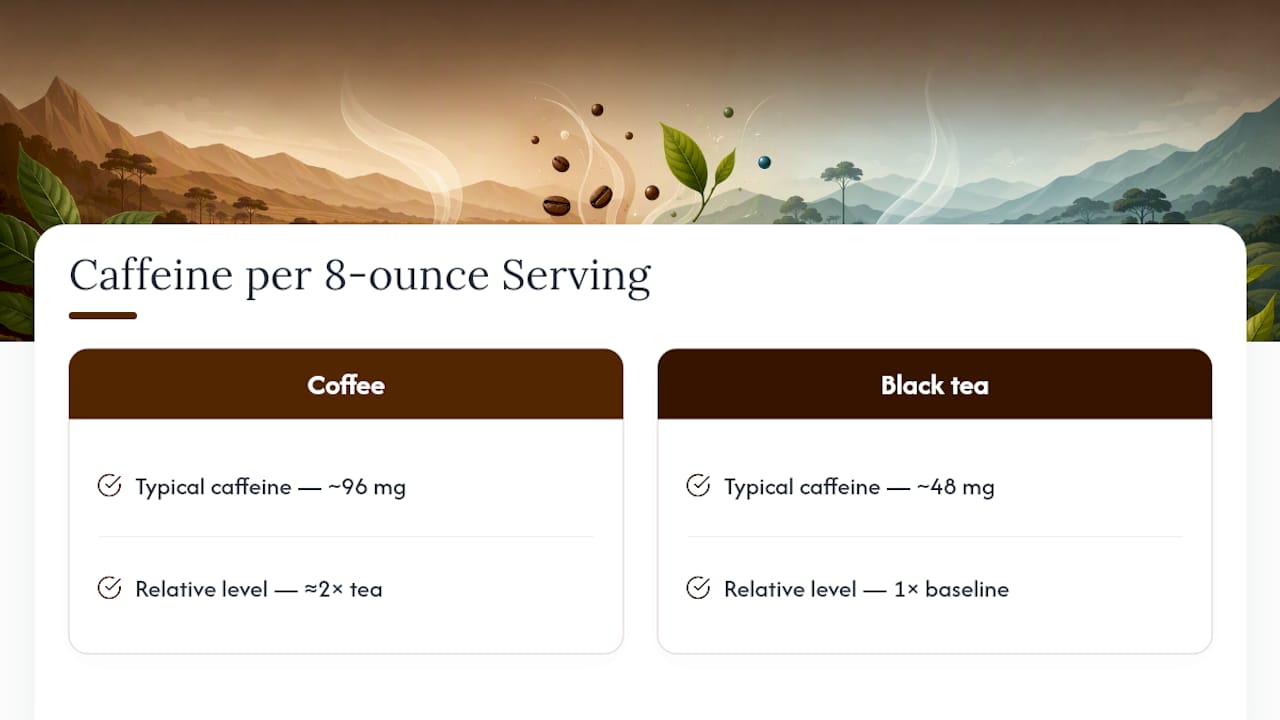
Why such wide bands? Arabica and robusta beans carry different caffeine loads, tea leaf grade and oxidation level change extraction, and serving sizes vary wildly between a diner mug and a 16-ounce travel cup. Even the same bag of coffee brewed two different ways can swing by 50 milligrams or more. The Mayo Clinic notes that up to 400 milligrams per day is considered safe for most healthy adults, a useful guideline when considering caffeine intake.
Why Coffee Usually Contains More Caffeine
Coffee wins the caffeine race mostly because of how it’s made, not because coffee beans are inherently loaded with more of the compound than tea leaves. Ounce for ounce dry weight, tea leaves and coffee beans aren’t as far apart as the finished drinks suggest. What separates them is extraction.
- A typical coffee uses a much higher grounds-to-water ratio than a cup of steeped tea, pulling more caffeine into the cup.
- Hotter water and longer contact time during brewing extract caffeine more efficiently, and drip coffee usually spends more time in contact with hot water than a quick tea steep.
- Roast level gets blamed for caffeine differences, but the effect is small and often backwards from what people expect: dark roasts lose slightly more mass during roasting, so a scoop of dark roast can actually contain marginally more caffeine by weight than the same scoop of light roast, even though dark roast tastes bolder.
- Brew method changes everything. Espresso is concentrated but small in volume, drip coffee spreads a moderate dose across a full mug, and cold brew’s long steep time (12 to 24 hours) often produces the highest total caffeine of any home method.
If you’ve ever assumed a “strong” dark roast has more kick than a light roast, that’s a volume-versus-weight mix-up, not a caffeine fact. Dkbeanleaf’s guide to roast levels breaks down where that confusion comes from.
Why Tea Can Feel Gentler Despite the Caffeine
Tea’s caffeine numbers are lower, but that’s only part of why a cup of green tea feels calmer than a cup of coffee. The rest comes down to chemistry working alongside the caffeine, not against it.
- Tea leaves naturally contain L-theanine, an amino acid that, paired with caffeine, appears to promote a calmer, more focused kind of alertness instead of the jittery spike some people get from coffee.
- Tea’s polyphenols may slow how quickly caffeine hits your system, smoothing out the curve compared to coffee’s faster absorption.
- Matcha breaks this pattern. Because you’re consuming the whole powdered leaf rather than steeped and discarded leaves, matcha delivers noticeably more caffeine than steeped green tea, sometimes rivaling a weak cup of coffee.
Pro Tip: If you want tea’s calmer focus but need more of a lift, matcha splits the difference. You get L-theanine’s steadying effect with a caffeine dose closer to coffee’s range.
How to Adjust Caffeine in Your Cup
You have more control over caffeine than the numbers on a package suggest. Brewing choices move the needle as much as which bean or leaf you start with.
- Shorten your steep or brew time. A 2 to 3 minute tea steep pulls less caffeine than a full 5 minutes, and a faster pour-over extracts less than a slow drip cycle.
- Use less product per cup. Fewer coffee grounds or fewer grams of loose tea leaves means less caffeine, independent of brew time.
- Watch cold brew concentration. Cold brew’s long steep, often 12 to 24 hours, extracts more total caffeine than hot brewing even at cooler temperatures, so diluting your concentrate matters more than people assume.
- Set realistic decaf expectations. Decaf coffee typically still carries 2 to 15 milligrams per cup, and decaf tea holds a similar trace amount. Neither is truly zero.
- Re-steep tea leaves. A second steep of the same green tea leaves pulls noticeably less caffeine than the first pass, useful if you want the flavor without the full dose.
Dkbeanleaf’s tea caffeine chart by type breaks these variables down leaf by leaf if you’re trying to dial in a specific number.
Daily Limits, Sensitivity, and Who Should Cut Back
Most healthy adults can handle up to about 400 milligrams of caffeine a day, roughly the equivalent of two to four cups of brewed coffee, according to Mayo Clinic guidance. That’s a ceiling, not a target, and plenty of people feel effects well below it.
- Pregnant individuals are commonly advised to keep intake lower, generally under 200 milligrams a day; check with a clinician for your specific situation.
- Sensitivity varies by genetics, body weight, and how regularly you consume caffeine, so two people drinking the same cup can feel completely different effects.
- Common side effects at higher intakes include disrupted sleep, elevated heart rate, jitteriness, and anxiety, tied to caffeine’s known stimulant effects on the nervous system.
- Anyone on stimulant medication, with a heart condition, or prone to anxiety should talk to a doctor before making caffeine a daily habit.
A ceiling worth remembering: Mayo Clinic puts the safe daily limit for most healthy adults at roughly 400 milligrams, about four cups of coffee or closer to eight cups of black tea.
If coffee’s jitters are already a familiar problem for you, Dkbeanleaf’s guide on what causes caffeine jitters walks through practical fixes beyond simply cutting back.
Which Should You Choose: Coffee or Tea?
Match the drink to what you actually need, not just habit. Your goal for the next few hours matters more than brand loyalty.
- Need a fast, strong wake-up? Brewed coffee or espresso gets you there quickest, though added milk and sugar add calories worth watching.
- Want steady focus without the edge? Green tea or matcha delivers a calmer lift thanks to L-theanine, with matcha running closer to coffee’s caffeine range.
- Trying to cut back significantly? Herbal tea (naturally caffeine-free) or decaf coffee lets you keep the ritual without the dose.
- Sensitive stomach in the morning? Tea tends to be gentler on digestion than coffee’s acidity for some people, though this varies individually.
Pairing whichever you choose with steady food intake helps avoid the crash some people blame on caffeine alone. Sustained-energy food pairing and natural strategies for the afternoon slump both make the case that what you eat around your cup matters as much as what’s in it.
What Dkbeanleaf Wants You to Know About Caffeine
Roast level and boldness get confused with caffeine constantly, and it’s one of the most persistent myths in coffee. Dkbeanleaf sources single-origin and blended beans specifically so customers can separate flavor strength from actual caffeine content, and the same logic applies to loose leaf teas. If you want to compare coffee and tea caffeine hands-on rather than by chart, a sample pack makes that experiment simple.
— Kristopher
The biggest mistake in the coffee versus tea caffeine debate isn’t misreading the numbers. It’s assuming caffeine content alone predicts how a drink will make you feel. L-theanine changes tea’s effect enough that milligram-for-milligram comparisons miss half the picture. Anyone choosing based purely on the highest number on a chart is optimizing for the wrong variable. What actually matters is how a given drink, at a given time, changes your focus and mood, and that only comes from paying attention to your own reactions rather than someone else’s table of averages.
— Kristopher
Sources
- Caffeine content for coffee, tea, soda and more - Mayo Clinic
- Which is healthier: Coffee or tea? - Harvard Health