

Light vs Dark Roast: Which to Drink and When
Light roast preserves the origin character of the bean — think citrus, berry, or floral notes — while dark roast replaces those flavors with roast-driven ones like dark chocolate, caramel, and smoke. If you want to taste where your coffee came from, go light. If you want a bold, consistent cup that holds up in milk, go dark.
- Choose light roast if you brew pour-over or filter coffee, prefer bright acidity, or want to taste the bean’s natural origin flavors.
- Choose dark roast if you pull espresso, drink lattes or cappuccinos, or want a smooth, low-acid cup with a heavier body.
Key Takeaways
Light roast preserves origin-driven flavor and more antioxidants; dark roast delivers roast-driven boldness, lower acidity, and better performance in milk-based drinks.
| Point | Details |
|---|---|
| Flavor source differs | Light roast tastes like the bean’s origin; dark roast tastes like the roast process itself. |
| Caffeine gap is negligible | Roast barely changes caffeine; perceived strength is a flavor effect, not a chemical one. |
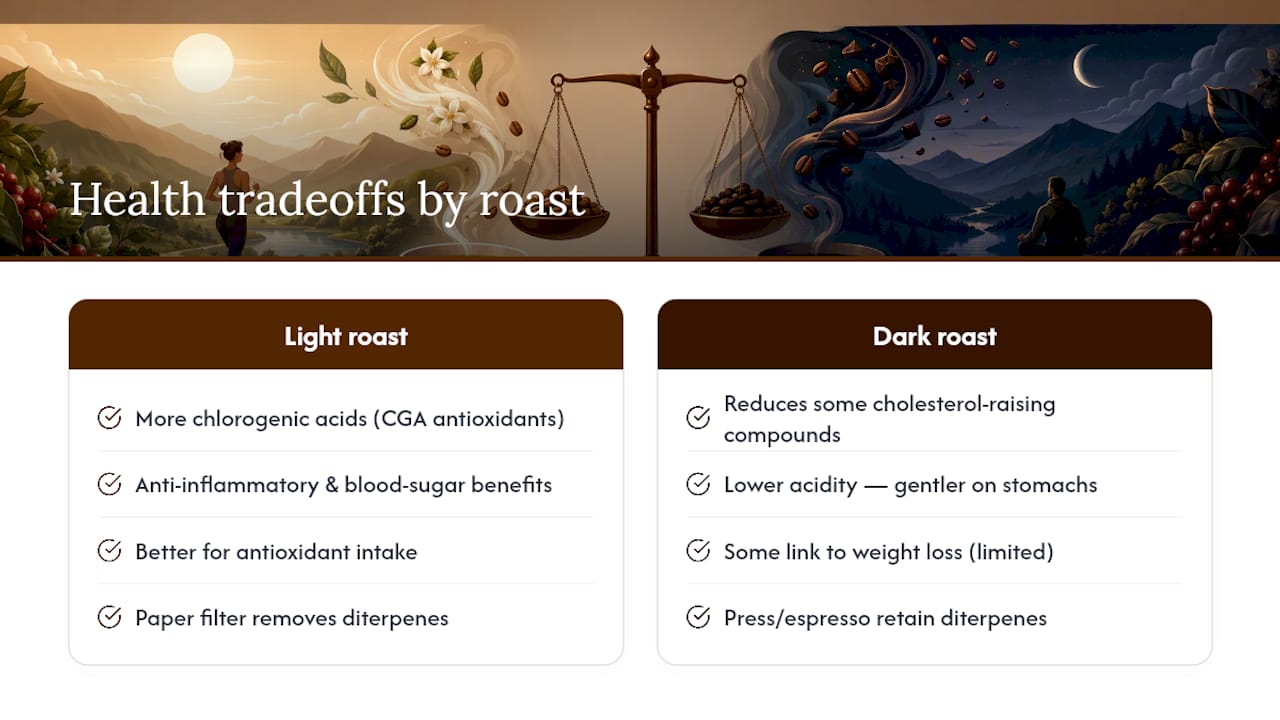
| Health tradeoffs are real | Light roast retains more chlorogenic acids; dark roast reduces some cholesterol-raising compounds. |
| Match roast to your brew | Pour-over suits light roast; espresso and milk drinks suit dark roast for consistent results. |
| Dkbeanleaf sample packs | Try light and dark roasts side by side without committing to a full bag. |
Table of Contents
- What is a light roast and why does it taste that way?
- What is a dark roast and what does roasting longer actually do?
- How do light and dark roast actually taste side by side?
- What roasting actually does to the bean at a chemical level
- Does light or dark roast have more caffeine?
- What does the research say about health effects?
- Which roast works best for each brewing method?
- How to choose between light and dark roast for your routine
- How to taste roast level in your cup
- Storage and freshness by roast level
- Why both roasts deserve a place in your rotation
- Try light and dark roast side by side with Dkbeanleaf
- Sources
What is a light roast and why does it taste that way?
A light roast is pulled from the drum around or just after first crack, the audible pop that signals the bean’s internal moisture has converted to steam and the cellular structure is beginning to expand. Roasters typically work in a temperature range appropriate for light roasts, stopping near the first crack. The beans come out light brown with a dry, matte surface — no surface oils, because the bean’s pores haven’t opened enough to let them migrate out.
That short roast time is the whole point. The less time a bean spends in heat, the more of its origin-derived compounds survive intact. Fruity esters, malic and citric acids, and delicate aromatic compounds that developed in the growing environment stay in the cup rather than being cooked away. As Roastopedia explains, light roasts dropped near first crack preserve those origin flavors and brightness that distinguish a Kenyan bean from an Ethiopian one.
Pro Tip: Light roasts are denser than dark roasts, so they need a slightly finer grind and hotter water (around 200°F–205°F) to extract fully. Under-extraction is the most common mistake with light roasts — it produces a sour, thin cup.
What is a dark roast and what does roasting longer actually do?
Dark roast beans are carried through second crack, a second audible pop that signals deeper cellular breakdown and the release of CO₂ and aromatic oils. Roasters use higher temperatures for dark roasts, often extending past the second crack. The result is a dark brown to near-black bean with a shiny, oily surface — those oils are lipids forced to the surface by the bean’s expanding, porous structure.
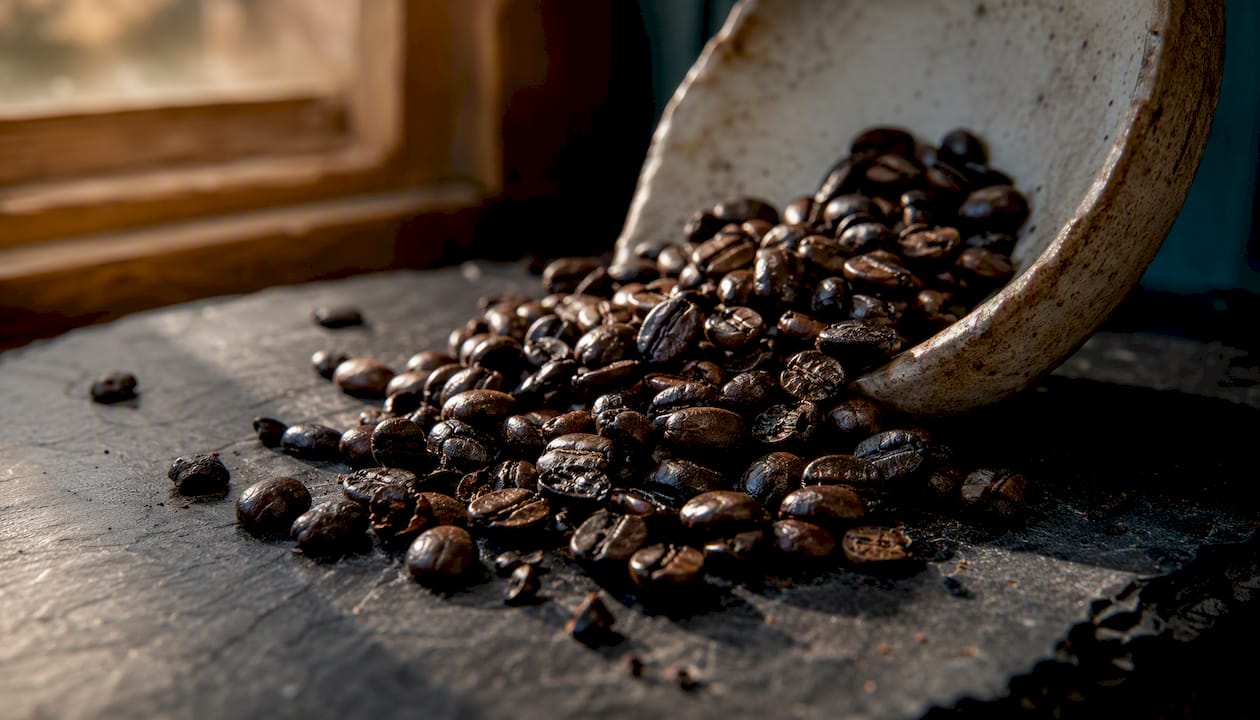
The extended roast time fundamentally changes what you taste. Origin-derived acids and fruity compounds break down, and new roast-derived flavors form through caramelization and Maillard reactions. Chocolate, molasses, smoke, and toasted nuts are the flavors you get from the roast process itself, not from the bean’s origin. A dark-roasted Brazilian bean and a dark-roasted Colombian bean will taste far more similar to each other than their light-roasted counterparts would. The Food & Wine roaster guidance puts it plainly: dark roasts deliver chocolatey, caramelized notes and perform better in milk-based drinks.
Pro Tip: Dark roasts extract faster because the bean is more porous and soluble. Grind slightly coarser and drop your water temperature to around 195°F–200°F to avoid a bitter, over-extracted cup.
How do light and dark roast actually taste side by side?
The sensory gap between the two is wider than most people expect before they taste them back to back.
| Dimension | Light Roast | Dark Roast |
|---|---|---|
| Flavor profile | Origin-driven: fruity, floral, tea-like | Roast-driven: chocolate, caramel, smoke |
| Acidity / brightness | High, crisp, sometimes wine-like | Low, muted, rounded |
| Body / mouthfeel | Light to medium, clean | Full, heavy, sometimes syrupy |
| Common tasting notes | Citrus, berry, jasmine, stone fruit | Dark chocolate, molasses, tobacco, toast |
| Aftertaste | Clean, quick | Lingering, roasty |
Imagine sipping a light-roasted Ethiopian Yirgacheffe: you get a bright lemon-citrus hit, a floral aroma, and a clean finish. Now picture a dark-roasted Sumatra: heavy body, earthy chocolate, a long smoky aftertaste. Same category of beverage, completely different sensory experience.
- Light roast acidity is often described as bright or lively, similar to biting into a fresh raspberry.
- Dark roast body tends to coat the palate more, which is why it pairs so naturally with steamed milk.
- Medium roast sits between the two, balancing some origin clarity with mild roast character — a useful middle ground if you find light roast too sharp or dark roast too heavy. Many of the best medium roast beans hit that balance well.
What roasting actually does to the bean at a chemical level
The flavor shift from light to dark isn’t random — it follows predictable chemistry. Two processes drive most of it.
Maillard reactions begin early in the roast, combining amino acids and reducing sugars to create hundreds of new aroma and flavor compounds, including the melanoidins responsible for coffee’s brown color and some of its roasty, bittersweet notes. Caramelization follows, breaking down sucrose into caramel-like compounds. Push the roast further and pyrolysis takes over, degrading organic compounds at high heat and producing the smoky, ashy notes associated with very dark roasts. An ACS Journal abstract documents these Maillard products and melanoidins and confirms that phenolic compound levels shift substantially as roast progresses.
Chlorogenic acids (CGAs), the primary antioxidant compounds in green coffee, decline steadily as roast darkens. Light roasts retain significantly more of them. Meanwhile, darker roasts produce more melanoidins, which have their own antioxidant properties but a different profile. The bean also loses mass during roasting as moisture and CO₂ escape, while its volume increases. That’s why dark roast beans are physically larger, lighter in weight, and more porous — which directly affects how fast they extract in hot water.
Does light or dark roast have more caffeine?
Neither, in any meaningful way. Caffeine remains largely stable during roasting with minimal loss. The Specialty Coffee Association is clear on this: “strength” in professional coffee language refers to extraction concentration, not roast level. Roast primarily changes flavor, not caffeine content.
The confusion comes from how people measure their dose.
- By weight: Light roast beans are denser and may contain slightly more caffeine per gram than dark roast. The difference is small enough to be practically irrelevant.
- By volume: Dark roast beans are larger and lighter, so a scoop generally holds fewer grams than a scoop of light roast. This means you’re actually dosing less coffee by weight, which can produce a slightly lower-caffeine cup.
- Perceived strength: Dark roast tastes stronger because roast-derived bitter compounds read as intensity. That’s a flavor perception, not a caffeine measurement.
Pro Tip: Weigh your coffee in grams rather than scooping by volume. A kitchen scale removes the density variable entirely and gives you consistent results regardless of roast level. This is standard practice in specialty coffee.
What does the research say about health effects?
The honest answer is: there are real tradeoffs, and the research is nuanced enough that neither roast wins outright.
Light roast retains substantially more chlorogenic acids, the antioxidant phytonutrients that have been linked to anti-inflammatory effects and blood sugar regulation in peer-reviewed research. PubMed-indexed studies on coffee bioactive compounds confirm that CGA levels drop significantly as roast darkens. If antioxidant intake is your priority, light roast has the edge.
Dark roast, however, has its own case. Nutritionfacts showing that prolonged roasting partly destroys some cholesterol-raising compounds found in coffee, and that dark roast may be gentler on the stomach for some people because the extended roast reduces certain acids that trigger irritation. One analysis cited there also found dark roast associated with better outcomes for weight reduction, though the evidence base for that specific finding is limited.
The stomach sensitivity question is worth separating from the antioxidant question. Lower-acid dark roasts are often better tolerated by people with acid reflux or sensitive stomachs. If you want to explore which roast is smoothest for stomach comfort, dark or medium-dark is usually the safer starting point.
Pro Tip: Brewing method matters as much as roast for health-relevant compounds. Using a paper filter (drip, pour-over) removes most of the cafestol and kahweol — the diterpenes that raise LDL cholesterol — regardless of roast level. French press and espresso leave those compounds in the cup.
Which roast works best for each brewing method?
Roast level and brewing method interact directly. Matching them well produces a noticeably better cup.
| Brewing Method | Best Roast | Why |
|---|---|---|
| Pour-over / filter drip | Light to medium | Highlights origin flavors; controlled extraction shows nuance |
| French press | Medium to dark | Heavy body suits immersion brewing; oils add richness |
| Espresso (straight) | Medium to dark | Stable crema; roast-driven sweetness balances pressure extraction |
| Milk-based drinks (latte, cappuccino) | Dark | Bold flavor cuts through steamed milk without disappearing |
| Cold brew | Medium to dark | Long steep rewards soluble, lower-acid beans |
| Moka pot | Medium to dark | High-pressure extraction amplifies bitterness in light roasts |
Light roasts shine brightest in pour-over and filter methods, where precise water temperature and controlled flow rate let the origin character develop without over-extraction. Dark roasts are built for espresso and milk drinks — the roast-derived sweetness and heavier body hold up against the intensity of pressure extraction and the richness of steamed milk. For a flat white specifically, a medium-dark or dark roast gives you the contrast you need between coffee and milk.
How to choose between light and dark roast for your routine
Start with what you actually want to taste, then work backward to your brewing setup.
- Ask what flavor you’re after. Do you want to taste the coffee’s origin — the region, the processing method, the varietal? Go light. Do you want a consistent, bold cup that tastes like coffee rather than a specific place? Go dark.
- Check your brewing method. Pour-over and filter? Light roast is your default. Espresso machine, French press, or moka pot? Medium-dark or dark will serve you better.
- Consider milk. If your daily cup is a latte, cappuccino, or oat milk drink, dark roast is the practical choice. Light roast can disappear under milk.
- Factor in stomach sensitivity. If you notice acid reflux or stomach discomfort after coffee, start with a medium-dark or dark roast and a paper filter. The combination reduces both acidity and cholesterol-raising compounds.
- Think about convenience. Dark roasts are more forgiving of minor grind and temperature inconsistencies. Light roasts reward precision. If you’re still dialing in your setup, medium or dark is more consistent day to day.
- Try a sample pack before committing. Buying a full bag of something you’ve never tasted is a gamble. A small sample of a light and a dark roast brewed the same way back to back tells you more than any description can. Check out the how to choose the best coffee roast level guide for a deeper decision framework.
How to taste roast level in your cup
You don’t need specialized training to identify roast impact. A few deliberate checks at each stage of the cup tell you most of what you need to know.
Before you brew: Look at the bean. Light roast beans are light brown, dry, and smaller. Dark roast beans are dark brown to nearly black, shiny with surface oil, and slightly larger. A dry bean that’s medium brown is likely a medium roast.
Aroma: Smell the grounds before water hits them. Fruity, floral, or tea-like aromas point to light roast. Toast, chocolate, or smoke signal dark roast. The aroma is often the clearest roast indicator you have.
First sip: Notice where the sensation hits. Bright acidity that registers on the sides of your tongue is a light roast signal. A heavy, coating sensation with bitterness at the back of the palate is dark roast territory.
Tasting checklist to run at home:
- Note acidity: sharp and lively, or muted and round?
- Note body: does it feel light and clean, or heavy and coating?
- Note sweetness: fruity and natural, or caramel and roasty?
- Note the finish: does it fade quickly (light roast) or linger (dark roast)?
Keep the language descriptive rather than evaluative. “Bright” and “roasty” are observations. “Good” and “bad” are just preferences. The goal is to build a vocabulary for what you’re tasting so you can repeat or adjust it next time.
Pro Tip: Taste your coffee at three temperatures: just brewed, halfway cooled, and nearly room temperature. Light roasts often reveal more complexity as they cool. Dark roasts can turn harsh. That temperature arc tells you a lot about roast quality.
Storage and freshness by roast level
Roast level changes how fast coffee goes stale, and the difference is meaningful enough to affect your buying habits.
- Light roast stays fresh longer in terms of flavor complexity, but it’s also less forgiving when it does start to fade. The delicate origin flavors that make light roast worth drinking are the first to go. Buy smaller quantities and use within 2–3 weeks of the roast date for best results.
- Dark roast has more surface oil, which oxidizes faster on contact with air. A dark roast that’s been sitting open for three weeks will taste flat and stale. However, the bold roast-driven flavors are more resilient to minor staleness than the subtle origin notes in a light roast.
- Both roasts benefit from the same storage basics: airtight container, away from light and heat, at room temperature (not the freezer, unless you’re storing a large quantity you won’t open for weeks).
Pro Tip: Buy whole beans and grind just before brewing. Ground coffee exposes far more surface area to oxygen and goes stale in days rather than weeks. The whole bean vs ground coffee difference in cup quality is one of the most noticeable upgrades you can make.
- For light roast: prioritize freshness above all else. A fresh light roast beats a stale one by a wider margin than with dark roast.
- For dark roast: check the roast date, not just the “best by” date. Roast date transparency is a sign of a quality roaster.
Why both roasts deserve a place in your rotation
The coffee world has a tendency to treat roast preference as a personality test, with light roast fans and dark roast fans talking past each other. That framing misses the point.
Specialty roasters don’t rank roasts by quality. They use roast level as a tool: light roast to showcase a single-origin bean’s complexity, dark roast to build a consistent, bold house blend that works across brewing methods and palates. The SCA’s perspective frames it exactly this way — roast is a design decision, not a hierarchy.
What I find underappreciated is how much the brewing method mediates the roast experience. A light roast pulled through a French press loses most of its brightness and reads more like a medium. A dark roast through a precise pour-over can taste surprisingly nuanced. The roast sets the range; the brew method determines where in that range you land.
The practical takeaway: don’t commit to one roast permanently before you’ve tried both with your actual brewing setup. The cup you make at home with your water, your grinder, and your method is the only one that matters for your decision.
Try light and dark roast side by side with Dkbeanleaf
The fastest way to settle your roast preference is to brew both back to back with the same method, the same water, and the same dose. Dkbeanleaf’s sample packs are built for exactly that: fresh-roasted coffee in smaller quantities so you can compare light and dark profiles without committing to a full bag of something you haven’t tasted yet.
Dkbeanleaf roasts in small batches — blends and single-origin options across the roast spectrum, plus flavored coffees and loose leaf teas if you want to branch out. The sample pack format removes the guesswork from roast selection and gives you a controlled way to find what actually works in your cup and your routine. Browse the current roast selection and start with a sample to find your roast.
Sources
The claims in this guide draw on the following authoritative sources. For personal health concerns related to coffee consumption, consult a qualified healthcare provider.
- Nutritionfacts
- SCAA
- Light Roast vs Dark Roast: A Complete Comparison | Roastopedia
- What Is the Difference Between Light Roast and Dark Roast Coffee? | Food & Wine
- Pubs