

Coffeehouse Culture History: Origins to Modern Day
Coffeehouse culture is defined as the social practice of gathering in public spaces to drink coffee, exchange ideas, and build community. Understanding what is coffeehouse culture history means tracing a tradition that began in 15th-century Yemen and spread across the Ottoman Empire, Europe, and eventually the world. These spaces were never just about the drink. They shaped political movements, launched financial institutions, and gave artists and writers a room of their own. The history of coffeehouses is, in many ways, the history of public intellectual life itself.
How and where did coffeehouse culture originate?
Coffeehouses originated in 15th-century Yemen and spread rapidly to major Middle Eastern cities by the early 16th century. Mecca, Cairo, and Damascus each had thriving coffeehouse scenes by the 1500s. That speed of adoption tells you something important: these spaces filled a social need that nothing else was meeting.
Ottoman urban centers called their coffeehouses “schools of the wise.” The name was not flattery. These were places where merchants, scholars, poets, and ordinary citizens sat together and talked. The coffeehouse was the first truly public forum in many of these cities, open to anyone who could pay for a cup.
- Coffee’s legendary origin traces to Ethiopia, where goat herder Kaldi reportedly noticed his animals became energetic after eating certain berries.
- Yemeni Sufi monks adopted coffee as a drink to stay alert during nighttime prayers, spreading its use through religious networks.
- By the early 1500s, coffeehouses in Mecca served as gathering points for pilgrims from across the Islamic world.
- The social mixing inside coffeehouses was genuinely radical for the era. Rank and class mattered less once you sat down.
Authorities in some cities banned coffeehouses in the 16th century, citing fears of political dissent and social upheaval. Mecca saw one of the earliest bans. That reaction is telling. When a government bans a place, it confirms that place has real power. Coffeehouses reflected the state of political authority and were consistently linked to ideas that challenged it.
Pro Tip: If you want to understand why coffeehouses felt threatening to rulers, think of them as the social media of their era: open, fast-moving, and impossible to fully control.
What defined the rise of coffeehouse culture in Europe?
The first European coffeehouse opened in Venice in 1629. England followed in the 1650s, with Oxford’s Queen’s Lane Coffee House opening around 1654 and London’s first coffeehouse appearing in 1652. Within decades, London alone had hundreds of them.
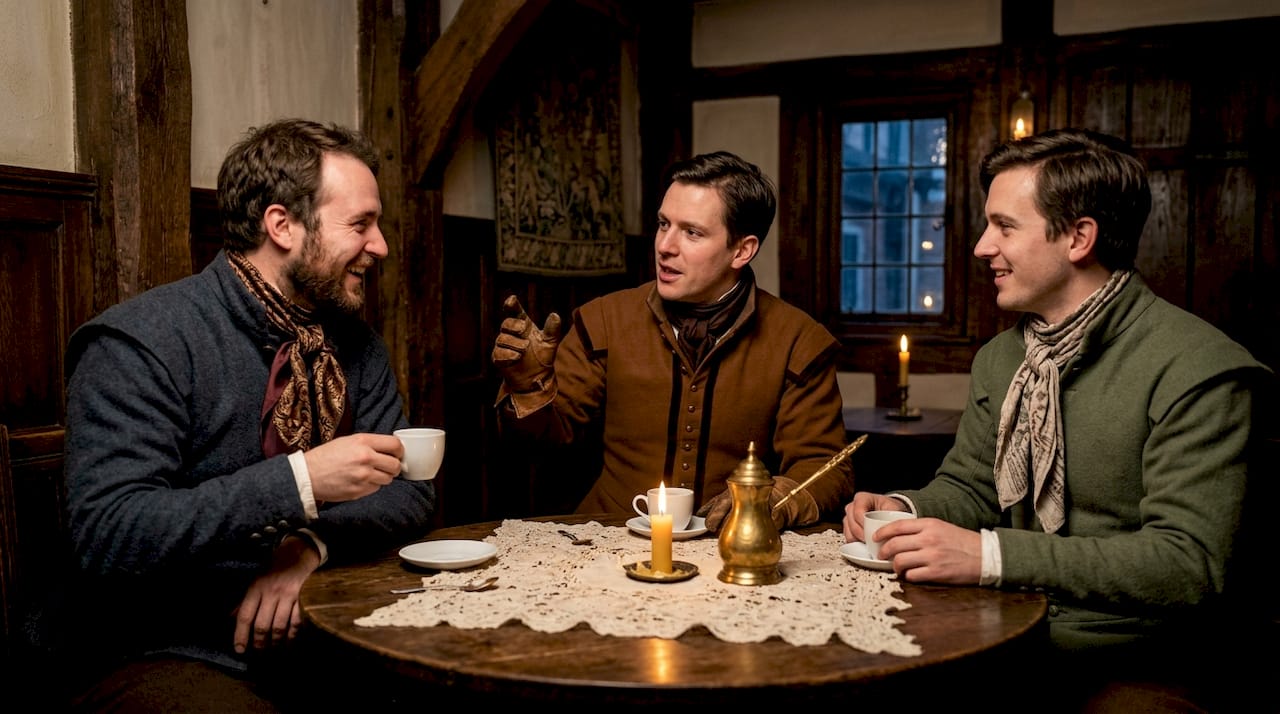
The defining concept of the English coffeehouse was the “penny university.” One penny bought you a cup of coffee and access to newspapers, pamphlets, and the conversations happening around you. That was a genuinely radical offer in a society where formal education was expensive and restricted. A craftsman could sit next to a lawyer and hear the same news.
How coffeehouses shaped European institutions
- Financial markets. Lloyd’s of London traces its origins directly to Edward Lloyd’s coffeehouse in the 1680s, where merchants and ship owners gathered to arrange marine insurance.
- Journalism. Early newspapers and newsletters circulated through coffeehouses before they had wide distribution networks. The coffeehouse was the first newsroom.
- Political organizing. Whig and Tory factions in England used specific coffeehouses as their base of operations. The coffeehouse was where political identity was formed and debated.
- Scientific exchange. The Royal Society, founded in 1660, had strong ties to London’s coffeehouse network. Scientists shared findings informally before formal publication.
The key distinction between coffeehouses and taverns was alcohol. Coffeehouses deliberately excluded alcohol, which meant conversations stayed focused and serious. A tavern was for relaxing. A coffeehouse was for thinking. That single design choice changed the nature of public discourse in Europe.
| Feature | Coffeehouse | Tavern |
|---|---|---|
| Primary drink | Coffee | Ale or wine |
| Social tone | Debate and exchange | Leisure and entertainment |
| Typical clientele | Mixed class, intellectuals | Neighborhood regulars |
| Historical output | Financial institutions, journalism | Social bonding, folk culture |
Pro Tip: The next time you work from a coffee shop, you are participating in a tradition that is nearly 400 years old. The coffeehouse as a workspace is not a modern invention.
How did coffeehouse culture influence arts and intellectual movements?
Coffeehouses served as alternate spheres during the Enlightenment, allowing open discourse among commoners and intellectuals on politics, science, and philosophy. Historians identify them as venues that supplemented universities during the 17th and 18th centuries. The university had gatekeepers. The coffeehouse did not.
Viennese coffeehouse culture in the 19th and early 20th centuries became a landmark social institution. Writers, artists, and intellectuals used Vienna’s cafes as living rooms and working studios. Sigmund Freud, Stefan Zweig, and Gustav Klimt all had their regular tables. The Viennese cafe was not a place you visited. It was a place you belonged to.
“The coffeehouse is a place where you can spend hours with a single cup of coffee, reading, writing, playing chess, and talking. It is a democratic institution that belongs to everyone and no one.” This observation, widely attributed to Viennese cafe culture historians, captures why these spaces produced so much creative work. They offered time, warmth, and the company of other serious people.
- The Beat Generation in 1950s America found its voice in coffeehouses in San Francisco and New York’s Greenwich Village. Poets like Allen Ginsberg and Lawrence Ferlinghetti read at venues like City Lights, which was as much a coffeehouse gathering point as a bookstore.
- The American folk revival of the early 1960s grew directly from the coffeehouse circuit. Bob Dylan, Joan Baez, and Phil Ochs all played small coffeehouse venues before reaching wider audiences.
- Parisian cafes in the late 19th and early 20th centuries hosted the Impressionist painters and Existentialist philosophers. Simone de Beauvoir and Jean-Paul Sartre wrote major works at Café de Flore.
- The morning coffee ritual that many people practice today carries a direct line back to these creative traditions of starting the day with coffee and thought.
The pattern across all these movements is consistent. Coffeehouses gave creative people a neutral, affordable space outside of institutions. That freedom produced work that institutions alone could not have generated.
What is the modern relevance of coffeehouse culture today?
Modern coffeehouses function as “third places,” a sociological term for spaces that are distinct from home and work. Research confirms that these spaces stimulate social cohesion and urban engagement in ways that neither domestic nor professional environments can replicate. The third place concept explains why people drive past perfectly good coffee at home to sit in a coffee shop for two hours.
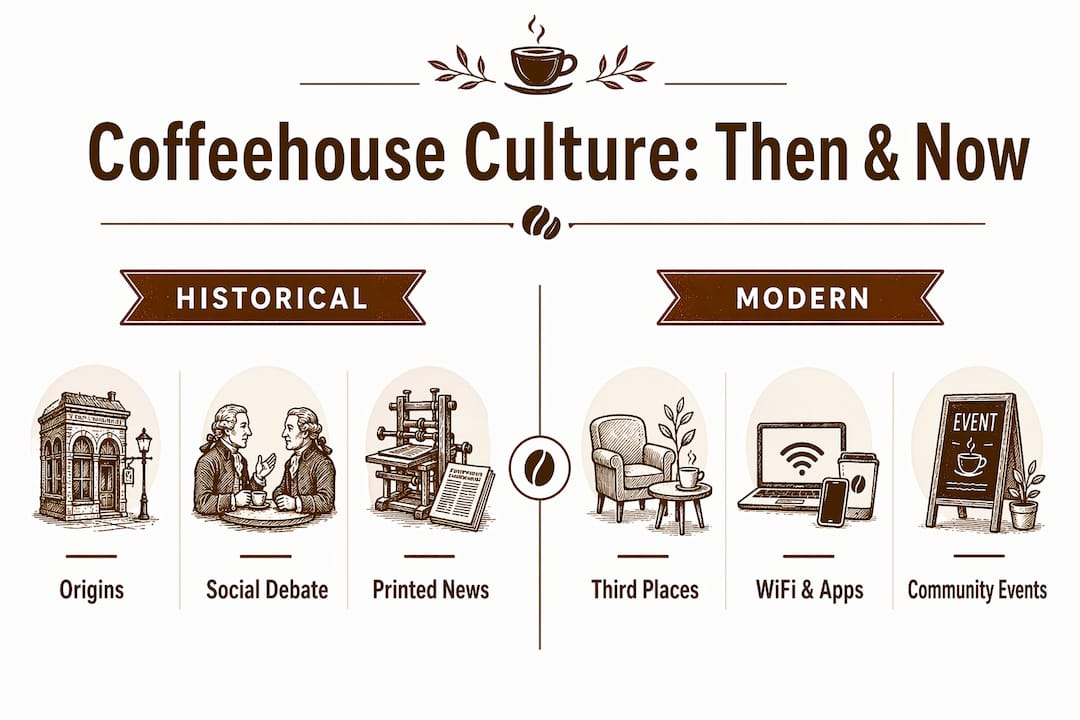
Contemporary coffee shops have expanded far beyond their historical function. They host open mic nights, community meetings, art exhibitions, and co-working sessions. The types of espresso drinks on offer have multiplied, but the core social function remains unchanged. You go to be around other people and to feel part of something.
| Historical coffeehouse | Modern coffee shop |
|---|---|
| Newspapers and pamphlets | Free Wi-Fi and news apps |
| Political debate | Community events and open mics |
| One penny admission | Specialty drink pricing |
| Fixed social rituals | Flexible, self-directed visits |
| Primarily male clientele | Open to all demographics |
Technology has changed the texture of coffeehouse visits without eliminating their social value. Laptops replaced notebooks. Podcasts replaced pamphlets. But the coffee cupping culture that values the drink itself, its origin, its flavor, and its preparation, connects directly to the seriousness with which historical coffeehouses treated their product.
The Ethiopian coffee ceremony is the clearest living example of coffeehouse culture’s original spirit. Roasting, grinding, and brewing coffee in front of guests is a prolonged social event that can last hours. It prioritizes hospitality and community over speed. That same spirit, slowed down and made intentional, is what the best modern coffee spaces still offer.
Pro Tip: When choosing a coffee shop for focused work or meaningful conversation, look for one that limits background noise and offers seating that encourages staying. Those design choices are deliberate and trace back to the original coffeehouse model.
Key Takeaways
Coffeehouse culture is one of history’s most consistent engines of intellectual exchange, political discourse, and community building, from 15th-century Yemen to the modern third place.
| Point | Details |
|---|---|
| Origins in Yemen and the Middle East | Coffeehouses emerged in 15th-century Yemen and reached Mecca, Cairo, and Damascus by the early 1500s. |
| The penny university model | English coffeehouses offered open access to news and debate for one penny, democratizing information centuries before the internet. |
| Alcohol-free design was deliberate | Excluding alcohol kept conversations serious and produced lasting institutions like Lloyd’s of London. |
| Arts and ideas flourished here | From Vienna’s literary cafes to America’s Beat coffeehouses, creative movements consistently used these spaces as their base. |
| The third place concept endures | Modern coffee shops still function as community anchors distinct from home and work, fulfilling the same social role as their historical predecessors. |
Why coffeehouses matter more than we give them credit for
I have spent a lot of time in coffee shops, and I have come to believe that most people dramatically underestimate what these spaces actually do. We treat them as a backdrop for productivity or a place to meet a friend. But the historical record shows something more significant. Coffeehouses have consistently appeared at the center of social change, not as a coincidence, but because of what they structurally offer.
The Enlightenment coffeehouses provided a rare social level playing field, widening intellectual participation beyond universities. That is not a small thing. It means that some of the ideas that shaped modern democracy and science were developed in rooms where class barriers were temporarily suspended over a shared drink.
What I find most underappreciated is the role of the physical space itself. The coffeehouse was designed to make you stay, to make you talk, and to make you return. That design was intentional from the beginning. Modern coffee shops that get this right, the ones with good acoustics, real seating, and a reason to linger, are continuing a tradition that is more than 500 years old. The ones that rush you through are missing the point entirely.
The connection between coffee bean origins and the culture built around them is real and worth honoring. When you understand where the drink came from and what it made possible, a cup of coffee becomes something more than a caffeine delivery system. It becomes a small act of participation in a very long conversation.
— Kristopher
Dkbeanleaf and the coffeehouse tradition
The coffeehouse tradition has always been about more than the drink in your hand. It is about the ritual, the community, and the feeling of belonging to something worth showing up for.

Dkbeanleaf carries that spirit into everything it offers, from premium teas that honor the same social traditions as coffee, to mugs, tees, and hoodies built for the people who take their coffee culture seriously. Whether you are recreating a quiet morning ritual or hosting friends for a long conversation, Dkbeanleaf has the gear to make it feel right. Browse the full collection at dkbeanleaf.com and bring a little history into your daily cup.
FAQ
What is coffeehouse culture, and when did it begin?
Coffeehouse culture is the social practice of gathering in public spaces to drink coffee and exchange ideas. It began in 15th-century Yemen and spread to major Middle Eastern cities by the early 1500s.
What was the “penny university” in coffeehouse history?
The penny university was the nickname for 17th-century English coffeehouses, where one penny bought a cup of coffee and access to newspapers and open debate. It democratized information at a time when formal education was expensive and restricted.
How did coffeehouses influence financial institutions?
Lloyd’s of London traces its origins to Edward Lloyd’s coffeehouse in the 1680s, where merchants arranged marine insurance deals. Coffeehouses were the original venues for commercial networking and deal-making.
Why were coffeehouses banned in some cities?
Authorities in cities like Mecca banned coffeehouses in the 16th century because they feared the open political debate happening inside would encourage dissent and challenge ruling power.
What is the modern equivalent of historical coffeehouse culture?
Sociologists call modern coffee shops “third places,” spaces distinct from home and work that foster community and social cohesion. Research confirms they continue the same social function as their historical predecessors.