

3 Quick Checks to Spot Stale Coffee Beans in Under 2 Minutes
If your beans smell weak, show no bloom with hot water, or make a flat, papery cup, they’re past peak. That’s the fast read: smell, bloom, and taste are your three quickest checks, and you can run all three in under two minutes. Stale coffee almost never means unsafe coffee, unless you spot mold or moisture damage. Here’s how to run each check and what to do once you know your beans are done.
TL;DR:
- Faint, dusty smells or a cardboard-like aroma indicate beans are beyond peak and should be discarded for brewing or used only in cold brew.
- Dull, chalky appearances and dry, crumbly grounds signal oxidation and loss of freshness, especially in older or ground beans.
- A weak or nonexistent bloom in hot water and a thin, short-lived crema in espresso are clear signs of stale coffee.
- Storage in airtight, opaque containers in a cool, dark place extends freshness; freezing in small vacuum-sealed portions is recommended for long-term storage.
- Mold or visible moisture damage requires immediate disposal, but stale beans, while disappointing, are usually safe to brew if no mold is present.
Table of Contents
- Signs Your Coffee Beans Have Gone Stale, Starting With Smell
- What Faded Color and Dry Texture Tell You
- How Stale Coffee Tastes in the Cup
- The Bloom Test and Other Degassing Checks
- Roast Date Versus Best-By: What the Timeline Actually Means
- Simple Storage Fixes That Slow Staling
- Two DIY Tests and When to Just Throw the Bag Out
- When I Replace Beans Versus When I Just Adapt the Brew
- Replace Stale Beans Without the Waste
- Sources
- FAQ
Signs Your Coffee Beans Have Gone Stale, Starting With Smell
Your nose catches staling before your tongue does. Fresh beans smell sharp and specific: chocolate, citrus, caramel, sometimes even floral or winey, depending on the origin. Stale beans smell faint, flat, or dusty, like cardboard left in a damp basement. That shift happens because the same aromatic oils that make coffee smell alive break down once they’re exposed to air for too long.
Run the open-bag sniff test: crack the bag, inhale right at the opening, and pay attention to what’s missing rather than what’s there. A generic “coffee smell” with no distinct notes is a red flag.
- Discard or use for cold brew: faint, papery, or musty smell with no distinct notes
- Keep for regular brewing: any sharp, specific aroma, even if it’s mild
- Discard the whole bag: any smell resembling wet cardboard, mildew, or basement mustiness
What Faded Color and Dry Texture Tell You
Fresh beans have a slight, even sheen depending on roast level, and they feel a little heavier in your hand. Stale beans look dull, sometimes chalky, and the color fades from deep brown toward gray. On darker roasts, you’ll often see oil on the surface, but that’s not automatically a bad sign. Normal roast oil sits as a light, even sheen. Advanced oxidation looks greasy and thick, almost sticky, and it usually comes paired with a rancid or waxy smell.
Texture matters just as much. Freshly ground coffee clumps slightly and feels a little oily between your fingers. Stale grounds go dry and crumbly, almost like sawdust.
- Faded, grayish color instead of rich brown signals age
- A dull, chalky surface (versus a light sheen) points to lost freshness
- Dry, crumbly grounds that don’t clump mean the oils have already broken down
How Stale Coffee Tastes in the Cup
Taste is where staling shows up loudest, but different brew methods expose it at different rates. A stale cup typically tastes flat, with muted acidity and a papery or cardboard-like aftertaste that lingers on the back of your tongue. Bitterness can spike too, since the bright, balancing flavors fade faster than the harsher compounds.
Espresso gives you the clearest read. Crema thickness and how long it holds is a solid freshness signal. Fresh beans pull a thick, tan crema that lasts. Stale beans produce a thin, pale layer that disappears in seconds.
- Pour-over and drip brewing expose staleness quickly since there’s nowhere for flat flavors to hide
- Espresso reveals it through weak, short-lived crema
- Cold brew tends to mask staleness because long steep times and dilution smooth over lost complexity
The Bloom Test and Other Degassing Checks
The bloom test is one of the most reliable freshness indicators available at home. Fresh grounds release carbon dioxide when they hit hot water, and that CO2 shows up as a visible, foamy bloom that expands and bubbles for 30 seconds or so. Stale coffee has already released most of its gas, so you’ll see barely any rise at all.
- Pour just enough hot water (about 200°F) to saturate the grounds, roughly twice their weight.
- Watch for 30 seconds. A strong, bubbling bloom that pushes grounds upward means the beans are actively degassing.
- A weak or nonexistent bloom, where the grounds just sit there wet, points to beans well past their prime.
You can check our own smell, bloom, and taste quick-check guide for a version of this test you can run before you even brew.
Roast Date Versus Best-By: What the Timeline Actually Means
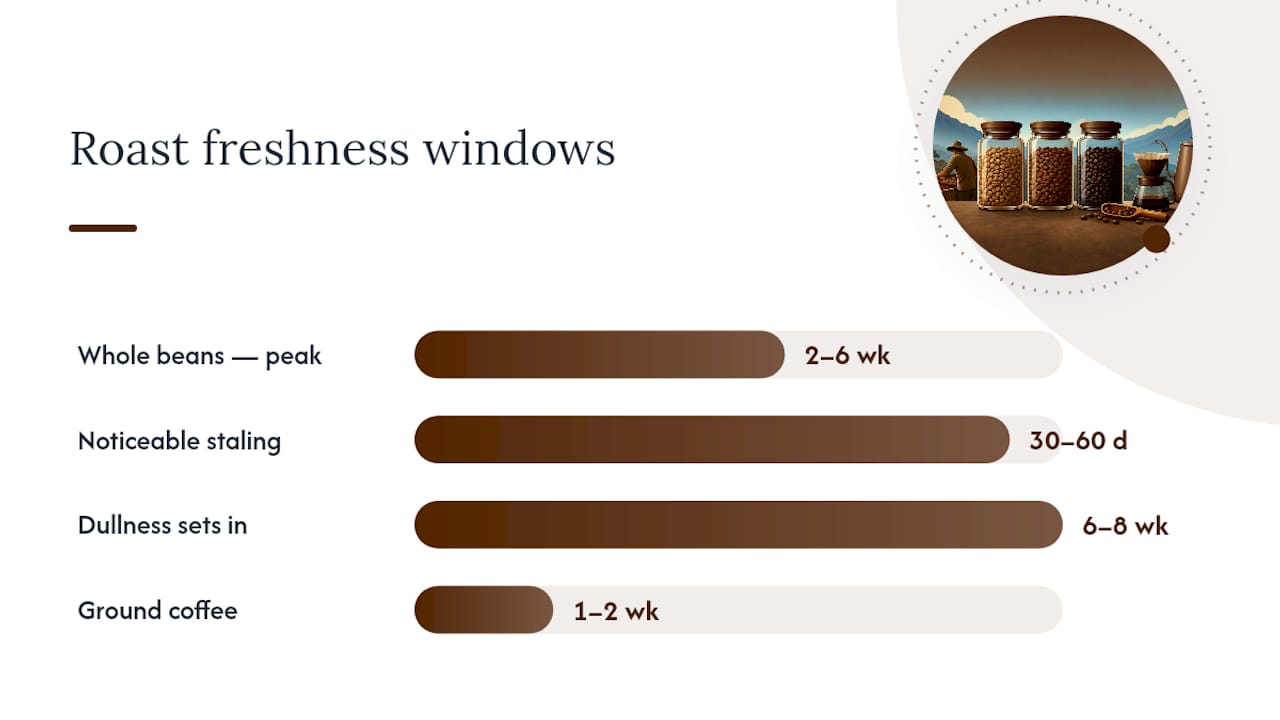
Whole beans usually taste best within the first two to six weeks after roasting. Past six to eight weeks, most coffee is noticeably duller, and staling becomes obvious to most palates somewhere between 30 and 60 days post-roast, with minimal bloom and muted aromatics by that point.
Ground coffee stales much faster than whole beans because grinding exposes far more surface area to oxygen. If you’re buying pre-ground, plan to use it within one to two weeks, not months. When a bag has no roast date, only a vague best-by date years out, treat it with suspicion. Read more on realistic windows in how long to wait for fresh roasted coffee.
Simple Storage Fixes That Slow Staling
Most staling problems trace back to storage, not bad beans. Airtight, opaque containers kept in a cool, dry, dark spot slow the process significantly, since light, heat, and air are the three things that speed up flavor loss.
Buy only what you’ll use in two to four weeks, and grind right before brewing instead of days ahead. If you’ve got more beans than you can use in that window, freezing single-dose, vacuum-sealed portions is a reasonable last resort for longer storage. Skip the fridge entirely. It introduces moisture and lets beans absorb odors from everything else in there.
- Store in opaque, airtight containers, never the bag it came in with a clip
- Keep beans away from the stove, sunny windows, or anywhere warm
- Buy smaller batches more often instead of stockpiling
- Freeze only in small, vacuum-sealed portions if you truly need long-term storage
For the full breakdown on containers and placement, see how to store coffee beans and stay fresh longer.
Pro Tip: Portion your beans into a week’s worth in a small jar, and keep the rest sealed away. Opening one big bag daily does more damage than people realize.
Two DIY Tests and When to Just Throw the Bag Out
Two simple home tests confirm what your nose and eyes already suspect. The zipper-lock bag test: seal a small handful of beans in a bag overnight. If it puffs up slightly by morning, you’re looking at active degassing consistent with a recent roast, generally within seven to ten days. No puff usually means degassing has already finished.
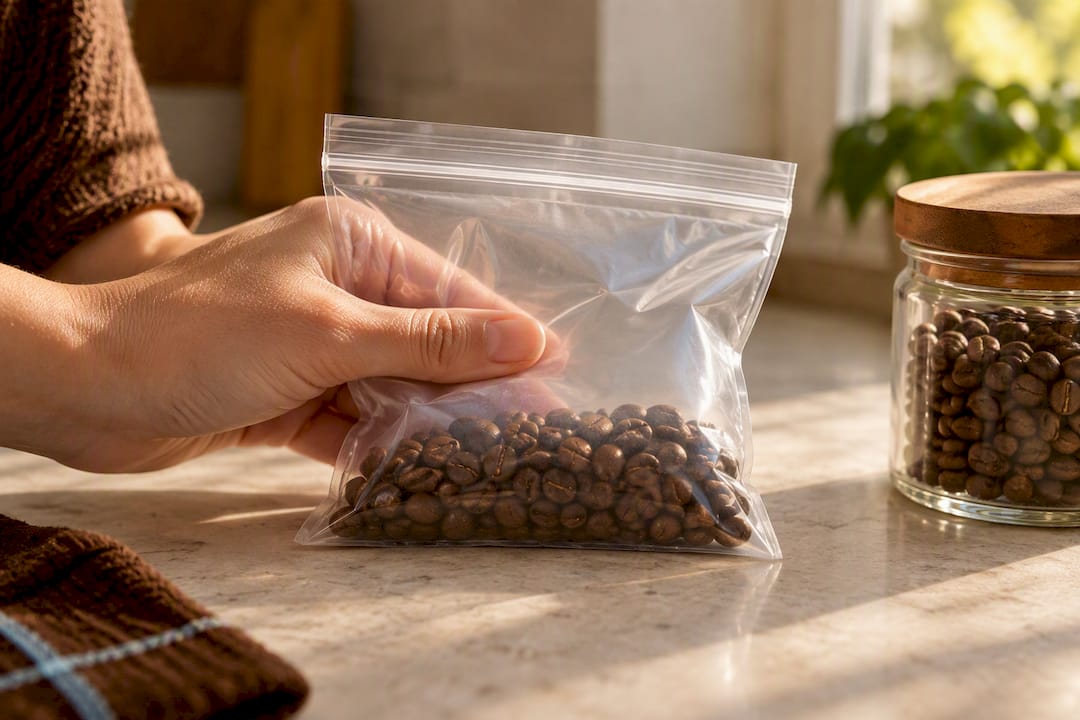
If your beans came in a one-way valve bag, press it gently. A short burst of aroma means the beans are still releasing gas. No burst means they’re likely past that stage.
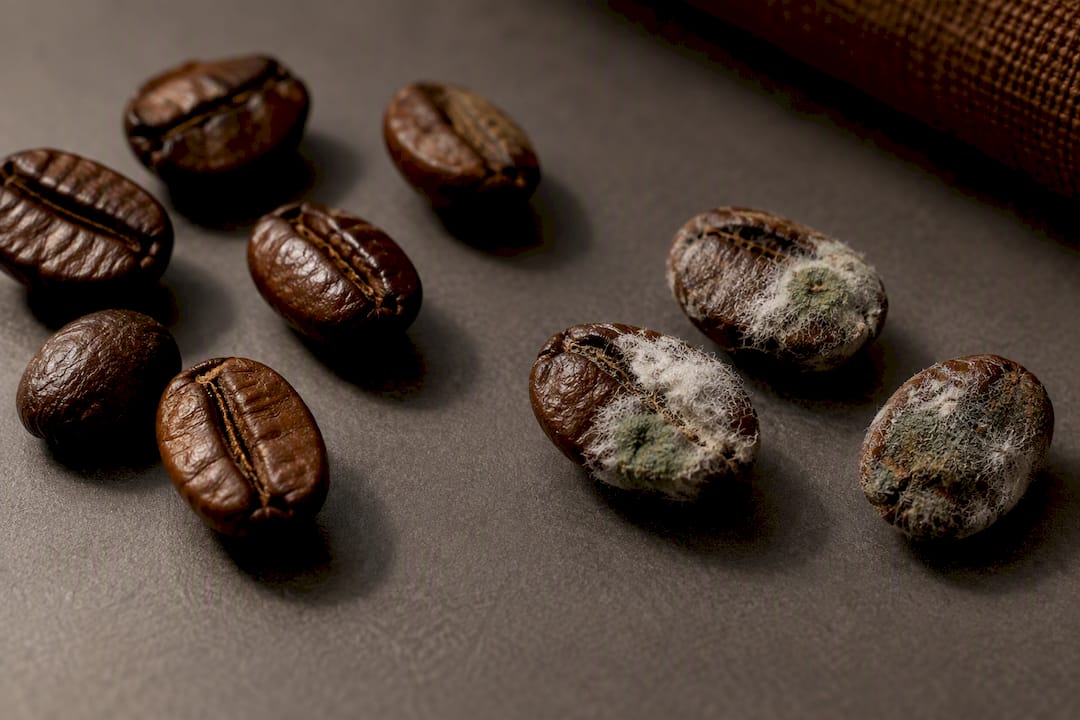
Safety is separate from staleness. Stale beans are almost never dangerous, just disappointing. Visible fuzzy white, green, or gray patches are different. That’s mold, and it means the whole bag goes in the trash, since mycotoxins can spread invisibly beyond the beans you can see.
When I Replace Beans Versus When I Just Adapt the Brew
I don’t toss beans the moment they slip past peak. If a cup needs to shine, a tasting, a gift, company over, I replace them. For everyday drinking, I push tired beans into cold brew or blend them into something bolder rather than waste them.
— Kristopher
Replace Stale Beans Without the Waste
Some coffee roasters roast to order, so the coffee you get may avoid months of warehouse time that can dull beans. If you’re testing whether fresher coffee actually tastes different to you, the smarter move isn’t buying another full bag you might not finish in time. Start smaller.

The Sample Pack lets you try a few origins or roast levels in quantities you’ll actually use before staling sets in, and the full coffee collection, including single-serve capsules, gives you a fresher rotation without committing to a giant bag that sits half-used for two months. Pick a sample pack or a small-batch bag today, and build a habit of buying what you’ll drink in the next few weeks instead of stockpiling what fades before you get to it.
Sources
- How to Tell If Your Coffee Is Fresh | America’s Test Kitchen
- How to store coffee | National Coffee Association (NCAUSA)
- Does coffee expire? How to tell if your coffee has gone bad — Day9 Coffee
FAQ
Can I Still Use Two-Year-Old Coffee Beans?
Yes, in most cases, though the flavor will be flat and one-dimensional. Two-year-old beans are almost certainly past any meaningful bloom or aroma, so expect a dull cup rather than a dangerous one. Run the sniff and bloom test first. If there’s no mold or off-smell, it’s safe to brew, just don’t expect much character.
Can You Drink Coffee Beans That Are 20 Years Old?
Drinking very old beans is unlikely to make you sick as long as they were stored dry and show no mold, but the coffee will taste essentially like flavored hot water with bitter, papery notes. At that age, virtually all aromatic oils have broken down. It’s a safe curiosity, not a cup worth planning around.
When Should You Throw Out Coffee Beans?
Throw out beans the moment you see fuzzy white, green, or gray growth, since that signals mold contamination that can spread beyond the visible spots. Short of mold, coffee doesn’t need to be discarded for safety. It just loses quality, so the decision to toss it comes down to whether you still enjoy the taste.
Can I Drink Coffee That “Expired” Two Years Ago?
Yes. The date on a coffee bag is a best-by estimate, not a safety cutoff, and coffee doesn’t spoil the way dairy or meat does. Check for mold or a musty smell first, and if neither is present, brew it. Just expect a noticeably flatter, less aromatic cup than fresh beans would give you.