

What Oxidation in Tea Means, and How It Shapes Flavor
Oxidation in tea is the leaf’s enzymatic browning reaction that converts catechins into theaflavins and thearubigins, and those chemical changes are what make green, oolong, and black teas taste so different from one another. It works a lot like a sliced apple turning brown, just guided by a tea maker instead of left to chance. That single process explains most of what separates a pale, grassy green tea from a deep, malty black one.
- Color: more oxidation means darker leaves and darker liquor
- Flavor: unoxidized leaves taste grassy and vegetal; heavily oxidized ones turn fruity, malty, or robust
- Category: producers use oxidation timing to decide whether a leaf becomes green, oolong, black, or something in between
Key Takeaways
Oxidation level, controlled through processing timing and heat, is the single biggest factor separating green, oolong, and black tea flavor.
| Point | Details |
|---|---|
| Oxidation is enzymatic | Polyphenol oxidase and oxygen convert catechins into theaflavins and thearubigins, not microbes. |
| Not the same as fermentation | True fermentation involves microbes, as in ripe pu-erh; oxidation does not. |
| Fixation stops the reaction | Heat from steaming or pan-firing denatures the enzyme and locks in flavor. |
| Oolong spans a huge range | Oxidation can run from about 8% to over 90%, judged by sensory cues, not a printed number. |
| Cup color signals oxidation | Pale green liquor means low oxidation; deep amber or reddish brown means high oxidation. |
Where to Read More on Tea Oxidation Chemistry
For deeper reading, check the review on processing and bioactive changes in tea, the polyphenol oxidase review, the Science Learning Hub’s overview of tea science, and the oolong oxidation spectrum explainer.
Ready to taste the spectrum yourself? Dkbeanleaf’s loose leaf tea collection includes sample packs that make it easy to compare lightly oxidized oolongs against fully oxidized black teas side by side. Pour your comparison into something worth the ritual, like the under-glaze red tea cup, since the right vessel can shape how you notice aroma as much as the leaf itself.
Table of Contents
- What Is Oxidation in Tea, Exactly?
- Is Tea Oxidation the Same as Fermentation?
- How Does the Enzyme Chemistry Actually Work?
- How Do Tea Makers Control Oxidation?
- How Does Oxidation Level Change Each Tea Type?
- Does Oxidation Affect Antioxidants and Health Benefits?
- How Can You Tell How Oxidized Your Tea Is?
- What Does the Research Say About Oxidation Chemistry?
- When Was Oxidation in Tea First Discovered?
- How Do Oxidation Methods Differ Across Tea Regions?
- Frequently Asked Questions
- Sources
What Is Oxidation in Tea, Exactly?
Picture a picked tea leaf as a sealed package of chemistry waiting to happen. Inside its cells sit catechins, the bitter plant compounds that give raw tea leaves their punch, kept separate from an enzyme called polyphenol oxidase (PPO). As long as the cell walls stay intact, the two never mix.
Bruise or roll that leaf, though, and the walls break down. PPO spills out, meets catechins and airborne oxygen, and starts converting them into quinones, unstable molecules that quickly link together into larger, colored compounds: theaflavins first, then thearubigins. This chain reaction, driven by enzymes and oxygen exposure, is what tea people call oxidation.
It’s worth being precise here because the word gets thrown around loosely. This is an enzymatic and chemical process, not a microbial one. No yeast, no bacteria, just an enzyme doing its job once it’s freed from its cellular cage.
Is Tea Oxidation the Same as Fermentation?
No, and this mix-up trips up even experienced drinkers. Enzymatic oxidation needs only PPO, oxygen, and time. True fermentation needs living microbes working in low-oxygen conditions, the same basic idea behind yogurt or sauerkraut.
- Black tea and oolong: enzymatic oxidation, no microbes involved
- Ripe pu-erh: genuine microbial fermentation, driven by organisms like Aspergillus
The confusion traces back to old Chinese tea vocabulary, where “fermentation” was applied broadly to any leaf that darkened or changed character during processing, long before anyone understood the underlying chemistry. Tea traders exported that loose terminology along with the leaves, and English language tea writing never fully corrected course. If you want to see real fermentation at work, pu-erh aging is the clearer example.
How Does the Enzyme Chemistry Actually Work?
PPO can’t touch catechins until a leaf’s cells are physically damaged. That’s why rolling, bruising, and crushing matter so much in processing: no disruption, no oxidation, regardless of how long the leaf sits around.
Once the reaction starts, catechins like EGCG convert into o-quinones, then into theaflavins, the bright orange-red pigments responsible for a brisk, coppery cup. Extended oxidation pushes further into thearubigins, browner and more complex polymers that deepen color and add body. PPO activity itself is sensitive to temperature and pH, which is why warm, humid rooms speed oxidation along, while a blast of dry heat during fixation denatures the enzyme and shuts the whole process down cold.
How Do Tea Makers Control Oxidation?
Producers treat oxidation as a dial, not a switch, and every step in processing either starts it, pushes it further, or slams the brakes on it.
- Withering: leaves lose moisture and soften, setting the stage for the next step
- Bruising or rolling: cell walls break, releasing PPO to meet catechins and oxygen
- Controlled oxidation: leaves rest in a warm, humid room while color and aroma develop
- Fixation (kill-green): heat from steaming or pan-firing denatures PPO, freezing the leaf’s chemistry in place
- Drying: locks in the final moisture level and stabilizes flavor for storage
Producers rarely rely on a stopwatch alone. They watch the leaf edges turn from green to reddish brown, smell for the shift from grassy to floral or fruity notes, and judge texture by feel. Black tea oxidation commonly runs for tens of minutes to a couple of hours in warm, humid conditions, but exact timing depends on leaf thickness, ambient humidity, and the flavor the maker is chasing.
Pro Tip: If you’re ever lucky enough to visit a working tea garden, ask to smell the leaves at different oxidation stages. The aroma shift from cut grass to ripe stone fruit happens faster than most people expect, sometimes in under an hour.
How Does Oxidation Level Change Each Tea Type?
Every major tea category comes from the same plant, Camellia sinensis, processed to a different point on the oxidation spectrum. The leaf doesn’t change. The decisions made after picking do.
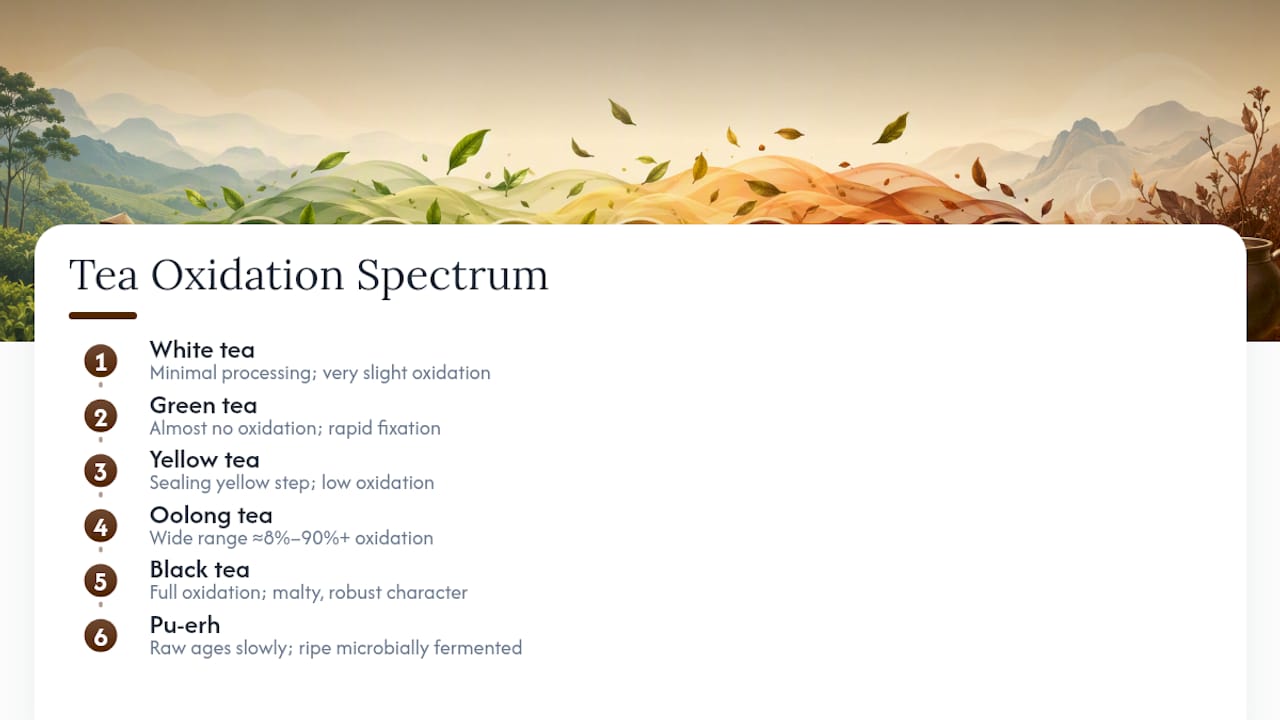
Green tea sees almost no oxidation. Fixation happens fast, often within hours of picking, which preserves the leaf’s natural catechins and gives it that signature grassy, vegetal, sometimes slightly nutty cup.
White tea takes an even lighter touch: minimal processing beyond withering, with very slight, uncontrolled oxidation. Expect delicate, subtly sweet, and hay-like flavors.
Yellow tea adds a unique twist: a slow, moist “sealing yellow” step that softens green tea’s grassiness without pushing oxidation forward much, resulting in a smoother, mellower version of green tea’s profile.
Oolong tea is where things get genuinely wide open. Depending on the style, oxidation can range from roughly 8% up to 90% or more. A lightly oxidized oolong tastes floral and green-leaning; a heavily oxidized one turns dark, fruity, and almost black-tea-like. Producers rarely print an exact percentage on the package because they judge oxidation by feel, aroma, and leaf color rather than a lab number. Many oolong makers use edge-bruising, gently tossing the leaves so only the margins oxidize while the center stays green, which is exactly why a single cultivar can produce wildly different oolongs depending on how it’s handled.
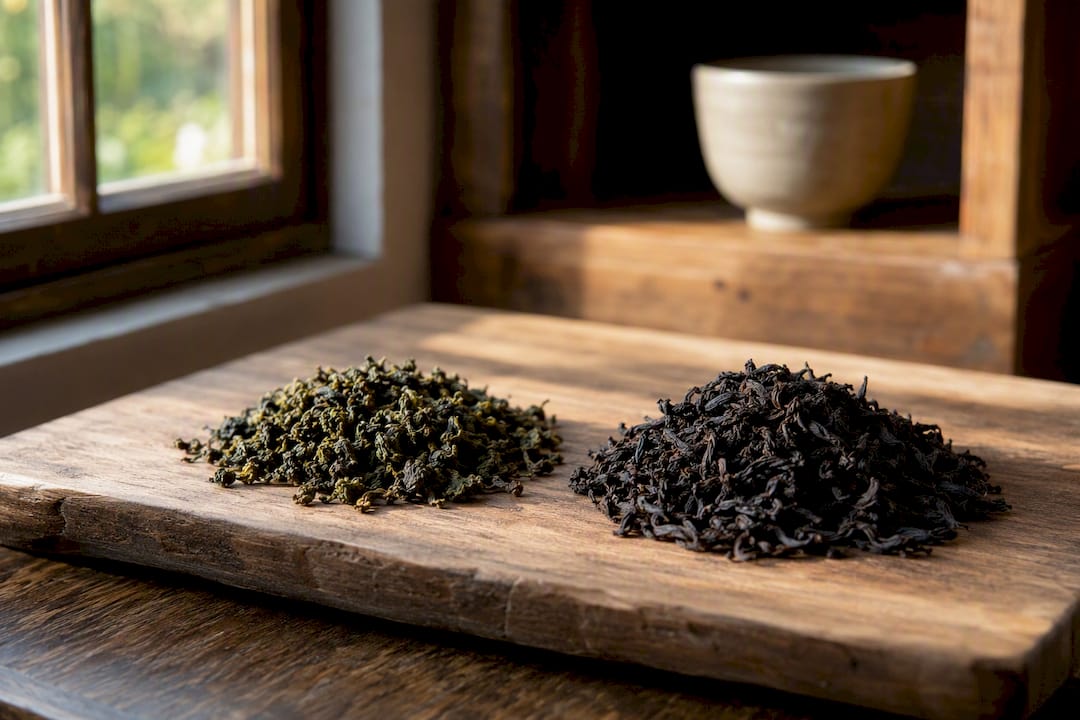
Black tea goes all the way, full oxidation, yielding the malty, robust, sometimes winey character most Americans associate with a classic morning cup.
Pu-erh breaks the pattern entirely. Raw pu-erh oxidizes lightly before undergoing slow microbial aging, while ripe pu-erh is deliberately fermented by microbes, producing theabrownins and other metabolites that create its earthy, almost woodsy signature.
Pro Tip: Curious what an oxidation spectrum tastes like in real life? Try a lightly oxidized oolong side by side with a darker roasted one. The gap in flavor is bigger than most people expect from “the same” tea type.
Does Oxidation Affect Antioxidants and Health Benefits?
Less-processed teas hold onto more of their original catechins, since oxidation converts these compounds into other forms rather than destroying them outright. Green and white teas generally test higher in catechins, while black teas carry more theaflavins and thearubigins instead.
That’s a difference in composition, not necessarily a difference in quality. Bioactive compounds shift and degrade throughout processing and digestion, which changes how they behave in the body, not simply whether they’re “better” or “worse” for you. Be wary of any claim that oxidized tea is automatically healthier or that unoxidized tea is automatically superior. The honest answer is that they offer different antioxidant profiles, and the science on functional outcomes is still more nuanced than most marketing copy admits.
How Can You Tell How Oxidized Your Tea Is?
Your eyes, nose, and mouth can tell you most of what you need to know before you ever check a label.
- Dry leaf color: green and tightly rolled suggests low oxidation; dark brown or black suggests full oxidation
- Liquor color: pale green or gold points to little oxidation; amber, orange, or reddish brown points to more
- Aroma: grassy and vegetal signals low oxidation; floral, fruity, or malty signals higher oxidation
- Mouthfeel: light oxidation tends toward brisk astringency; heavier oxidation tends toward fuller body with less bite
Regional style names often hint at oxidation level even when a percentage isn’t listed, so a little familiarity with those terms goes further than reading a bag closely. Buying small sample sizes from a seller you trust beats guessing from a photo, and it’s worth comparing loose leaf against bagged tea since loose leaf tends to preserve more of these visual cues intact.
What Does the Research Say About Oxidation Chemistry?
Researchers track oxidation progress in controlled settings by measuring the disappearance of EGCG alongside the appearance of theaflavins, giving them a numeric window into a process tea makers judge by eye and nose. Theaflavins tend to build early, then plateau or decline as they convert further into thearubigins, which is part of why timing a black tea’s oxidation window matters so much for final color and body. Anyone wanting the technical detail can dig into reviews on polyphenol oxidase’s role in tea manufacturing, which lays out the enzyme kinetics behind every cup.
When Was Oxidation in Tea First Discovered?
Nobody sat down one day and invented oxidation on purpose. It emerged from centuries of trial, error, and storage accidents in China, where tea makers noticed that leaves left to sit and bruise during transport or handling darkened and developed new flavors instead of simply spoiling.
Green tea processing, which stops oxidation almost immediately through pan-firing, appears to be among the oldest deliberate methods, dating back well over a thousand years. Black tea’s fuller oxidation came later, and popular tea history credits regions like Fujian province with developing the technique, reportedly out of necessity as much as curiosity. One often-repeated account involves tea merchants speeding up drying with fire during a time crunch, which pushed leaves further along the oxidation curve than usual and produced a darker, bolder tea that turned out to travel and sell well.
Oolong sits in the middle of this timeline, generally understood to have developed later as producers refined partial oxidation techniques, learning to stop the process at dozens of different points rather than treating it as an all-or-nothing choice. What started as inconsistent, weather-dependent guesswork slowly became a repeatable craft, passed down through generations of tea families long before anyone could explain the enzyme chemistry behind it. The science caught up to the practice, not the other way around.
How Do Oxidation Methods Differ Across Tea Regions?
Walk through tea-producing regions and you’ll find strikingly different approaches to the same basic chemistry, shaped by climate, tradition, and the tea styles each region became known for.
China treats oxidation with enormous regional variation. Fujian and Guangdong produce some of the world’s most diverse oolongs, using techniques like repeated tossing and edge-bruising to hit dozens of different oxidation targets. Yunnan, meanwhile, is the historic home of pu-erh, where post-processing microbial fermentation takes over after a lighter initial oxidation.
India, particularly Assam and Darjeeling, leans heavily into fuller oxidation for robust, malty black teas, though Darjeeling’s first-flush harvests are sometimes processed with lighter oxidation to preserve a more delicate, muscatel character.
Taiwan built its reputation on high-mountain oolongs oxidized toward the lighter end of the spectrum, prized for floral, creamy profiles that showcase the island’s cooler growing elevations.
Japan stands apart almost entirely, focusing overwhelmingly on green tea and using steaming, rather than pan-firing, to halt oxidation nearly the instant leaves are picked. That single processing choice is a large part of why Japanese green teas taste noticeably more vegetal and marine than Chinese pan-fired versions.
Climate plays a quiet but constant role underneath all of this. Humid, warm regions naturally push oxidation faster, forcing producers to adapt fixation timing to their local weather rather than following a fixed universal recipe.
Oxidation Is a Craft Tool, Not Leaf Damage
Oxidation isn’t decay to manage. It’s a lever producers pull on purpose, the same way a baker controls fermentation time in bread dough. Grab two oolongs at opposite ends of the spectrum and taste the range for yourself.
Frequently Asked Questions
What is oxidation in tea in simple terms? It’s the chemical reaction that happens when a tea leaf’s cells are broken, letting an enzyme called polyphenol oxidase react with catechins and oxygen. That reaction darkens the leaf and creates new flavor compounds, the same basic process that browns a cut apple.
What is oolong tea oxidation, and why does it vary so much? Oolong oxidation refers to the partial browning producers stop somewhere between green tea’s near-zero oxidation and black tea’s full oxidation. It varies widely, roughly 8% to over 90%, because producers use techniques like edge-bruising to target very different flavor profiles from the same leaf.
Is oxidation the same as fermentation in tea? No. Oxidation is enzymatic and needs oxygen; fermentation involves microbes working in low-oxygen conditions. Black tea and oolong are oxidized. Ripe pu-erh is genuinely fermented.
Does oxidation destroy antioxidants in tea? Not exactly. It converts catechins into other compounds like theaflavins and thearubigins rather than eliminating antioxidant activity altogether. Green and white teas simply retain more of the original catechins since they undergo far less processing.
How can I tell if my tea is highly oxidized just by looking at it? Check the dry leaf color and the brewed liquor. Green, unrolled leaves and pale gold liquor suggest low oxidation, while dark brown or black leaves and deep amber or reddish liquor point to high oxidation.
Sources
- Processing and bioactive changes in Camellia sinensis teas (review)
- A comprehensive review of polyphenol oxidase in tea (Camellia sinensis): Physiological characteristics, oxidation manufacturing, and biosynthesis of functional constituents
- The science of tea — Science Learning Hub
- Oolong oxidation spectrum - Mikey Does
- Fermentation vs oxidation in tea — TeaTrade learning