

Fix Water for Coffee in 10 Minutes With a $10 TDS Pen
The best water for coffee is either filtered tap water, if your municipal supply already sits near Specialty Coffee Association targets, or reverse osmosis (RO) water remineralized with a precise packet like Third Wave Water. Aim for total dissolved solids (TDS) near 150 mg/L. Test your water before choosing a route, and never brew with water from a household softener.
TL;DR:
- Water with a TDS of 75 to 150 mg/L generally supports optimal extraction without causing bitterness or scale buildup.
- Avoid using softened water containing sodium, as it produces flat, salty coffee regardless of bean quality or brewing method.
- Testing your tap water with a TDS meter can help determine if an easy fix, like a carbon filter or bottled water, is sufficient before investing in more complex systems.
- Distilled or reverse osmosis water requires remineralization to reach the ideal mineral profile for brewing, especially for espresso.
- Consistently recheck water quality every few months, especially during seasonal changes, to prevent scale buildup and flavor deterioration.
Table of Contents
- What Do TDS, Hardness, and pH Actually Mean for Your Coffee?
- How Do You Get Good Water at Home Without Overcomplicating It?
- How Do You Test Your Water Before Choosing a Fix?
- What Are Some Exact Recipes and Bottled Water Options to Try?
- Your 10-Minute Water Upgrade Checklist
- Who’s Behind This Water Guide, and How Was It Put Together?
- The One Question That Actually Matters Before You Buy Anything
- Pair Your Better Water With Beans Worth the Effort
- Sources
- FAQ
What Do TDS, Hardness, and pH Actually Mean for Your Coffee?
Every mineral in your water changes how coffee extracts, and the numbers behind that aren’t guesswork. The Specialty Coffee Association built a target profile specifically because water this far off in either direction wrecks a cup that the beans, grinder, and technique got right.
TDS (total dissolved solids) measures everything dissolved in your water, mostly calcium, magnesium, and bicarbonate, in milligrams per liter. It’s the single number that tells you the most about how your water will behave in a brew.
GH (general hardness) is mostly calcium and magnesium. These minerals bind to coffee compounds during extraction and help pull out flavor, but too much leaves a chalky, muddy finish and coats your equipment in scale.
KH (alkalinity), measured as calcium carbonate, is your water’s buffering capacity against acid. High alkalinity flattens the bright, lively acidity that makes good coffee interesting. Too little, and the cup can taste sharp or sour without buffering to round it out.
pH measures how acidic or basic the water itself is, separate from hardness or alkalinity.
Chlorine and chloramine don’t affect extraction chemistry much, but they absolutely affect taste. A faint pool smell in your tap water shows up in the cup, no matter how good your beans are.
Here’s where the SCA says these numbers should land:
- TDS: around 150 mg/L, with an acceptable range of 75 to 250 mg/L
- Alkalinity: roughly 40 to 75 mg/L as calcium carbonate
- pH: 6.5 to 7.5
- Chlorine: as close to zero as your filtration allows
Pro Tip: If your coffee tastes flat and one-dimensional no matter what you change about your brew ratio or roast, check your water before you blame the beans. Underextracted, thin coffee is often a mineral problem, not a grind problem.
Water below 75 mg/L TDS, distilled or heavily filtered, extracts poorly and produces a thin, sour, or hollow cup because there’s nothing for the coffee compounds to bind to. Water above 250 mg/L tends toward bitterness, a muddy or heavy texture, and, over months, a visible crust of scale inside your kettle or espresso boiler. High alkalinity specifically mutes acidity, which is why some tap water makes even a bright Ethiopian roast taste dull.
If you own an espresso machine, treat scale as a mechanical problem, not just a flavor one. Boilers and internal lines that scale up lose efficiency, run hotter than they should, and eventually need costly descaling or repair. This is where espresso brewing differs from drip in ways that matter for your water choice: the pressure and prolonged heat exposure in an espresso machine make it far less forgiving of hard water than a drip carafe ever will be.
How Do You Get Good Water at Home Without Overcomplicating It?
You have five realistic paths, and which one makes sense depends entirely on what your tap water already looks like and how much fuss you’re willing to tolerate on a Tuesday morning.
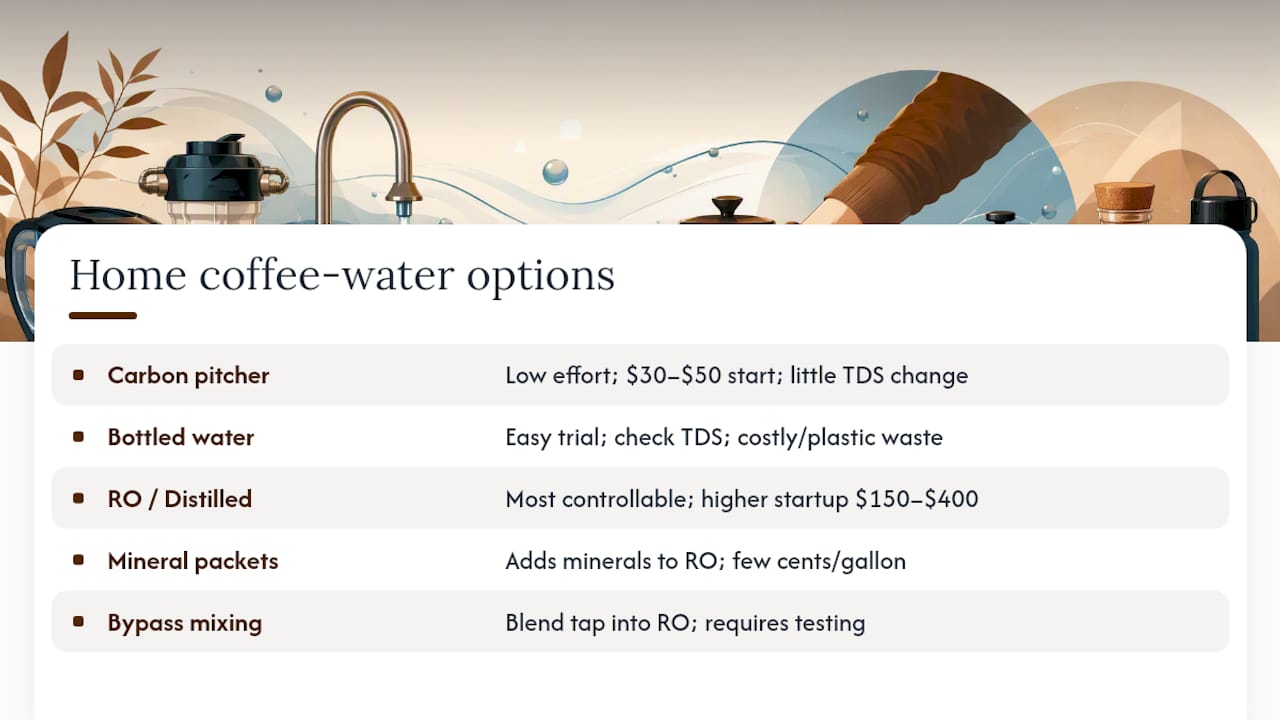
1. Carbon filter pitchers. A basic carbon filter pitcher removes chlorine, chloramine, and off-tastes, but it does almost nothing to hardness or TDS. This matters: if your tap water is already within the SCA range, a filter pitcher is the cheapest, fastest fix available. If your water is very hard or very soft to begin with, a carbon filter won’t move the needle on the number that matters most. Replacement cartridges typically last two to three months with daily coffee use, and most pitchers cost $30 to $50 to start.
2. Bottled water. This is the easiest way to run a quick trial without committing to equipment. Check the label for the TDS or “total dissolved solids” figure, sometimes listed as mineral content, and skip anything with sodium as a primary additive. Bottled water is a reasonable permanent solution if you drink one or two cups a day, but the cost and plastic waste add up fast for a household running through several pots a week.
3. RO or distilled water plus remineralization. This is the most controllable option and the closest thing to a professional cafe setup. Distilled or RO water starts at close to zero TDS, which means you’re building the mineral profile from scratch rather than fighting whatever your municipal supply gives you. Startup cost runs higher: a countertop RO system runs $150 to $400, or you can buy distilled water by the gallon for a couple of dollars and remineralize it yourself.
4. Mineral packets like Third Wave Water. These sachets dissolve into a gallon of distilled or RO water and deliver a lab-formulated mineral profile without any measuring or math. They’re the practical middle ground between “just add tap water” and “build a chemistry set.” Cost typically comes out to a few cents per gallon once you divide the packet price by usage.
5. Bypass mixing. If a full RO system feels like too much, blend a small percentage of your regular tap water into RO or distilled water to reintroduce minerals without hitting the extremes of either source alone. This is a lower-cost workaround, though it requires testing to get the ratio right since every tap water source is different.
A few warnings worth repeating before you pick a route. Never brew with water that’s passed through a household ion-exchange softener. Softeners swap calcium and magnesium for sodium, which produces flat, sometimes faintly salty coffee no matter how good your grind is. And if your municipal supply uses chloramine instead of chlorine, know that it’s more chemically stable and harder for a basic carbon filter to remove completely, so you may need a filter rated specifically for chloramine.
How Do You Test Your Water Before Choosing a Fix?
A TDS pen costs $10 to $20 and gives you a reading in seconds. Dip it in a glass of your tap water, wait for the number to stabilize, and you’ve got the single most useful data point for deciding what to do next.
Here’s how to read that number:
| TDS reading (mg/L) | What it means | Likely next step |
|---|---|---|
| Under 50 | Too low, water is nearly mineral free | Needs remineralization, don’t drink straight from RO/distilled |
| 50–75 | Low end of acceptable | Fine for filter coffee, may taste thin for some palates |
| 75–150 | Solid range, close to SCA ideal | Filter chlorine if needed, otherwise brew as-is |
| 150–250 | Upper acceptable range | Good for filter coffee, may need dilution for espresso |
| Over 250 | Too hard | Consider RO/distilled + remineralize, or a bypass blend |
Your municipal water quality report, usually published annually online, lists hardness, alkalinity, and sometimes a TDS estimate for your specific supply. It’s public record and searchable by city or utility name.
Sensory checks matter too, even without any equipment. A chlorine or pool-like smell means you need a carbon filter regardless of what your TDS reading says. A faint salty note that wasn’t there before you moved into a house with a water softener is a strong sign your tap line runs through it, and you should find an unsoftened tap (a hose bib or laundry line often bypasses the softener) for brewing.
If you own an espresso machine, or you keep tasting something off that a filter doesn’t fix, a full lab water test is worth the cost. It catches things a TDS pen can’t, like specific contaminants or unusual mineral ratios that standard filtration won’t address.
What Are Some Exact Recipes and Bottled Water Options to Try?
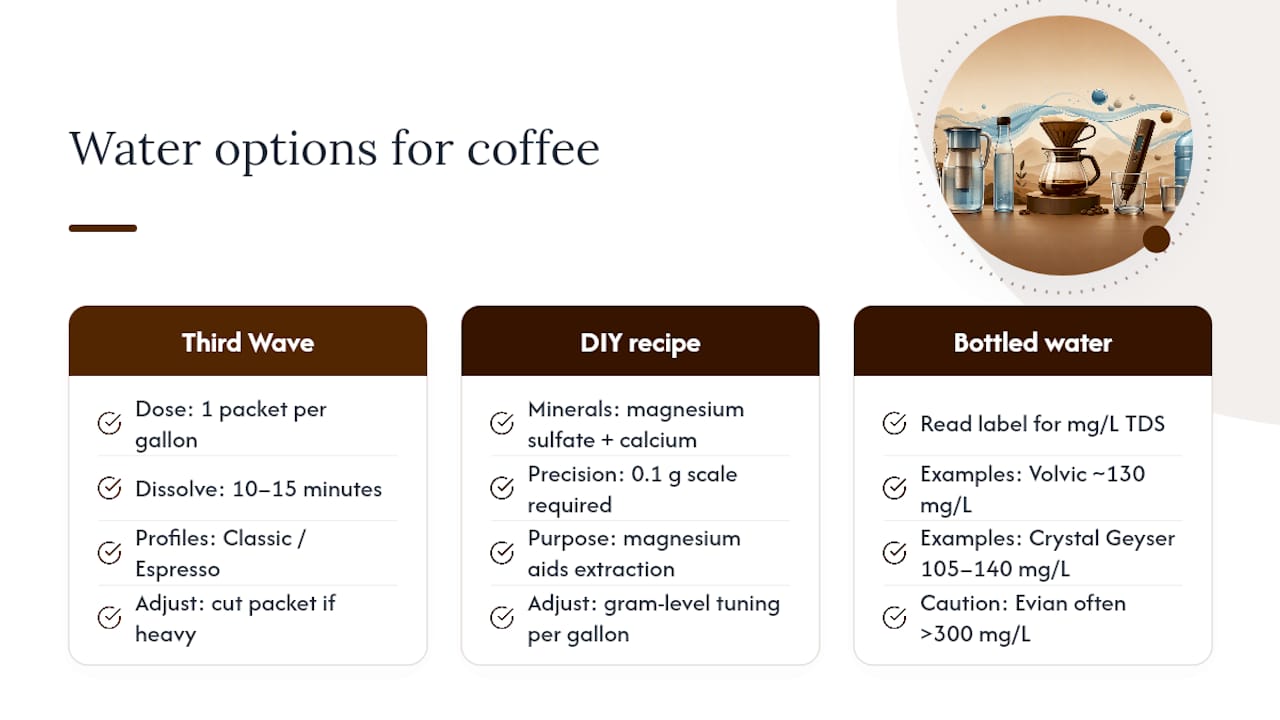
Third Wave Water sells two main profiles: Classic, built for drip and pour-over, and Espresso, formulated with slightly lower mineral content to protect boilers while still supporting good extraction. Mix one packet into a gallon of distilled or RO water and let it dissolve fully, usually 10 to 15 minutes, before brewing. If your first batch tastes a touch heavy, some home brewers cut the packet in half and adjust from there.
For a DIY approach, home brewers commonly build a base recipe using magnesium sulfate (often sold as Epsom salt, food grade) along with a calcium source, dissolved into distilled water at gram-level precision. Magnesium is a common building block because it contributes to extraction without accelerating scale buildup as aggressively as calcium alone. This only works reliably with a scale accurate to 0.1 grams, since the difference between a good cup and a flat one can come down to fractions of a gram per gallon.
Not every bottled water on the shelf works for coffee, and label reading matters more than brand loyalty. Volvic tends to run around 130 mg/L TDS, and some Crystal Geyser bottlings land in the 105 to 140 mg/L range, both comfortably inside SCA territory. Premium mineral waters like Evian, by contrast, often exceed 300 mg/L and will push your coffee toward bitter and heavy. Always check the label yourself since mineral content varies by source and bottling run, even within the same brand.
Espresso and filter coffee want slightly different numbers. Filter coffee does well right around the 150 mg/L SCA sweet spot. Espresso machines, because of prolonged heat and pressure exposure, perform better with water closer to 75 to 150 mg/L TDS, trading a small amount of extraction punch for real protection against scale in the boiler.
Your 10-Minute Water Upgrade Checklist
- Buy a TDS pen ($10 to $20) and test your straight tap water today.
- Pull up your municipal water quality report online and note the hardness and alkalinity figures.
- If your tap TDS reads 75 to 250 mg/L with no chlorine smell, add a carbon filter pitcher and stop there.
- If your tap reads outside that range, buy a gallon of distilled water and a pack of Third Wave Water.
- Get a 0.1 gram scale if you plan to try a DIY mineral recipe instead of packets.
- Brew a test batch, then retest the finished water with your TDS pen to confirm it landed near 150 mg/L.
Pro Tip: Retest your water every month or two, especially if your city adjusts treatment seasonally. Utilities often add more chlorine in summer, and that shift shows up in your cup before it shows up in any report.
Filter cartridges typically need replacing every two to three months. Watch for visible scale on kettle elements or espresso group heads as your early warning sign that hardness crept back up.
Who’s Behind This Water Guide, and How Was It Put Together?
This guide draws on Specialty Coffee Association water standards, technical breakdowns from equipment-focused publications, and municipal water testing practices, cross-checked against how baristas and home brewers actually troubleshoot flat or bitter cups. The recommendations here favor solutions a normal household will actually keep maintaining, not the most theoretically perfect setup that gets abandoned after a month. For more on how specific flavor problems trace back to brewing choices, see our breakdown of why coffee tastes bitter and how to fix it.
The One Question That Actually Matters Before You Buy Anything
Most guides bury the real question under a pile of chemistry: will you actually keep doing this in six months? A full RO and remineralization setup produces the most consistent, cafe-grade water available to a home brewer, and it’s genuinely the right answer if you’re chasing repeatable results cup after cup. But if that system is going to sit unused after the novelty wears off, a $12 TDS pen and a bottle of Volvic will do more for your coffee than an expensive setup gathering dust under the sink. Start small, measure what you’re actually drinking, and upgrade only when you’ve proven to yourself that the improvement is worth the extra step.
— Kristopher
Pair Your Better Water With Beans Worth the Effort
Dialing in your water is half the equation. The other half is starting with coffee that actually rewards the extra care, since even perfect water can’t fix a stale or low-quality roast.
Fresh coffee in blends and single origins can clearly show the difference once your water hits the 150 mg/L sweet spot. Our tea collection and sample packs are a low-commitment way to test a few origins side by side while you’re still dialing in your water setup, and a Dkbeanleaf mug on the counter is a good reminder to actually run that TDS test you keep putting off. This isn’t a water treatment product. It’s the coffee and gear that make the water upgrade worth doing in the first place. Browse the tea collection and pick a sample pack to start tasting the difference for yourself.
Sources
- Water for Coffee: TDS, Minerals, and Why It Matters — Coffee Studies
- Water for Espresso & Coffee: TDS, GH/KH, and the Best Bottled and Filtered Options | Home Espresso Lab
- Everything You Should Know About Water for Coffee — Coffee Chronicler
- Surprising ways water affects the taste of coffee — Premier H2O
FAQ
What TDS Level Is Best for Coffee?
The Specialty Coffee Association recommends around 150 mg/L, with an acceptable range of 75 to 250 mg/L for filter coffee.
Can I Use Tap Water for Coffee?
Yes, if a TDS pen and your municipal water report show it falls within the 75 to 250 mg/L range and it doesn’t come from a softener or carry a strong chlorine smell.
Is Distilled Water Good for Coffee?
No, not on its own. Distilled water has almost no minerals to support extraction, so it needs remineralizing with a product like Third Wave Water or a measured DIY recipe before brewing.
Why Does Softened Water Ruin Coffee?
Household softeners replace calcium and magnesium with sodium, which produces flat or faintly salty coffee regardless of bean quality or brew method.
What’s the Best Bottled Water for Coffee?
Bottled waters like Volvic and some Crystal Geyser bottlings often land near 105 to 140 mg/L TDS, close to the SCA target, while high-mineral waters like Evian usually run too hard for good extraction.