

Coffee Chaff Role Explained for Home Roasters
Coffee chaff, formally called silverskin or spermoderm, is the thin papery layer that wraps the coffee seed and detaches naturally during roasting as beans expand under heat. Understanding the role of coffee chaff explained here goes beyond trivia. It connects directly to roast quality, flavor outcomes, and what you do with the material after roasting. Chaff is a lightweight, cellulose-based structure. It signals roast progress, affects cup taste when mismanaged, and has genuine value in the garden. Every home roaster who ignores it is leaving useful feedback on the table.
What is the role of coffee chaff in roasting?
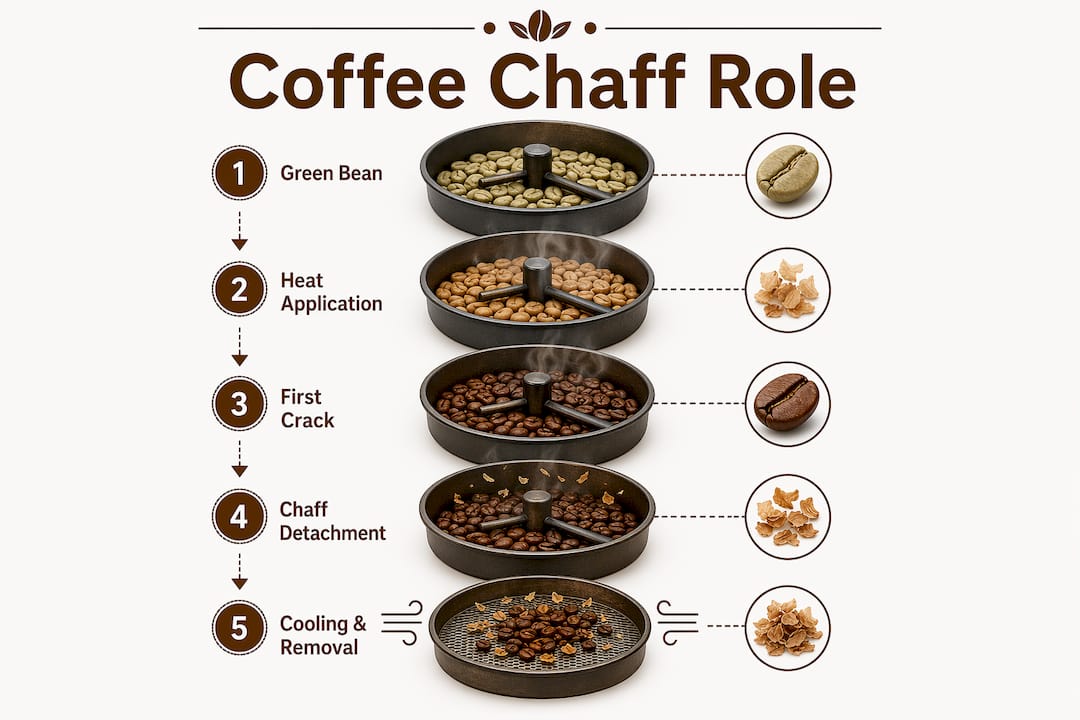
Coffee chaff is the final protective integument surrounding the coffee endosperm. It clings to the bean through green storage and early roasting, then releases as internal pressure builds. That release is not random. It follows a predictable pattern tied directly to heat, moisture, and bean density.
The most important moment happens at first crack. The first crack acoustic signal coincides with peak chaff release, marking the phase where roasters must control heat for optimal flavor development. Think of first crack as the bean announcing it is ready to shed its skin. If you are home roasting in a popcorn popper or a dedicated drum roaster like the Behmor 1600, you will hear the crack and see chaff flying. That is your cue.
Beans with higher moisture content retain chaff longer into the roast. Higher moisture retains chaff longer, and inadequate detachment signals under-roasting. Dense, high-altitude beans from Ethiopia or Colombia often show this behavior. They hold onto their silver skin well past the point where a lower-grown bean would have shed it cleanly.
Chaff burning on the bean surface is a different problem entirely. It signals scorching, meaning the outer surface is taking heat faster than the interior can absorb it. You will see dark, sooty flecks stuck to the bean. The cup will taste acrid. Catching this early, by watching chaff behavior, lets you dial back drum temperature before the damage is done.
Pro Tip: Watch the chaff collector in your roaster between first and second crack. A sudden surge of chaff release followed by stillness is normal. Chaff that keeps releasing in small amounts past second crack often means uneven heat distribution in the drum.
Here is what chaff behavior tells you at each roast stage:
- Pre-first crack: Chaff clings tightly. Beans are still absorbing heat and losing moisture.
- First crack: Chaff releases in volume. Bean expansion peaks. This is the primary diagnostic window.
- Development phase: Residual chaff detaches. Small amounts are normal. Large amounts suggest moisture issues in the green bean.
- Second crack and beyond: Almost no chaff should remain. Any visible chaff at this stage is a warning sign.
How do you remove chaff from roasted coffee?
Chaff removal is not optional. Burnt chaff imparts bitter and acrid flavors that degrade cup quality. Even unburnt chaff left in the roast batch can cause problems during grinding and brewing. It is lighter than the bean, so it distributes unevenly in the grinder and can clog burr sets over time.
The four main removal methods are:
- Cooling and agitation. Immediately after roasting, transfer beans to a colander or cooling tray and stir vigorously. The brittle chaff fragments break free and fall through the mesh. This is the simplest method for home roasters.
- Airflow separation. Many drum roasters include a built-in chaff collector that uses airflow to pull loose chaff away from beans during and after roasting. The Behmor 1600 and Gene Cafe CBR-101 both use this approach. Clean the collector after every roast.
- Screening. Pass cooled beans through a mesh screen sized to let chaff fall through while retaining beans. This works well for large batches and catches fragments that agitation misses.
- Winnowing. Pour beans slowly between two containers in front of a fan or in a light breeze. Chaff blows away. Beans fall straight down. This is the low-tech version of commercial air separation.
Cooling and mechanical agitation post-roast not only stops the roasting process but helps detached chaff separate completely, preventing off-flavors. The two goals, stopping the roast and removing chaff, happen simultaneously. That is why rapid cooling matters. Slow cooling lets residual heat keep working on the bean and gives chaff more time to scorch against the surface.
If chaff reaches your grinder, it grinds into fine powder that passes through most filters. The result is a slightly papery, thin-bodied cup. It is subtle but noticeable to anyone who has tasted a clean roast side by side.
What are the uses of coffee chaff beyond roasting?
Coffee chaff has a second life in the garden, and it is genuinely useful. Chaff works as nutrient-rich compost, a mulch additive, and a soil enhancer that provides nitrogen and improves soil structure. Organic gardeners use it to speed vegetable growth and deter pests like slugs and snails. The texture is abrasive enough to discourage soft-bodied pests without harming plants.
The coffee chaff benefits for gardeners include:
- Nitrogen source. Chaff breaks down quickly and releases nitrogen into the soil. It is a green material in composting terms, despite being dry and papery.
- Soil aeration. Mixed into dense clay soils, chaff creates air pockets that improve drainage and root penetration.
- Mulch layer. Spread around vegetable beds, chaff suppresses weeds and retains moisture. It is lighter than wood chip mulch and breaks down faster.
- Pest deterrent. A ring of dry chaff around vulnerable plants creates a barrier that slugs and snails avoid.
- Compost accelerator. The near-neutral pH of chaff, noted by Gigawatt Coffee Roasters, makes it safe for composting without acidifying the pile the way coffee grounds can.
One caution applies here. Overuse of chaff in soil can hinder water absorption because wet chaff becomes sticky and mats together. Keep chaff to a low percentage of any mulch or compost mix. A thin layer or a 10–15% ratio in compost is enough to get the benefits without blocking water and airflow.
Pro Tip: Collect chaff in a paper bag after each roast session. After a few weeks, you will have enough to top-dress a raised bed or add a meaningful amount to a compost bin. It costs nothing and keeps roasting waste out of the trash.
Beyond the garden, chaff has been explored as an insulation material and a fiber source for recycled paper. These applications are still niche, but they point toward a future where roastery waste has real commercial value.
How does chaff indicate roast quality and expertise?
Expert roasters read chaff the way a baker reads crust color. The amount, timing, and distribution of chaff release all carry information about the bean and the roast.
Chaff quantity correlates with green bean density and moisture, making it a subtle indicator of bean origin and quality. A dense, high-altitude bean from a region like Yirgacheffe or Huila will produce different chaff behavior than a lower-grown bean from a humid climate. Roasters who track this over time build an intuitive map of how each origin behaves in the drum.
Uneven chaff retention is a specific diagnostic signal. Visible chaff retention indicates uneven heat penetration and is often higher in dense, high-altitude beans. If you pull a roast and see patches of silver skin still clinging to some beans while others are clean, the drum temperature was uneven. Some beans sat in a cooler zone. The fix is adjusting charge temperature or drum speed on the next roast.
The table below shows how chaff behavior maps to roast conditions:
| Chaff observation | What it signals |
|---|---|
| Clean release at first crack | Good heat penetration, adequate moisture loss |
| Chaff retained past first crack | High moisture in green beans, possible under-roast |
| Chaff burning on bean surface | Scorching, excessive surface heat |
| Patchy chaff retention | Uneven heat distribution in the drum |
| Very low chaff volume overall | Dense, dry green beans, often high-altitude origin |
“Chaff behavior provides roasters with feedback. If chaff remains attached too long or burns on beans, it signals roasting issues that can be rectified by adjusting heat or time.” — Roastopedia
Artisan roasters at operations like Intelligentsia Coffee and Counter Culture Coffee document chaff behavior as part of their roast logs. They treat it as one data point among many, alongside bean temperature, development time ratio, and color readings. For home roasters, the same discipline applies at a smaller scale. You do not need a Cropster profile to notice whether chaff is releasing cleanly or sticking around too long.
Understanding coffee cherry anatomy helps here. The silver skin is the innermost layer of the cherry, sitting directly against the endosperm. Its behavior during roasting reflects everything that happened to the bean before it reached your drum, from altitude and processing method to drying conditions and storage time. Chaff is the last physical record of the bean’s origin story.
Key takeaways
Coffee chaff is a direct diagnostic tool for roast quality, not just a byproduct to discard.
| Point | Details |
|---|---|
| Chaff is the silver skin | It is the cellulose layer that detaches from coffee beans during roasting due to heat and expansion. |
| First crack is the key moment | Peak chaff release at first crack signals the critical phase for heat control and flavor development. |
| Remove chaff to protect flavor | Burnt or residual chaff causes bitter, acrid flavors in the cup and clogs grinders over time. |
| Chaff has real garden value | Use it as compost, mulch, or a pest deterrent, but keep it below 15% of any soil mix to avoid matting. |
| Chaff reveals roast problems | Patchy retention or late release signals uneven heat, high moisture, or scorching in the roast. |
Why I stopped treating chaff as trash
Most home roasters I talk to treat chaff as the annoying mess that comes with roasting. They vacuum it up, toss it, and move on. I did the same for the first two years of home roasting. Then I started paying attention to it, and it changed how I roast.
The first thing I noticed was that my chaff collector told me more about roast consistency than my thermometer did. When I saw uneven chaff release, patchy retention on cooled beans, or chaff that smelled sharp and burnt rather than toasty, I had a problem. The thermometer said everything was fine. The chaff said otherwise. I started logging chaff observations alongside temperature curves, and my roast consistency improved within a month.
The second shift was in the garden. I roast about a pound a week. That adds up to a meaningful amount of chaff over a season. Spreading it around my tomato plants and mixing it into my compost bin costs me nothing and reduces what I throw away. The roasting process already gives you so much information if you pay attention. Chaff is part of that feedback loop.
My honest advice: keep a small container next to your roaster. Collect chaff for a month. Use it in your garden. Watch your beans during the roast instead of just listening for first crack. Chaff is not a nuisance. It is the bean talking to you.
— Kristopher
Explore coffee and brewing essentials at Dkbeanleaf

Dkbeanleaf carries a range of coffee and tea products built for people who take their cup seriously. Whether you are deep into home roasting or just building out your brewing setup, the right gear and quality ingredients make a real difference. Browse the tea collection for options that pair well with your coffee ritual, from hibiscus berry to peach paradise blends. Pick up a durable enamel mug that handles the heat of a fresh pour without fuss. Dkbeanleaf is the kind of shop that understands coffee culture from the roaster to the cup.
FAQ
What is coffee chaff made of?
Coffee chaff is a lightweight, cellulose-based material. It is the innermost protective layer of the coffee seed, also called the silverskin or spermoderm, and it detaches from the bean during roasting.
Does chaff affect the taste of coffee?
Yes. Burnt chaff causes bitter and acrid flavors that degrade cup quality. Removing chaff promptly after roasting protects the clean flavor profile of the bean.
Is coffee chaff the same as coffee grounds?
No. Chaff differs from coffee grounds in composition and origin. Chaff is the dry outer layer removed during roasting. Grounds are the particles left after brewing. Chaff is lighter, breaks down faster, and has a near-neutral pH.
Can I use coffee chaff in my garden?
Yes. Chaff works as compost, mulch, and a pest deterrent. Keep it to a low percentage of any soil mix because wet chaff mats together and can block water absorption.
Why does some chaff stick to roasted beans?
Residual chaff on cooled beans usually signals uneven heat penetration during the roast. Patchy chaff retention is more common with dense, high-altitude beans and points to a drum temperature or airflow issue worth correcting.