

How to Grind Coffee Beans Without a Grinder
Grinding coffee beans without a grinder is fully achievable using common household tools, provided you control grind size and avoid heat damage. The mortar and pestle, rolling pin, blender, and meat tenderizer each produce workable results when matched to the right brewing method. What separates a drinkable cup from a disappointing one is not the absence of a grinder. It is technique, batch size, and knowing which tool suits your brew style. This guide covers every practical method for no grinder coffee preparation, from coarse French press grinds to near-espresso fineness.
How to grind coffee beans without a grinder: tools and setup
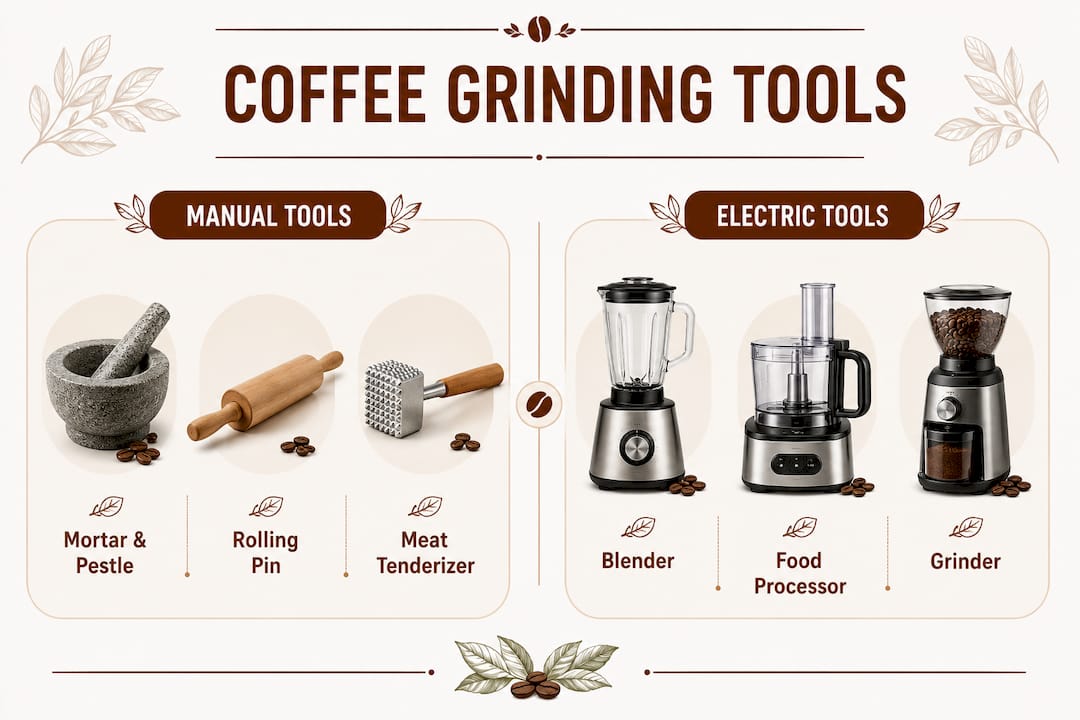
The right tool determines your grind size before you crush a single bean. Four household items cover the full range of coffee bean grinding methods: a mortar and pestle, a rolling pin with a heavy-duty freezer bag, a blender or food processor, and a meat tenderizer. Each produces a different particle profile, and choosing the wrong one for your brew method is the most common mistake.
Before you start, freeze your beans for 30 minutes. Freezing beans before grinding hardens them, which improves particle breakdown and reduces heat buildup during processing. Work in small batches of 15–20 grams at a time. Larger batches create uneven results and, with blenders, risk overheating the motor.
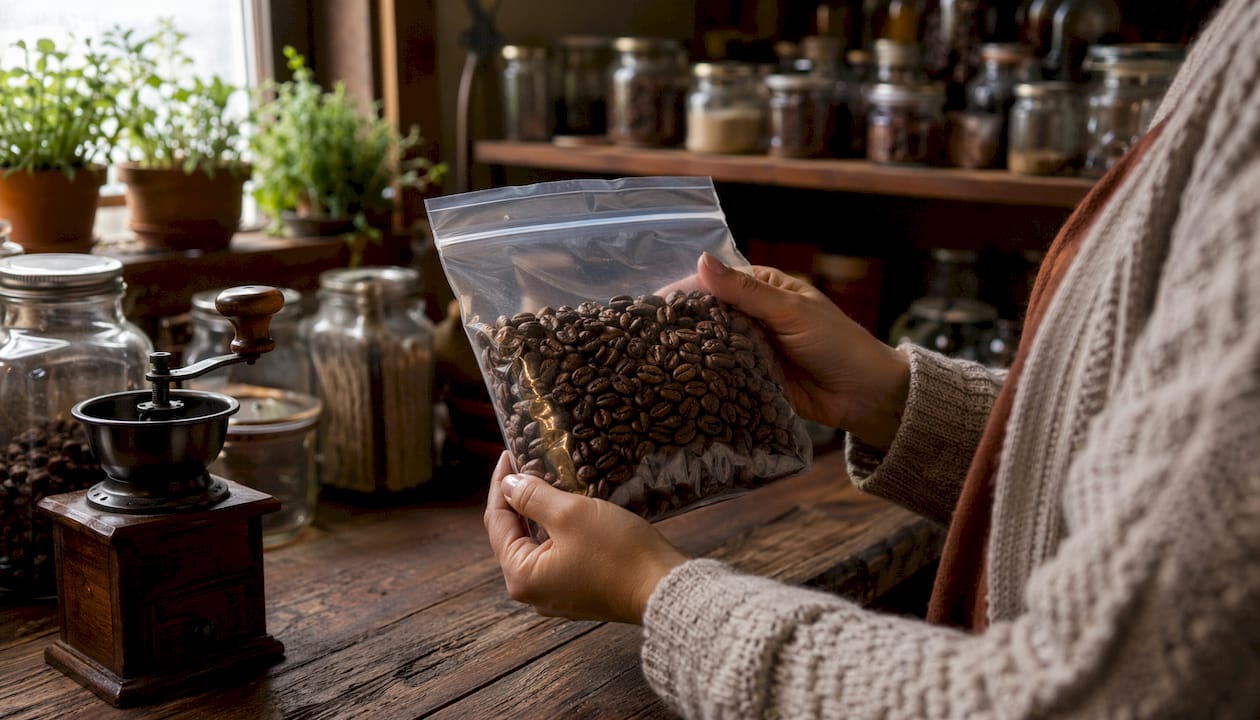
Pro Tip: Always use a freezer-style bag, not a standard sandwich bag, when rolling or pounding beans. Standard bags rupture under pressure and scatter grounds across your counter.
Here is how the four main tools compare at a glance:
| Tool | Grind size output | Physical effort | Batch size | Noise level |
|---|---|---|---|---|
| Mortar and pestle | Fine to medium | High | Small (15g) | Low |
| Rolling pin | Coarse | Medium | Medium (20g) | Low |
| Blender or food processor | Medium coarse | Low | Medium (20g) | High |
| Meat tenderizer | Coarse only | High | Small (10g) | High |
The rolling pin method is relatively quiet compared to blenders, making it a practical choice for offices or shared spaces. Placing a folded kitchen towel under the bag reduces noise further and prevents the bag from sliding.
Step-by-step techniques for each grinding method
Mortar and pestle
The mortar and pestle is the most viable manual technique for fine grind control. It uses compression and attrition, which avoids heat damage and produces more uniform particles than any other household method. Reaching espresso-grade fineness takes 3–5 minutes per small batch, so patience is non-negotiable.
- Add no more than 15 grams of beans to the mortar.
- Press straight down with the pestle to crack each bean. Do not grind yet. This first stage prevents beans from jumping out and gives you control over the process.
- Once all beans are cracked, switch to a circular grinding motion, pressing firmly against the bowl wall.
- Check the grind every 30 seconds by pinching a small amount between your fingers. Stop when the texture matches your target.
- Tilt the mortar and tap lightly to collect grounds from the edges before removing.
The two-stage technique of cracking first, then grinding, is the key to particle uniformity. Skipping straight to circular grinding sends whole beans bouncing out of the bowl.
Rolling pin method
The rolling pin produces a coarse, flaked particle profile suited for French press and cold brew. Rolling slowly and deliberately creates flakes rather than shards, which extract more evenly in immersion brewing.
- Place 20 grams of beans inside a heavy-duty freezer bag. Seal it, removing as much air as possible.
- Lay the bag flat on a folded kitchen towel on a hard surface.
- Use the rolling pin to press down firmly and roll forward. Apply steady, even pressure.
- Fold the bag to redistribute beans to unbroken areas. Repeat rolling until you reach a coarse, even texture.
- Open the bag carefully and check the grind before transferring to your brewer.
Pro Tip: Roll in one direction only. Back-and-forth rolling creates uneven particle sizes because already-broken pieces get re-crushed while whole beans remain intact.
Blender or food processor
A blender is the fastest alternative grinding method, but it tends to create an uneven grind and heat that can scorch the beans if you run it continuously. The pulse setting is the only setting worth using.
- Add no more than 20 grams of beans to the blender jar.
- Pulse for 2–3 seconds, then stop completely.
- Shake or tap the blender jar to redistribute grounds.
- Pulse again for 2–3 seconds. Repeat 6–8 times total.
- Check the grind texture after each round. Stop when you reach a medium-coarse consistency.
Short pulse bursts prevent heat buildup and protect the aromatic oils that give coffee its flavor. Running the blender for 10 continuous seconds destroys those oils and produces a flat, dull cup.
Meat tenderizer
The meat tenderizer is the least consistent tool for grinding coffee by hand. Use it only when nothing else is available, and expect a coarse, uneven result.
- Place 10 grams of beans in a sealed freezer bag on a folded towel.
- Strike the bag with the flat face of the tenderizer using controlled, moderate force.
- Redistribute beans after every 4–5 strikes.
- Stop when most pieces are roughly pea-sized or smaller.
Reserve this method for French press or cold brew only. The particle size is too inconsistent for any other brew style.
How do you fix uneven grinds from improvised methods?
Improvised grinding causes a bimodal particle size distribution with both fine powder and large chunks in the same batch. This is the core problem with alternative coffee grinding techniques. Fines extract too fast and taste bitter. Large chunks extract too slowly and taste sour. Both problems appear in the same cup.
Bimodal particle distribution forces your coffee to taste sour and bitter at the same time. The fines over-extract while the boulders under-extract, and no amount of brew time adjustment fully corrects both problems simultaneously.
Here is how to reduce the damage:
- Sieve out fines. Pour your ground coffee through a fine mesh strainer or tea strainer. Discard the powder that falls through. The remaining grounds will extract more evenly.
- Remove large chunks. Pick out any pieces larger than 3–4mm by hand before brewing. They will not extract properly regardless of brew time.
- Adjust brew time. If you cannot sieve, brew for slightly less time than normal to avoid over-extracting the fines. Check the coffee dose ratio to recalibrate your recipe.
- Lower water temperature. Dropping brew temperature by 5–10°F slows extraction across all particle sizes, which reduces the bitterness from fines.
Pro Tip: Avoid flow-through brew methods like V60 or espresso when your grind is inconsistent. Stick to immersion methods like French press or cold brew, which are far more forgiving of uneven particle sizes.
A common brewing mistake is using an inconsistent grind with a percolation brewer and then blaming the beans. The beans are usually fine. The grind is the problem.
Which brewing method works best with each grinding tool?
Mismatched grind and brewing style cause weak or bitter coffee due to extraction imbalances. Matching your improvised grind to the right brewer is the single most effective way to improve your cup when grinding without a traditional grinder.
Coarse grinds from rolling pin or hammer work well for French press and cold brew. Fine grinds from a mortar and pestle suit pour over and espresso better. Here is the full picture:
| Brew method | Ideal grind size | Best alternative tool | Notes |
|---|---|---|---|
| French press | Coarse | Rolling pin, meat tenderizer | Immersion method; tolerates inconsistency well |
| Cold brew | Extra coarse | Rolling pin | Long steep time compensates for uneven grind |
| Drip coffee | Medium | Blender (pulsed) | Requires more consistent output than immersion |
| Pour over | Medium fine | Mortar and pestle | Inconsistent grinds cause channeling |
| Espresso | Fine | Mortar and pestle only | Hardest to achieve; expect imperfect results |
| AeroPress | Medium coarse | Blender or mortar and pestle | Flexible; adjustable steep time helps |
For pour over specifically, review pour over best practices before brewing with an improvised grind. The technique adjustments matter as much as the grind itself.
Pro Tip: If your grind is coarser than ideal for your brewer, extend steep or contact time by 30–60 seconds and use water at the higher end of the 195–205°F range. This partially compensates for under-extraction from large particles.
For a full overview of how each brew method interacts with grind size, the coffee brewing methods guide covers every major style with practical parameters.
Key Takeaways
Grinding coffee without a grinder is possible with the right tool, technique, and brew method match. Improvised methods always produce some particle inconsistency, so choosing an immersion brewer and sieving your grounds are the two most effective ways to protect cup quality.
| Point | Details |
|---|---|
| Mortar and pestle leads for fine grinds | Use the two-stage crack-then-grind technique for the most uniform particle size. |
| Pulse blenders in short bursts | Limit each burst to 2–3 seconds to prevent heat damage and preserve aromatic oils. |
| Match grind to brew method | Coarse grinds suit French press and cold brew; fine grinds suit pour over and espresso. |
| Sieve uneven batches | Remove fines and large chunks before brewing to reduce sour-bitter extraction imbalance. |
| Freeze beans before grinding | Cold beans break down more uniformly and generate less heat during processing. |
What I have learned from grinding coffee without a grinder
Kristopher’s take
Manual grinding taught me something a burr grinder never could: how much grind consistency actually matters. The first time I used a mortar and pestle for a pour over, the cup was uneven and strange. The second time, after I started sieving out the fines, it was genuinely good. Not burr-grinder good, but good enough to enjoy without apology.
The honest truth is that improvised grinding is a damage control solution, not a replacement for proper equipment. Specialty beans lose their nuanced flavor without a burr grinder. You will taste the difference, especially with lighter roasts where floral and fruit notes depend entirely on even extraction.
That said, the mortar and pestle is preferred in quiet settings and genuinely offers the best balance of flavor preservation and grind control among all no-grinder methods. If you practice the two-stage technique consistently, you will get results that surprise you.
My advice: use these methods when you need them, enjoy the process, and invest in a quality burr grinder when you are ready to take your coffee seriously. Until then, the mortar and pestle is your best friend.
— Kristopher
Quality coffee starts with great beans
Grinding technique only takes you so far. The beans you start with determine the ceiling of what any cup can taste like, regardless of how you process them.

At Dkbeanleaf, the focus is on whole beans and teas worth brewing carefully. Whether you are working with a mortar and pestle this morning or a full setup, starting with quality ingredients makes every method perform better. Browse the premium tea collection for a flavorful alternative on days when you want something different from your usual coffee ritual. Good flavor starts before the grind, and Dkbeanleaf is built around that idea.
FAQ
Can you grind coffee beans without any equipment?
You can crush coffee beans using a heavy spoon and a hard surface, though the result will be very coarse and inconsistent. This method works only for cold brew or French press, where long steep times compensate for uneven particle sizes.
What is the best household tool to grind coffee by hand?
The mortar and pestle is the best household tool for manual coffee grinding. It produces the most uniform particle size, avoids heat damage, and can reach fine grind levels suitable for pour over and espresso with enough effort.
Does grinding coffee in a blender ruin the flavor?
Continuous blending overheats the beans and burns aromatic oils, which flattens the flavor. Using the pulse setting in 2–3 second bursts prevents heat buildup and preserves most of the coffee’s aroma.
What grind size works best for French press without a grinder?
French press requires a coarse grind, which the rolling pin method produces reliably. The flaked particle profile from slow, deliberate rolling extracts evenly during the 4-minute immersion steep.
How do you fix a coffee grind that is too uneven?
Pour the ground coffee through a fine mesh strainer to remove powdery fines, then pick out any large chunks by hand. Brew with an immersion method like French press or cold brew, and lower your water temperature slightly to reduce over-extraction from remaining fine particles.