

What Is Specialty Grade Coffee? A Clear Answer
You’ve probably seen “specialty coffee” on a bag, a café menu, or a social media post and assumed it meant something premium or artisanal. The truth is, what is specialty grade coffee comes down to a specific, standardized system, not a marketing label. The Specialty Coffee Association (SCA) defines it as a coffee recognized for distinctive attributes resulting in significantly higher marketplace value, evaluated through a framework that goes far beyond taste alone. And with 46% of American adults now drinking specialty coffee on any given day, understanding what that label actually means matters more than ever.
Key takeaways
| Point | Details |
|---|---|
| The 80-point threshold | Coffees scoring 80 or above on the SCA’s 100-point scale qualify as specialty grade. |
| Four-part CVA framework | The SCA evaluates coffee through Physical, Descriptive, Affective, and Extrinsic assessments. |
| More than flavor | Specialty coffee value includes origin transparency, sustainability, and processing methods. |
| Subjective preference is built in | The Affective Assessment separates personal taste from objective quality so both are honored. |
| Freshness and traceability count | Roast dates, small-batch production, and supply chain transparency define the real-world experience. |
What is specialty grade coffee, according to the SCA
The industry term you need to know is specialty coffee, and it has a definition with teeth. The SCA describes it as coffee that earns its value through distinctive sensory qualities and a broader set of factors including social impact, sustainability, and supply chain integrity. This is not a vibe or a brand positioning choice. It is a structured evaluation.
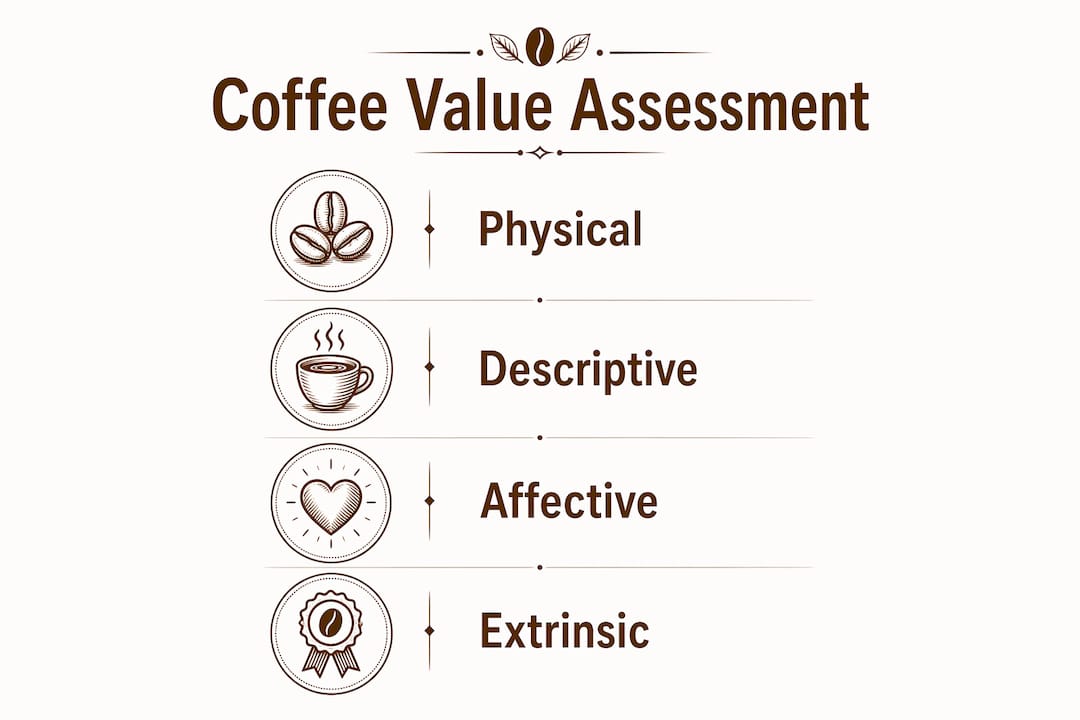
The SCA’s current framework, updated in 2025, is called the Coffee Value Assessment (CVA). It replaced the older cupping form that relied almost entirely on a flavor score to determine quality. The CVA recognizes that a holistic assessment approach better captures why a coffee is worth more to buyers, consumers, and the producers who grow it.
The CVA breaks down into four distinct components:
- Physical Assessment: Evaluates green and roasted bean defects, moisture content, and screen size.
- Descriptive Assessment: Covers aroma, flavor, body, acidity, and aftertaste using standardized sensory references so evaluators across the globe stay calibrated.
- Affective Assessment: Measures personal preference using a 9-point hedonic scale, capturing whether a taster actually likes the coffee independent of its technical quality.
- Extrinsic Assessment: Considers origin story, processing method, certifications, and sustainability practices that add value beyond the cup.
This four-part structure gives everyone in the supply chain, from farmers to roasters to retailers, a shared language for talking about coffee quality with far less ambiguity.
The coffee grading system and the 80-point rule
Coffee grading is the mechanism that separates commodity beans from specialty beans, and it comes down to a number. The SCA uses a 100-point scoring scale, and the cutoff is clear: 80 points or above earns the specialty grade designation.
Here is how the scale breaks down in practice:
- Below 60 points: Off-grade or defect-heavy coffee, typically used in low-cost blends.
- 60 to 79 points: Commercial or commodity grade, which covers most supermarket and fast-food coffee.
- 80 to 84 points: Specialty grade entry level. Clean, good, and clearly above average.
- 85 to 89 points: Excellent specialty coffee with notable complexity and distinction.
- 90 to 100 points: Outstanding or exemplary. These are competition-level coffees representing a tiny fraction of annual production.
| Category | Score Range | What it means |
|---|---|---|
| Commercial grade | Below 80 | Standard quality, often blended, minimal traceability |
| Specialty grade | 80 and above | Distinctive qualities, evaluated holistically |
| Excellent specialty | 85 and above | High complexity, single-origin or micro-lot |
| Exemplary | 90 and above | Competition-level, extremely rare |
The 80-point threshold functions as a gatekeeper, but a score alone does not tell the full story. Two coffees can both score 82 points and have dramatically different flavor profiles, origins, and production ethics. That is exactly why the CVA’s additional assessments exist. A score confirms minimum quality. The rest of the framework explains what kind of quality you are getting.
Pro Tip: When buying bagged coffee, look for the SCA score printed on the label or available on the roaster’s website. A listed score above 80 with sourcing details is a strong signal of genuine specialty grade certification.
Breaking down the CVA’s four assessments
Understanding each assessment component helps you read coffee descriptions with sharper eyes.
Physical assessment
This is the foundation. Before a coffee ever hits a grader’s palate, its physical characteristics are evaluated. Inspectors check for primary defects like full blacks or sours and secondary defects like partials or floaters. Moisture content and bean size uniformity are also measured. Specialty grade standards set strict limits on defect counts: zero primary defects and a maximum of five secondary defects in a 350-gram sample.
Descriptive assessment
This is the objective sensory layer. Trained cuppers evaluate aroma, flavor, and finish against standardized references, not their personal tastes. The goal is reproducibility. A trained evaluator in Tokyo and one in Seattle should arrive at similar descriptive scores for the same coffee when following SCA protocol. This is the layer that earns coffee its professional credibility.
Affective assessment
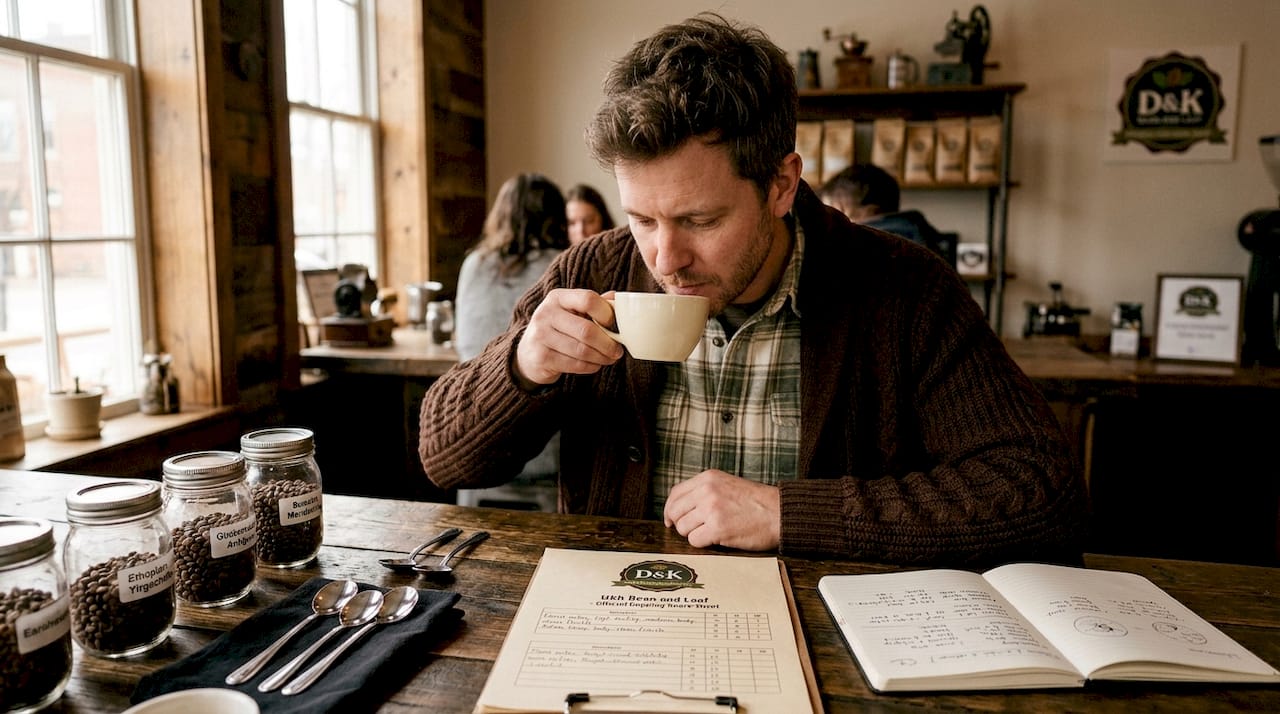
Here is where things get genuinely interesting, and where the CVA gets smarter than its predecessor. The Affective Assessment uses a 9-point hedonic scale to capture whether a taster enjoys the coffee, entirely separate from its technical quality. A natural-processed Ethiopian coffee might score 87 descriptively but land at a 6 on someone’s preference scale because they dislike fermented-forward flavors. Both pieces of information are valid and useful.
Separating descriptive from affective scoring prevents personal taste from distorting the objective quality record. This protects both buyers and producers from a system where one person’s palate disqualifies a genuinely excellent coffee.
Extrinsic assessment
This component captures everything happening outside the cup. Origin details, processing method (washed, natural, honey), certifications like Fair Trade or organic, and information about the farm’s labor practices all factor in. Origin and sustainability factors increasingly matter to consumers, and the CVA formalizes that by making them part of the official evaluation. It is also worth noting that the CVA supports modular adoption, meaning roasters and buyers can prioritize certain assessments based on their immediate needs without abandoning the whole system.
Pro Tip: If you are tasting specialty coffees at home, try writing down your descriptive notes before deciding whether you like the coffee. You might be surprised how often a technically excellent cup is not your personal favorite, and that is completely fine.
How specialty coffee differs in production and experience
Scoring frameworks explain what qualifies a coffee. Production tells you why that quality exists in the first place.
Specialty coffee is generally:
- Grown at optimal altitude and latitude, often between 1,000 and 2,000 meters, where slower cherry development creates denser beans with more complex sugars.
- Harvested selectively by hand, with pickers choosing only fully ripe cherries rather than stripping entire branches.
- Processed with precision, whether washed, natural, or honey-processed, to highlight specific flavor characteristics rather than just remove the fruit efficiently.
- Roasted in small batches, often with specific roast profiles designed for each lot rather than a one-size-fits-all approach.
The result is a cleaner, more complex cup with consistent character from bag to bag. Specialty roasters typically work directly with farms or importers with known supply chains, which means when a bag says “single-origin Ethiopia Yirgacheffe,” that claim is verifiable.
Commercial coffee, by contrast, prioritizes volume and consistency across massive blends. Neither model is inherently dishonest. They serve different markets. But the difference between specialty and commercial coffee is not just taste. It is the entire philosophy of how the crop was grown, handled, and evaluated before it reached you.
Understanding how roast level affects flavor is another practical way to engage with specialty coffee. A lighter roast on a high-quality bean often reveals fruity or floral notes that a darker roast would mask entirely.
How to recognize and buy genuine specialty coffee
Most of us are not licensed Q Graders walking into a café with a scoring sheet. Here is how to make smart choices without needing credentials:
- Check for a roast date. Specialty coffee is meant to be consumed within four to six weeks of roasting. If there is no roast date on the bag, that is a red flag.
- Look for origin specificity. “100% Arabica” tells you very little. “Colombia Nariño, Finca Las Mercedes, washed” tells you exactly where the coffee came from and how it was processed.
- Read the flavor notes with curiosity, not skepticism. “Stone fruit and dark chocolate” is not pretension. It is a shorthand description of what the descriptive assessment found. Your job is to see if you pick it up.
- Support transparent brands. Roasters who share farm names, altitude, processing details, and their sourcing relationships are demonstrating the transparency that defines specialty coffee’s value chain.
- Trust your own palate. The Affective Assessment exists precisely because your preference is legitimate data. Specialty coffee at 82 points that you love beats a 90-point coffee you find unpleasant every time.
Pro Tip: Buy in smaller quantities more frequently. A 250-gram bag consumed within three weeks will always outperform a 1-kilogram bag that sits open for two months, even if both coffees technically qualify as specialty grade.
My take on specialty coffee’s evolving definition
For years, the coffee world treated the cupping score like a verdict. Hit 80, you are in. Score below that, you are out. I get why that felt clean and objective. But I have always thought it missed something real.
The CVA’s structure changed how I think about what makes a coffee worth paying for. When I taste a natural-processed Burundi and score it 84 descriptively but a 6 on the hedonic scale, that is honest information. It means the coffee is genuinely good and not to my taste. Old systems would have muddied those two facts together and produced a number that was technically neutral but practically misleading.
What I find more compelling is the extrinsic layer. Specialty coffee consumption in the U.S. has grown 84% since 2011. That growth is not driven by people suddenly caring more about acidity. It is driven by consumers wanting to know where their food comes from. The extrinsic assessment formalizes what the market was already demanding.
My advice: stop chasing high scores and start chasing coffees whose full story resonates with you. Explore the sensory experience with genuine curiosity. The score gets you to the door. Your palate and your values decide whether to walk through it.
— Kristopher
Explore specialty coffee with Dkbeanleaf
At Dkbeanleaf, specialty coffee is not just a product category. It is a standard we take seriously. Every selection in our lineup is chosen with traceability, freshness, and cup quality in mind, because you deserve to know exactly what you are drinking and where it came from.
Pair your morning ritual with a white glossy mug built for the way specialty coffee deserves to be served, or grab a travel mug with a handle for when the day does not slow down. If you are a tea drinker who appreciates the same sourcing standards, our curated tea collection applies that same philosophy to every steep. Great coffee starts with what is in the bag. Great mornings start with Dkbeanleaf.
FAQ
What score makes a coffee specialty grade?
Coffees that score 80 points or above on the SCA’s 100-point scale are considered specialty grade. Scores of 90 and above represent exemplary, competition-level quality.
What is the Coffee Value Assessment?
The CVA is the SCA’s current evaluation framework, assessing coffee through four components: Physical, Descriptive, Affective, and Extrinsic. It replaced the older cupping form to produce a more transparent and complete picture of a coffee’s value.
Does specialty coffee always taste better?
Not necessarily. The Affective Assessment acknowledges that high technical scores and personal preference are two separate things. A coffee can be technically excellent and still not match your individual taste.
What is the difference between specialty and commercial coffee?
Specialty coffee scores above 80 on the SCA scale, is typically traceable to a specific origin, and is evaluated holistically. Commercial coffee prioritizes volume and consistency, often scoring below 80, with limited supply chain transparency.
How can I tell if a coffee is genuinely specialty grade?
Look for a listed SCA score above 80, a roast date within the past six weeks, and specific origin details like farm name, country, and processing method. These markers signal genuine specialty grade quality rather than marketing language.