

Is Crazing on Mugs Safe? What the Cracks Actually Mean
Light crazing alone rarely poses an immediate health hazard for occasional use, but it can make a mug a poor choice for daily drinking unless the clay body is vitrified and you’re washing it properly. That’s the short answer to whether crazing on mugs is safe. If your mug shows those fine spiderweb lines under the glaze, don’t panic, but don’t ignore it either.
- Run the overnight water test below before your next use
- If the mug fails, stop daily use until you’ve checked it
- The verdict rests on three things: FDA food-contact guidance, lab washing studies from ceramics researchers, and Dkbeanleaf’s own experience with mug materials
Key Takeaways
Crazing itself is rarely dangerous; the clay body’s porosity and the glaze’s age and composition are what actually determine whether a mug is safe for food use.
| Point | Details |
|---|---|
| Crazing is cosmetic, porosity is the risk | A vitrified clay body under a crazed glaze is generally functionally safe; a porous body is not. |
| Test before you toss | The overnight water absorption test and a ring test both reveal porosity in minutes. |
| Cleaning matters more than looks | Hot, soapy washing or dishwasher cycles remove detectable bacteria from crazed samples in lab testing. |
| Vintage pieces need a lead check | Old or unmarked glazes can leach lead or cadmium, a risk crazing makes worse regardless of cleanliness. |
| Retire, don’t just discard | Failed mugs make good planters or pen holders; Dkbeanleaf offers vitrified mugs as a daily-use replacement. |
Table of Contents
- What Crazing Is and Why It Forms in Mugs
- What the Evidence Says About Bacteria, Leaching, and Real Risk
- Home Tests: How to Check a Mug for Porosity or Glaze Safety
- Cleaning and Sanitizing Routines That Reduce Microbial Risk
- When to Retire a Crazed Mug and Safe Repurposing Ideas
- What Actually Matters Here, and What Doesn’t
- Frequently Asked Questions
- Sources
What Crazing Is and Why It Forms in Mugs
Crazing is a network of fine cracks that forms in the glaze layer of a ceramic piece, not in the clay body underneath. It happens when the glaze and the clay cool at different rates after firing, creating a mismatch in thermal expansion. The glaze essentially shrinks faster or slower than the clay wants it to, so it splits into a web of hairline fractures. You’ll usually spot it as a spiderweb pattern, sometimes invisible until you add hot liquid or a bit of tea stain settles into the lines.
This is different from a crack or chip, which goes through the clay itself and can create sharp edges or structural weak points. Crazing stays cosmetic on the surface in many cases.
- Crazing affects only the glaze, not the mug’s structural integrity
- Cracks and chips compromise the clay body and are a separate concern entirely
- The clay’s own porosity, meaning how vitrified or “glassy” it became during firing, decides whether crazing matters for food safety
A dense, well-fired body resists moisture penetration even with a cracked glaze on top. A porous one doesn’t, and that distinction drives almost everything else in this guide.
What the Evidence Says About Bacteria, Leaching, and Real Risk
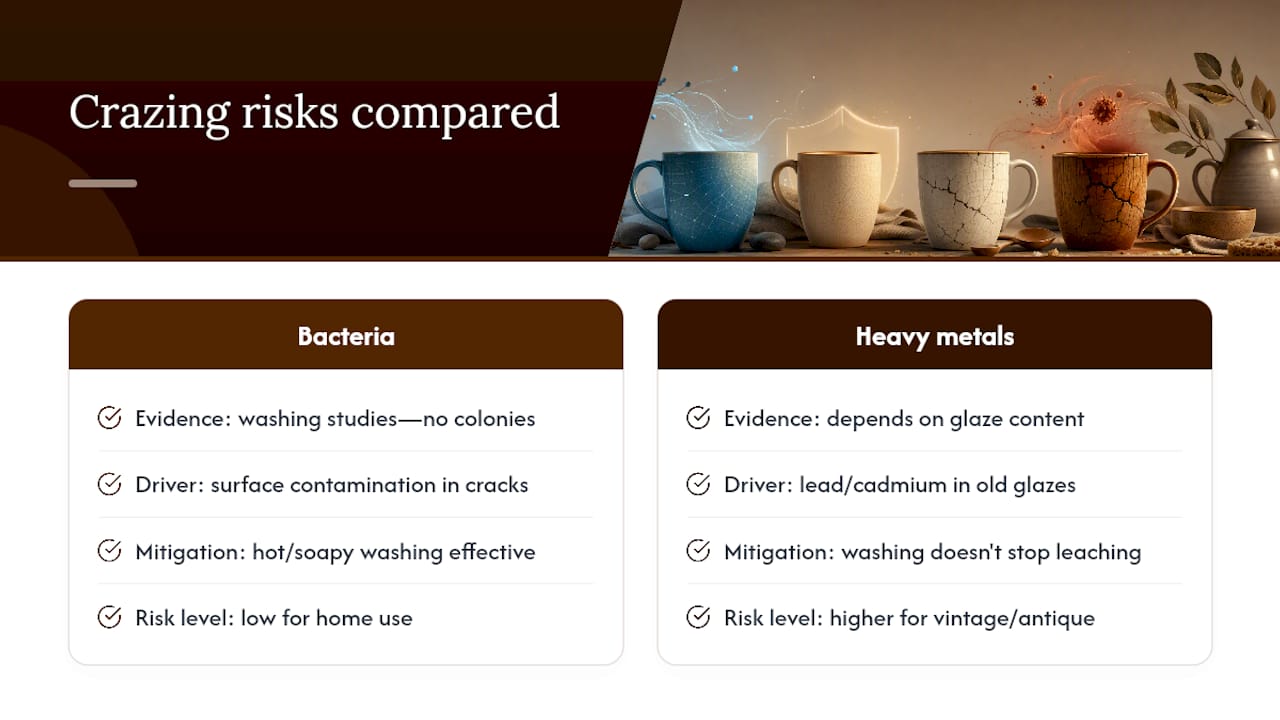
Professional food service holds itself to a stricter standard than your kitchen cabinet. The FDA Food Code specifies that food-contact surfaces in restaurants and commercial kitchens should be smooth and free of crazing or other surface irregularities. That’s a commercial benchmark built around high-volume, repeated use, not a blanket verdict for the mug sitting in your cupboard.
Lab testing tells a more reassuring story for home use. Washing studies covered by Ceramic Arts Network found that dishwasher cycles and hot, soapy hand washing removed or killed detectable bacteria on crazed glazed samples tested in triplicate. No colonies turned up after standard washing, even on pieces with visible surface cracking.
“The greatest hazard isn’t occasional use of a crazed cup. It’s porous clay bodies and improper food storage that create real risk,” according to analysis from DigitalFire, which concludes that routine hot washing effectively addresses bacterial concerns on most crazed ware.
The other risk runs separately from bacteria: heavy metals. Vintage and antique glazes sometimes contain lead or cadmium, and crazing gives those substances more surface area to leach from into your coffee or tea. That risk doesn’t depend on how clean the mug is. It depends on what’s in the glaze itself, which is why old flea-market finds deserve more scrutiny than a modern mug from a known maker.
Home Tests: How to Check a Mug for Porosity or Glaze Safety
You don’t need a lab to get a real answer here. Three simple checks tell you most of what matters.
- Run the overnight water test. Fill the mug with room-temperature water and let it sit overnight on a dry paper towel. In the morning, check the towel. Damp spots under the mug mean the clay body is absorbing water through the crazed glaze, a sign of porosity that raises real safety concerns.
- Try the ring test. Tap the mug gently with a spoon. A clear, bell-like ring usually points to a dense, well-vitrified body. A dull thud suggests a softer, more porous body, even if the glaze looks fine.
- Check for staining and rough patches. Run a finger over the crazed area. Persistent brown staining that won’t scrub out, or a rough, gritty feel, both suggest the glaze has let moisture and residue work into the surface repeatedly.
- Use a lead-test kit on anything vintage, handmade, or unmarked. These swab kits are cheap and take minutes. A positive result means stop using the mug for food or drink immediately, no exceptions.
Pro Tip: Keep a $10 lead-test swab kit in your kitchen drawer. It takes thirty seconds and settles the vintage-mug debate for good, instead of letting a “probably fine” mug linger in daily rotation for years.
Cleaning and Sanitizing Routines That Reduce Microbial Risk
If a crazed mug passes your home tests, cleaning habits become the thing that actually keeps it safe day to day.
- Run it through the dishwasher regularly. Heat and detergent are doing the real work, and the lab studies on crazed ceramic samples back that up directly.
- If you hand wash, use hot water and dish soap rather than a quick rinse. A detailed breakdown of dishwasher safety for mugs covers which materials hold up best under repeated heat cycles.
- Dry the mug fully before storing it. Damp storage in a cabinet gives bacteria far more time to establish themselves than a quick wash cycle ever would.
- Avoid stacking wet mugs. Trapped moisture between pieces is where lingering odor problems usually start.
Cleaning has limits, though. If a mug is in daily rotation and keeps developing stains or a musty smell no matter how you wash it, that’s the clay telling you it’s too porous for the job, not a washing failure.
When to Retire a Crazed Mug and Safe Repurposing Ideas
Some signals mean it’s time to pull a mug from the coffee rotation for good, no further testing needed.
- A positive result on the overnight water test or a lead-test kit
- Persistent odor or staining that survives a hot wash and dishwasher cycle
- Any suspicion of a lead or cadmium glaze, especially on vintage or unmarked pieces
- Heavy daily use on a mug you simply can’t keep clean between washes, based on consumer guidance on retiring cracked mugs from food use
Retiring a mug doesn’t mean the trash. A crazed mug still makes a fine planter for succulents, a pen and pencil holder on a desk, or a standalone decoration on a shelf where it never touches food again. Dkbeanleaf’s own repurposing guide walks through six practical projects for exactly this situation, several of which take under ten minutes.
Why Trust This Guidance on Mug Safety
This guidance comes from Kristopher, whose writing on ceramic mug care and materials appears throughout Dkbeanleaf’s blog, including a craft-focused explainer on how ceramic mugs are made. Dkbeanleaf sells and studies mugs daily, which shapes the practical, test-first approach here.
The goal isn’t to scare anyone away from a favorite mug. It’s to give you a thirty-second test instead of a guess.
What Actually Matters Here, and What Doesn’t
Most advice on crazing gets fixated on the glaze cracks themselves, which is the wrong focus. The clay underneath does the real work of keeping moisture, and whatever’s in it, out of your drink. A crazed mug on a well-vitrified body is closer to a cosmetic annoyance than a health threat. A crazed mug on a cheap, porous body is a different problem entirely, and no amount of scrubbing fixes that.
I’d also push back on the instinct to toss every crazed mug the moment lines appear. That overreacts to a cosmetic issue and underreacts to the two things that genuinely matter: porosity and glaze composition. Run the water test before you make any decision. It costs nothing and takes one evening.

Where I’d prioritize differently than most advice columns: test vintage and unmarked mugs for lead before worrying about crazing at all. That risk exists independent of the cracks and matters more for anything bought secondhand or inherited.
A Safer Mug Doesn’t Have to Mean Guesswork
If your water test came back damp, or you’re just tired of wondering whether a favorite mug is quietly failing you, the simplest fix is starting fresh with something built for the job. Dkbeanleaf’s mugs use vitrified, food-safe ceramic bodies designed to hold up under daily hot use without the porosity issues that make crazing a real concern in the first place.

Pair a new mug with something worth drinking out of it. Browse the tea collection and pick a loose-leaf blend to go with it, or check out drinkware options built specifically to avoid the porosity problems this article just walked through. Either way, you get a mug you can stop testing and start using.
Frequently Asked Questions
Is crazing on mugs safe for occasional use? Occasional use of a crazed mug is generally low risk if the clay body is vitrified and you wash it with hot, soapy water or run it through the dishwasher regularly.
Does crazing mean a mug has cracked all the way through? No. Crazing affects only the glaze layer. A structural crack or chip goes through the clay itself and is a separate, more serious issue.
Can crazed ceramics harbor harmful bacteria? Lab studies on crazed glazed samples found that standard dishwasher cycles and hot hand washing eliminated detectable bacteria, so proper cleaning largely addresses this concern.
Should I worry about lead in a crazed vintage mug? Yes. Vintage and antique glazes sometimes contain lead or cadmium, and crazing increases the surface area available for leaching. A lead-test kit settles this in minutes.
What’s the simplest home test for mug safety? Fill the mug with water, let it sit overnight on a dry paper towel, and check for dampness underneath in the morning. Moisture means the clay is porous and absorbing liquid through the glaze.
Sources
- FDA Food Code (2013)
- Techno File: Dirty Dishes — Ceramic Arts Network (Ceramics Monthly)
- Crazing and bacteria: Is there a hazard? — DigitalFire