Third Wave Coffee: What It Is and Why It Matters
Third wave coffee treats coffee the way a sommelier treats wine. It’s an artisanal movement built on knowing exactly where your beans came from, who grew them, how they were processed, and what roast profile best expresses their character. The result is a cup that tells a story rather than just delivering caffeine.
At its core, third wave coffee is defined by a few non-negotiable commitments:
- Quality focus: single-origin beans sourced from specific farms or regions, not blended commodity lots
- Origin traceability: full transparency about farm, farmer, and processing method
- Ethical sourcing: paying producers above commodity prices and investing in farm-level relationships
- Light-to-medium roasting: preserving the bean’s natural flavors rather than masking them with dark roast char
- Innovative brewing: methods like pour-over and Chemex that highlight what makes each origin distinct
This is coffee as an ingredient with a biography, not just a beverage.
What is third wave coffee, and where did it come from?
The story of third wave coffee runs through three distinct eras of American coffee culture, each one a reaction to what came before.
-
Late 19th century to mid-20th century (first wave): Coffee became a mass-market commodity. Brands like Folgers put canned, pre-ground coffee on every kitchen table. Convenience was the point; flavor was secondary. The consumer experience was purely about accessibility.
-
1960s to 1990s (second wave): A new generation of coffee drinkers wanted more. Roasters like Peet’s Coffee pioneered darker roasts and a European-style café experience. Espresso drinks became mainstream, and the coffee shop evolved into what sociologists call a “third place,” somewhere between home and work where people gathered socially. Regional origin labeling appeared, though beans were still often blended and roasted dark.
-
1970s roots, late 1990s formalization (third wave): The approach actually originated in the 1970s, with roasters like the Coffee Connection experimenting with lighter roasts and single-origin sourcing. The movement gained formal identity in 1999 when the term “third wave” was first coined, and writer Trish Rothgeb brought it into wide industry use in 2003.
-
Trish Rothgeb’s contribution: Rothgeb coined the term with a specific intention: to bring consumers into the world of coffee production and emphasize quality and authenticity, not elitism. She wanted the movement to be welcoming, not gatekeeping.
-
Timothy J. Castle’s parallel influence: Castle, a prominent coffee importer and writer, helped shape the early vocabulary around specialty coffee quality and traceability that third wave culture later built on.
-
The Specialty Coffee Association’s role: The Specialty Coffee Association of America provided the institutional platform for this new approach. It established the “Gold Cup” award to recognize cafés meeting rigorous quality standards, giving third wave values an official benchmark.
-
Emergence of competitions and education: Barista competitions, cupping events, and formal coffee education programs grew alongside the movement, turning barista craft into a recognized profession rather than a service job.
What does “third wave coffee” actually mean?
The term is more a cultural movement than a product category, and that distinction trips people up. You can buy a bag of specialty-grade beans and brew them carelessly. Third wave coffee is about the entire mindset surrounding that bean.
“Third wave coffee is a mindset focused on hospitality, guest care, and creating a deeper consumer-labor relationship beyond just the coffee product itself.” — Sarah Dooley, as cited in Perfect Daily Grind
That framing matters. Third wave coffee shops don’t just sell you a drink; they want you to understand what you’re drinking. Baristas share the bean’s origin story, explain the processing method, and describe what flavor notes to expect. Consumer education is built into the transaction.
The term also differs from “specialty coffee,” though the two overlap. Specialty coffee is a technical grade: the Specialty Coffee Association defines it as green beans scoring 80+ points on a 100-point scale. Third wave coffee is the cultural and ethical framework that surrounds those beans. A café can serve specialty-grade coffee without any third wave values, and a third wave café will almost always serve specialty-grade coffee. They’re related but not synonymous.
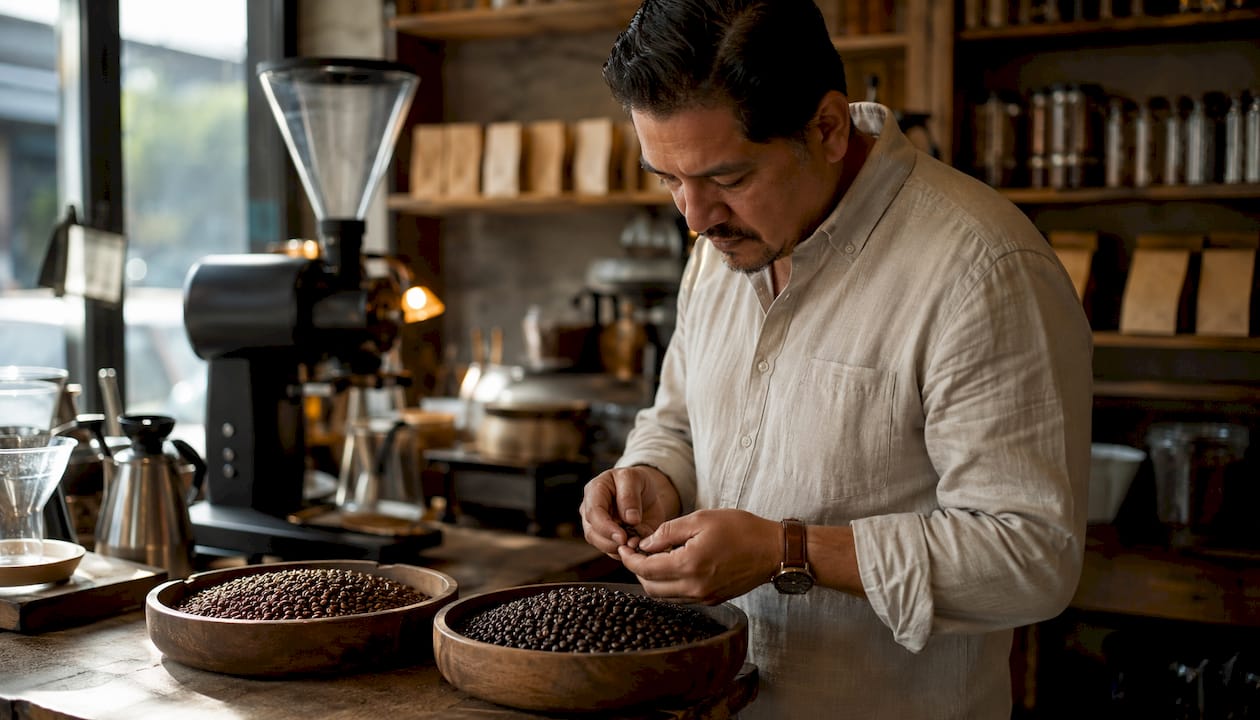
Pro Tip: When you visit a café and the barista can tell you the farm name, the harvest date, and the processing method for the coffee you’re about to drink, you’re in a third wave environment.
How third wave coffee changed the café experience
Third wave coffee transformed consumer expectations in ways that are now so normalized it’s easy to forget how recent they are. The idea that a barista would explain tasting notes, that a menu would list a coffee’s country and region of origin, or that a café would use a scale to measure brew ratios to the gram — none of that existed in mainstream coffee culture before this movement.
“The third wave includes ethics and sustainability, especially addressing threats to coffee species from climate change and the economic survival of the farmers who grow them.” — Sam Sobolewski, as cited in Time
The cultural impact goes well beyond the cup itself. Third wave values reshaped supply chains, pushed roasters to visit origin farms directly, and created direct-trade relationships that bypass traditional commodity brokers. Cafés became spaces for coffee education as much as consumption.
Present-day third wave values include:
- Transparency: publishing sourcing information, including farm names and processing details
- Sustainability: paying above commodity prices and investing in farm infrastructure
- Craft brewing: using methods that require skill and attention rather than automation
- Consumer education: treating every customer as someone capable of appreciating complexity
- Ethical accountability: acknowledging the environmental and economic pressures facing coffee-growing regions
How first, second, and third wave coffee differ
The three waves represent a clear progression in what coffee culture values, and understanding the differences makes the third wave’s priorities much sharper.
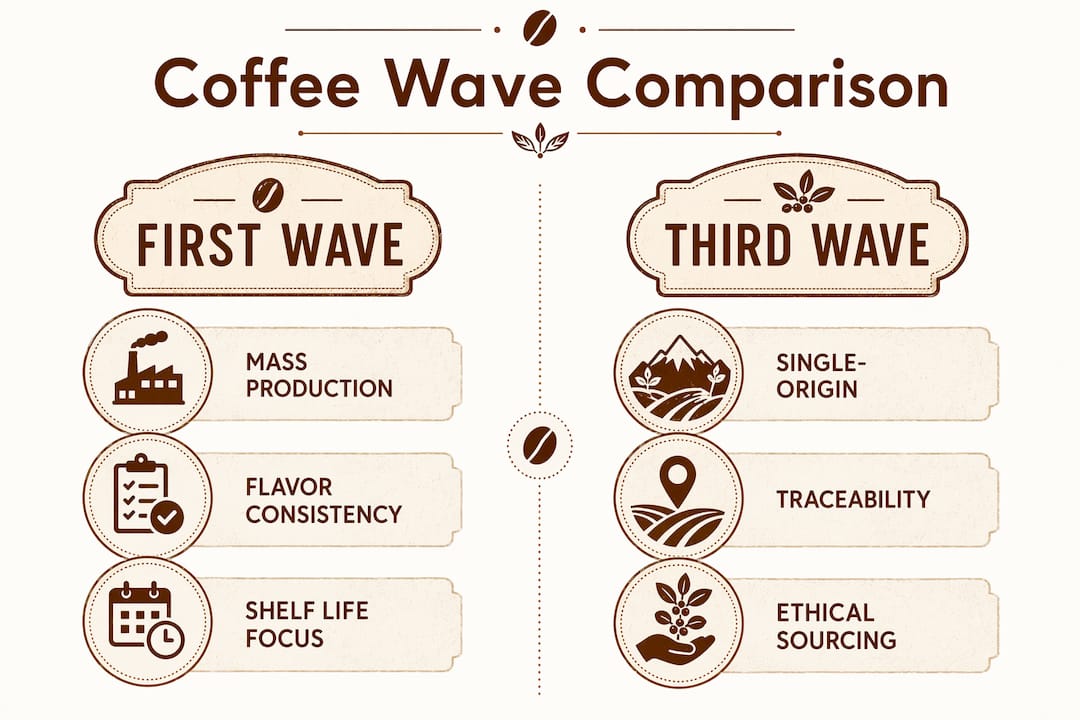
First wave coffee was about getting coffee into as many homes as possible. Flavor consistency mattered less than shelf life and price. The coffee was often pre-ground, canned, and designed to be brewed in large percolators. Origin was irrelevant; the goal was a hot, caffeinated drink available to everyone.
Second wave coffee shifted the focus to experience and ritual. Espresso-based drinks, flavored lattes, and the café-as-social-space defined this era. Consumers learned to distinguish between a cappuccino and a macchiato, and regional labels like “Colombian” or “Kenyan” appeared on bags, though the beans were still often blended and roasted dark to produce a consistent house flavor. The coffee shop became a destination, not just a pit stop.
Third wave coffee moved the conversation to the bean itself. The consumer experience evolved from convenience to social ambiance to artisanal focus, with education and transparency at the center. Roasting shifted lighter to preserve origin character rather than create a uniform profile. Brewing methods became tools for expression, not just extraction. And the farmer, previously invisible, became part of the story told at the point of sale.
The clearest way to see the difference: a first wave drinker asks for “coffee,” a second wave drinker asks for “a latte,” and a third wave drinker asks what the processing method was on the Ethiopian natural they saw on the menu board.
What the specialty coffee standards and third wave culture actually look like together
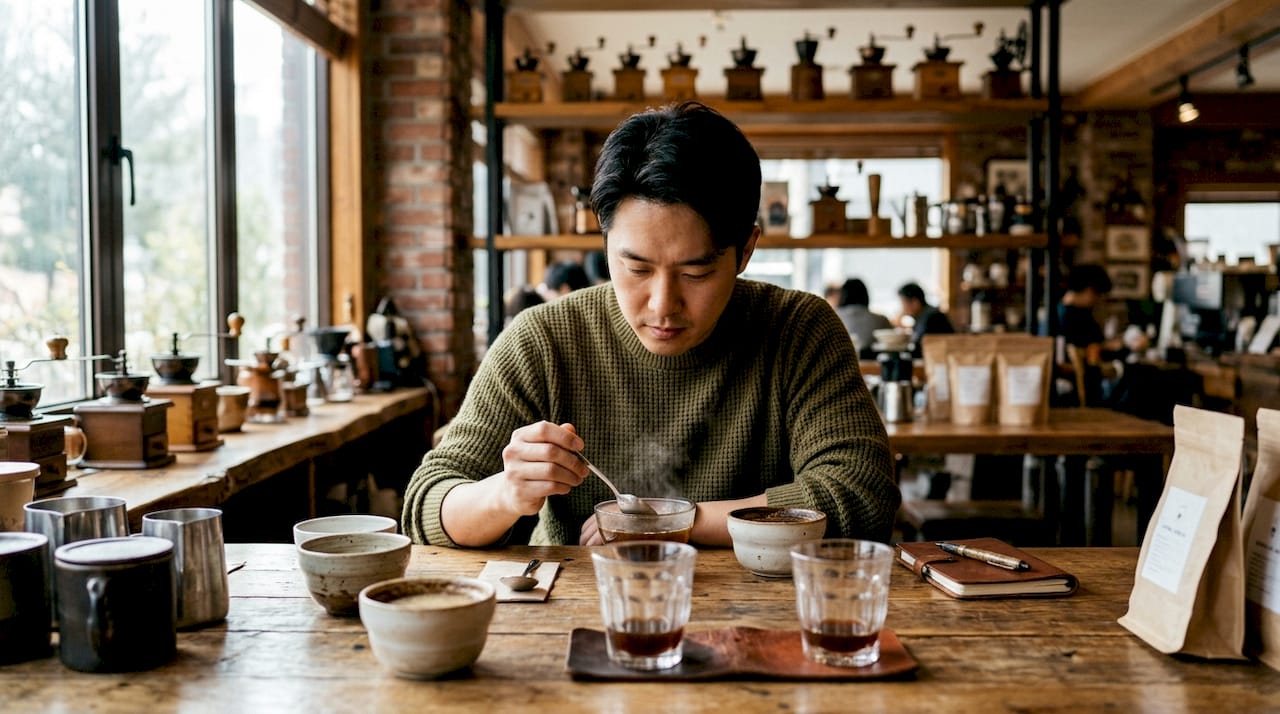
The technical and cultural sides of third wave coffee are distinct but inseparable in practice. Here’s how they compare:
| Dimension | Specialty Coffee Standard | Third Wave Cultural Mindset |
|---|---|---|
| Definition | Beans scoring 80+ points on the SCA 100-point scale | A movement prioritizing quality, ethics, and education |
| Focus | Bean quality at origin and in the cup | Full supply chain transparency and consumer relationship |
| Measurement | Objective cupping scores by trained Q Graders | Subjective experience, storytelling, and hospitality |
| Roasting | Preserves origin character; often light to medium | Light roasting to highlight terroir and processing notes |
| Brewing | Precision methods: pour-over, Chemex, AeroPress | Methods chosen to express each bean’s specific character |
| Producer relationship | Quality-based sourcing | Direct trade, above-commodity pricing, farm investment |
The SCA’s 80-point threshold is the entry ticket. Third wave culture is what happens after you walk through the door.
“Third wave coffee is about coffee shops being true to themselves and committed to high-quality delivery. It was never meant to be an elitist concept.” — Trish Rothgeb, as cited in Roastopedia
The industry debate worth knowing: some voices now consider the third wave largely complete as a movement, with a “fourth wave” emerging around advanced fermentation science, real-time data in roasting, and intensive climate sustainability work. Whether you call it a fourth wave or the maturation of the third, the direction is clear: coffee culture keeps getting more technical and more ethically aware.
Key Takeaways
Third wave coffee is an artisanal movement that treats coffee as a product with a traceable story, ethical sourcing, and flavors worth understanding rather than just consuming.
| Point | Details |
|---|---|
| Third wave defined | An artisanal movement prioritizing single-origin beans, transparency, ethical sourcing, and light roasting. |
| Term coined in 1999 | Trish Rothgeb formalized the term in 2003 to emphasize quality and authenticity, not exclusivity. |
| Distinct from specialty coffee | Specialty coffee is a technical grade (SCA 80+ points); third wave is the cultural and ethical framework around those beans. |
| Key brewing shift | Methods like pour-over replaced espresso-centric approaches to highlight each origin’s distinct character. |
| Ongoing evolution | Industry voices point to a fourth wave focused on fermentation science and climate sustainability. |
Why third wave coffee changed how I think about what’s in my cup
The thing most coffee writing gets wrong about the third wave is treating it as a style of café. It’s not. It’s a set of values that happen to express themselves through cafés, roasters, and brewing equipment. Strip away the pour-over kettles and the single-origin tasting notes, and what you’re left with is a simple idea: the people who grew this coffee deserve to be known, and the coffee itself deserves to be understood.
What strikes me about the movement is how it reframed the barista’s role. Before the third wave, a barista was a person who operated an espresso machine. After it, a barista became something closer to a guide, someone who could explain why a washed Ethiopian tastes like bergamot and lemon while a natural processed one from the same region tastes like blueberry jam. That shift in expectation changed the entire dynamic of what it means to order a coffee.
The criticism worth taking seriously is that third wave culture can tip into performance. When the sourcing story becomes more important than the cup, or when the minimalist café aesthetic signals quality without delivering it, the movement loses its grounding. Rothgeb herself was clear that the third wave was never meant to be elitist. The goal was always to bring more people into a genuine appreciation of coffee, not to create a new hierarchy.
Where it goes from here is genuinely interesting. The fourth wave conversation, centered on fermentation data and climate resilience, suggests the industry isn’t done asking hard questions. At Dkbeanleaf, that spirit of curiosity about what’s in the cup and where it came from is exactly what drives the way we think about coffee and tea. If you want to wear that same curiosity on your sleeve, our coffee culture tees and hats and caps are made for people who take their cup seriously.