

How Altitude Shapes Coffee Flavor: a Connoisseur's Guide
Altitude is the single most discussed environmental variable in specialty coffee, and the role of altitude in coffee flavor is direct: higher elevations slow cherry maturation, which forces beans to accumulate more sugars, organic acids, and aromatic compounds before harvest. The result is a denser, more chemically complex bean that tastes fundamentally different from its low-elevation counterpart. Regions like Ethiopia’s Yirgacheffe (above 1,800 meters), Guatemala’s Huehuetenango (1,500 to 2,000 meters), and Colombia’s Nariño (above 2,000 meters) have built global reputations almost entirely on this principle. Understanding how elevation and coffee quality connect gives you a reliable framework for predicting what’s in your cup before you brew a single gram.
How altitude influences coffee bean development and chemistry
The mechanism behind altitude effects on coffee starts with temperature. The environmental lapse rate drops temperature roughly 6.5°C for every 1,000 meters of elevation gain. Cooler air slows the metabolic activity inside a coffee cherry, stretching the ripening window from weeks into months. That extended timeline is where flavor complexity is born.
During this slower ripening, the cherry has more time to convert starches into fermentable sugars and to synthesize organic acids like citric, malic, and phosphoric acid. These compounds become the aromatic precursors that survive roasting and express themselves as the bright, fruity, or floral notes you taste in a well-sourced high altitude coffee bean. The bean also grows denser and smaller, packing more dissolved solids into a tighter cellular structure.
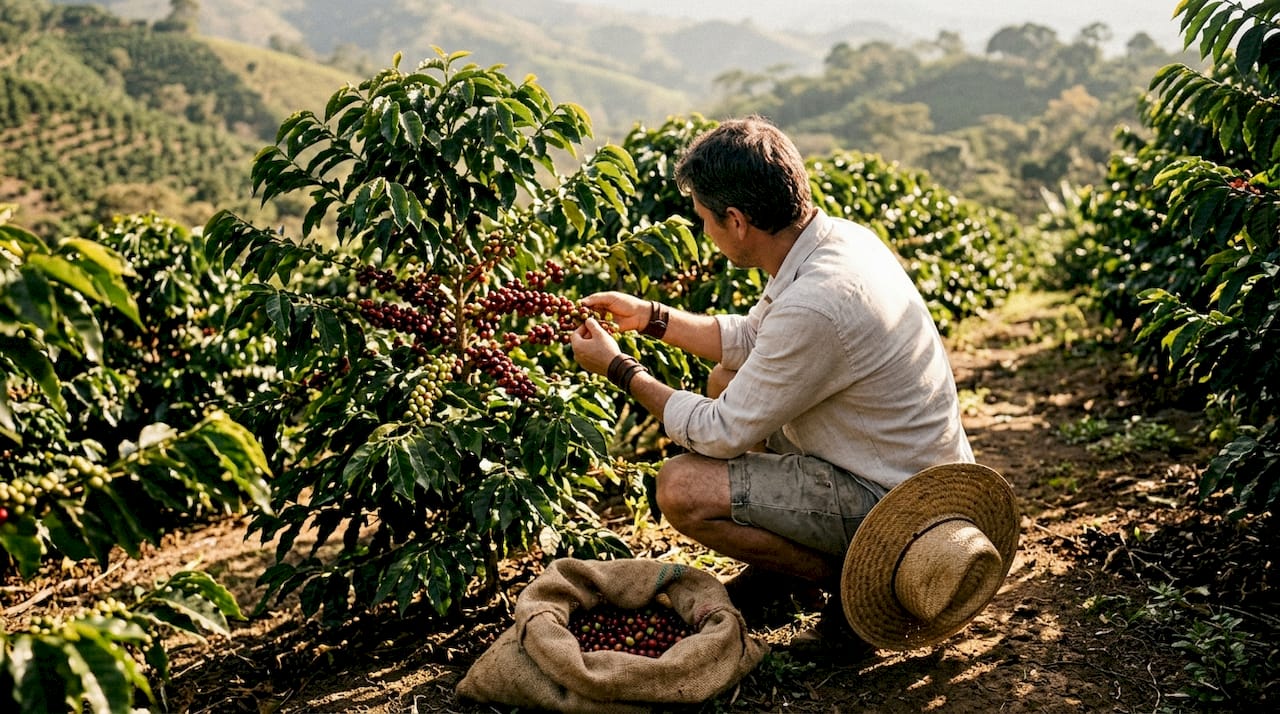
That density has a measurable impact at the brewing stage. Elevation explains about 25.6% of extraction yield variation, meaning high-altitude beans release more solubles per gram than low-altitude beans under identical brew conditions. This is not a trivial difference. It means your standard recipe may over-extract a Kenyan AA from 1,900 meters while under-extracting a Brazilian natural from 900 meters.
Key chemical compounds affected by altitude include:
- Chlorogenic acids: Higher concentrations in high-altitude beans contribute to perceived brightness and antioxidant character.
- Caffeine: Remains relatively stable across elevations but interacts with other compounds differently in denser beans.
- Nicotinic acid: Influences aroma development during roasting and is more concentrated in slower-ripened cherries.
- Sucrose: Accumulates in greater quantities during extended maturation, providing the sweetness foundation that balances acidity.
Pro Tip: When you see MASL (meters above sea level) on a coffee bag, treat it as a density indicator. Beans grown above 1,500 MASL will almost always require a coarser grind and a slightly longer brew time than the same roast level from a lower elevation.
Understanding how coffee cherry ripening connects to flavor gives you a much sharper lens for reading origin labels.
What flavor profiles can you expect by elevation?
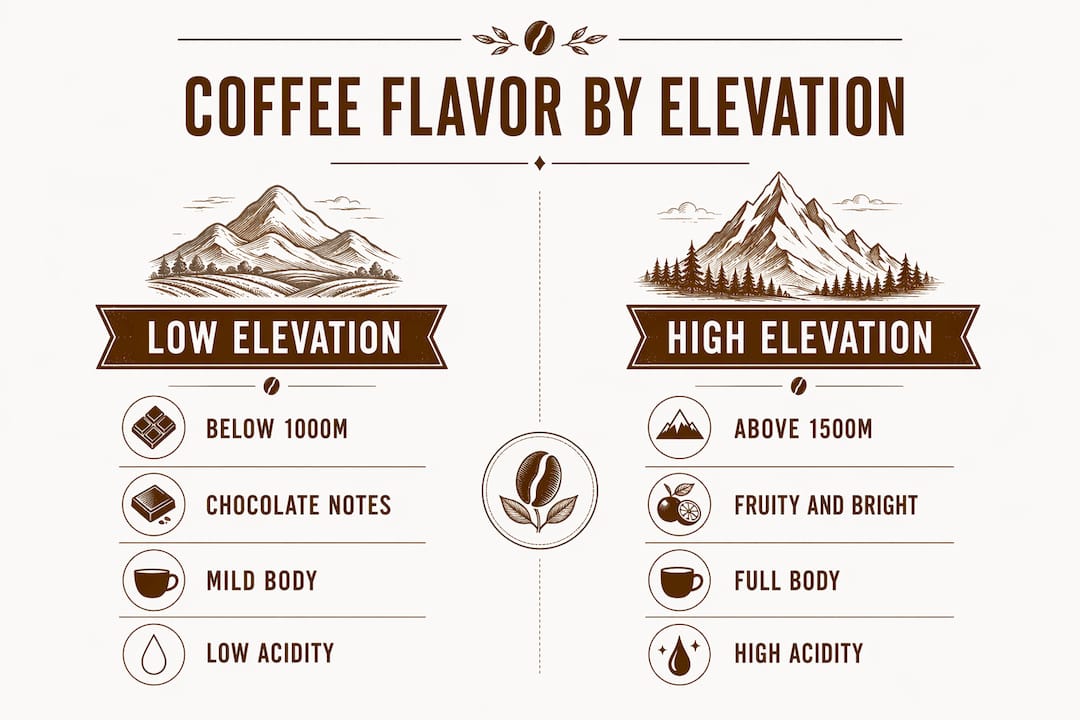
Coffee flavor by elevation follows a consistent pattern across origins, though terroir, variety, and processing all modify the final result. Here is the practical breakdown:
| Elevation range | Typical flavor notes | Body and acidity |
|---|---|---|
| Below 1,000m | Chocolate, nuts, mild fruit, earthy | Full body, low acidity |
| 1,000 to 1,500m | Caramel, hazelnut, stone fruit | Medium body, moderate acidity |
| 1,500 to 2,000m | Citrus, berry, floral, honey | Light to medium body, bright acidity |
| Above 2,000m | Jasmine, peach, tea-like, complex fruit | Delicate body, intense acidity |
Flavor profiles shift predictably with altitude: low elevation yields chocolate, nuts, and smooth body, while high elevation yields floral, berry, citrus, and honey notes with crisp acidity. This table is a starting point, not a guarantee.
A few important nuances to keep in mind:
- Variety matters: A Gesha grown at 1,400 meters will outperform a Caturra at 1,900 meters in floral complexity, simply because of genetics.
- Processing method: A natural-processed coffee from 1,200 meters can taste fruitier than a washed coffee from 1,800 meters, because fermentation adds its own fruit-forward character.
- Consumer preference: High-altitude coffees have polarizing acidity and brightness, preferred in specialty coffee circles but less appealing to drinkers who favor smooth, low-acid cups. Neither preference is wrong.
The types of coffee beans grown at each elevation also shape the flavor ceiling. Arabica dominates above 1,000 meters because it thrives in cooler conditions. Robusta, which grows best below 800 meters, produces a different flavor profile by design, not by deficiency.
How does altitude affect roasting and brewing?
Roasting high-altitude beans is where many roasters either unlock or destroy the complexity that elevation built. Dense high-altitude beans resist heat and require slower development phases and controlled heat application to preserve brightness. Rushing the roast with aggressive heat causes the outer layers to develop faster than the core, producing a bean that tastes baked or harsh rather than clean and bright.
Dark roasting is the most common way to erase altitude-derived complexity. When a high-altitude Ethiopian or Guatemalan bean gets pushed to a French or Italian roast, the chlorogenic acids and aromatic precursors that took months to develop are burned off in minutes. The result tastes like any other dark roast, regardless of origin. Roasters report that high-altitude beans’ complexity demands precise roasting, and misuse often yields harsh flavors rather than balanced cups.
Understanding coffee roast levels and how they interact with bean density is one of the most practical skills a coffee enthusiast can develop.
For home brewers, the grinding behavior of high-altitude beans creates a specific challenge. Denser beans produce more fines during grinding, which increases surface area and accelerates extraction. If you use the same grind setting for a high-altitude Kenyan as you do for a low-altitude Brazilian, you will likely over-extract the Kenyan and get a bitter, astringent cup.
Practical adjustments for brewing high-altitude coffees:
- Grind coarser than your default setting when working with beans above 1,500 MASL.
- Use pour-over with paper filtration to highlight clarity and bright notes. Methods like Hario V60 or Chemex filter out the fines that cause bitterness.
- Lower your brew water temperature slightly, to around 90 to 93°C, to avoid scorching the delicate aromatic compounds.
- Extend your bloom time to 45 seconds. Denser beans off-gas CO2 more aggressively, and a longer bloom improves even saturation.
Pro Tip: If your high-altitude coffee tastes bitter rather than bright, the problem is almost always grind size. Dial one or two steps coarser before adjusting any other variable. Pour-over techniques are particularly effective for showcasing the clarity that high-altitude beans offer.
Why altitude isn’t the only factor in coffee flavor
Altitude is a strong flavor indicator, but it is not a quality guarantee. Altitude interacts with genetics, processing, and terroir to set a flavor direction, not a final outcome. A poorly managed farm at 2,000 meters can produce a flat, defective cup, while a skilled producer at 1,100 meters using careful fermentation and sorting can produce something genuinely exceptional.
The specialty coffee industry uses terms like SHB (Strictly Hard Bean) and SHG (Strictly High Grown) to classify beans grown above certain altitude thresholds, typically 1,200 to 1,400 meters depending on the country. These designations signal density and potential complexity, but they do not certify flavor quality. SHB is a production classification, not a taste score.
Several factors that can override or significantly modify altitude’s influence:
- Genetics and variety: Heirloom Ethiopian varieties and Gesha carry flavor complexity that lower-altitude growing cannot suppress.
- Processing method: Washed, natural, and honey processing each add distinct flavor layers that interact with altitude-derived characteristics.
- Terroir: Soil mineral content, rainfall patterns, and shade cover all affect how altitude’s temperature advantage translates into cup quality.
- Post-harvest handling: Improper drying or storage can introduce defects that no amount of elevation can fix.
The most informed way to buy coffee is to read altitude alongside tasting notes, roast level, and processing method together. Altitude tells you what the bean is capable of. Everything else determines whether that potential was realized.
Key takeaways
Altitude sets the flavor ceiling for coffee, but roasting, processing, and brewing determine whether that ceiling is ever reached.
| Point | Details |
|---|---|
| Altitude slows ripening | Cooler temperatures at higher elevations extend cherry maturation, building sugar and acid complexity. |
| Density affects extraction | High-altitude beans release more solubles per gram, requiring coarser grinds and adjusted brew ratios. |
| Flavor follows elevation | Below 1,000m yields chocolate and nuts; above 1,500m yields citrus, floral, and bright acidity. |
| Dark roasts erase altitude gains | Roasting high-altitude beans too dark destroys the aromatic compounds that elevation built. |
| Altitude is one variable | Genetics, processing, and terroir can override or amplify altitude’s flavor contribution significantly. |
Altitude as a starting point, not a verdict
I have spent years tasting coffees across every elevation band, and the most useful thing altitude has ever done for me is narrow my expectations before the first sip. It is a reliable shortcut, not a rigid rule. When I see a washed Yirgacheffe at 1,900 MASL, I expect jasmine and lemon. When I see a natural Brazilian at 900 MASL, I expect chocolate and low acidity. I am right often enough that altitude has become the first number I look for on any bag.
But the most memorable cups I have had did not always come from the highest elevations. A honey-processed Costa Rican from 1,300 meters once outperformed a washed Kenyan from 1,800 meters in sheer complexity, because the producer’s fermentation work was extraordinary. That experience recalibrated how I weight altitude against processing. Altitude sets the potential. Processing and roasting decide whether you get there.
My advice for any serious coffee drinker is to use altitude as your first filter, then let tasting notes and roast level refine your choice. If you are new to high-altitude coffees, start with a light roast from Ethiopia or Colombia above 1,700 MASL and brew it as a pour-over. That combination gives altitude the best possible chance to show you what it can do. Once you have tasted that brightness and floral complexity, you will understand why elevation is the first thing specialty roasters put on the bag.
— Kristopher
Explore altitude-driven coffees with Dkbeanleaf

At Dkbeanleaf, the coffees in our selection are chosen with elevation and flavor profile in mind, so you can taste the difference altitude makes without guesswork. Whether you are drawn to the bright citrus and floral notes of a high-altitude Ethiopian or the smooth chocolate body of a lower-elevation Brazilian, our coffee collection is organized to help you find what your palate is looking for. Pair your next brew session with one of our unisex organic sweatshirts, because the best cups deserve the most comfortable mornings. If you want to branch out beyond coffee, our tea selection offers a different kind of altitude-influenced flavor exploration worth trying.
FAQ
What is the role of altitude in coffee flavor?
Altitude slows cherry ripening through cooler temperatures, allowing beans to accumulate more sugars, organic acids, and aromatic compounds. This produces denser beans with brighter acidity, more complex fruit notes, and greater overall flavor depth.
Does altitude affect coffee aroma?
Yes. Slower maturation at higher elevations allows greater development of aromatic precursors, including nicotinic acid and chlorogenic acid derivatives. These compounds produce the floral, citrus, and berry aromas associated with high-altitude coffees from origins like Ethiopia and Kenya.
What elevation produces the best coffee?
There is no single best elevation. Coffees above 1,500 MASL tend to offer the most complexity and brightness, but genetics, processing, and roasting determine whether that potential is realized. A well-processed coffee from 1,200 meters can outperform a poorly managed crop from 2,000 meters.
Why do high-altitude beans require a coarser grind?
Denser beans fracture differently in grinders and produce more fines, which accelerates extraction and increases bitterness risk. Grinding coarser compensates for this by reducing surface area and slowing the extraction rate.
What do SHB and SHG mean on a coffee bag?
SHB (Strictly Hard Bean) and SHG (Strictly High Grown) are altitude-based density classifications used in countries like Guatemala and Honduras. They indicate beans grown above approximately 1,200 to 1,400 meters, signaling density and flavor potential, though not a guaranteed cup quality score.