

What Is Terroir in Coffee: A Connoisseur's Guide
Terroir in coffee is defined as the complete set of environmental conditions, including altitude, soil mineral content, climate, rainfall, and microbial ecosystems, that shape a coffee bean’s flavor and chemical profile before it ever reaches a roaster. The concept borrows from wine but runs just as deep in coffee. Higher altitudes correlate with increased phenolic content and acidity, while caffeine levels actually decrease as elevation rises. That single fact tells you terroir is not just geography. It is chemistry. Understanding coffee terroir gives you a framework for predicting what a cup will taste like based purely on where and how the coffee grew.
What is terroir in coffee, and what factors define it?
Terroir is the sum of interacting environmental variables that no farmer can fully replicate elsewhere. Single factors like altitude alone inadequately represent terroir. The best assessments consider altitude, soil, climate, shade, slope, wind, and local ecosystem together.
Each factor plays a distinct role:
- Altitude slows cherry ripening at higher elevations and cooler temperatures. Slower ripening builds more sugars and acids inside the bean, which is why high-grown coffees often taste brighter and more complex.
- Soil mineral composition directly supplies the nutrients a coffee plant draws on during growth. Boron in the soil links to fruity flavor notes, while Magnesium, Phosphorus, and Zinc associate with rough or astringent flavors.
- Climate variables including temperature swings, rainfall timing, humidity, and wind determine how evenly a cherry develops. A dry season that arrives too early stresses the plant and compresses flavor development.
- Microclimates and slope create variation even within a single farm. A north-facing slope at 1,600 meters can produce a noticeably different cup than a south-facing plot 200 meters away on the same property.
- Microbial communities in the soil and on the cherry surface form what researchers now call “microbial terroir.” Bacterial taxa abundances differ across farms with distinct flavor profiles, meaning the invisible life in the soil is shaping what you taste.
Pro Tip: When reading a coffee’s origin label, look beyond the country. A farm’s altitude, soil type, and regional microclimate tell you far more about expected flavor than the country name alone. Use a resource like Dkbeanleaf’s guide on altitude and coffee flavor to decode those details.
How does terroir influence the chemical and sensory profile of coffee?
Terroir works by modulating the concentration of specific chemical compounds inside the green bean. Terroir modulates chlorogenic acids and trigonelline, two compounds that directly shape bitterness, acidity, and the body of a brewed cup. Chlorogenic acids break down during roasting into flavor-active molecules, so a bean with higher phenolic content going in will produce a more complex cup coming out.
Soil nutrients create measurable flavor signatures. Random forest models accurately predict flavor from soil characteristics, which means the link between soil chemistry and cup quality is now quantifiable, not just anecdotal. A farm with high Boron levels consistently produces coffees with fruity notes. A farm with elevated Magnesium and Zinc tends toward rougher, less refined cups. Wetness index and organic matter in the soil predict caramel notes with statistical reliability.
“Terroir modulates key chemical compounds such as chlorogenic acids and trigonelline that shape coffee’s flavor potential, which farmers can use for precise management. Chemical markers influenced by terroir affect coffee bean quality and flavor expression.” Integration of chemical analysis with sensory testing for terroir assessment
The table below maps the main terroir factors to their chemical and sensory effects:
| Terroir factor | Chemical effect | Sensory result |
|---|---|---|
| High altitude | Increased phenolic content, lower caffeine | Bright acidity, complexity |
| Boron-rich soil | Enhanced fruity compound development | Fruity, berry-like notes |
| High Magnesium/Zinc soil | Elevated rough flavor precursors | Astringency, rough finish |
| High organic matter and wetness | Caramel-linked compound formation | Caramel, sweet body |
| Microbial diversity | Altered flavor precursor metabolism | Unique, farm-specific signatures |
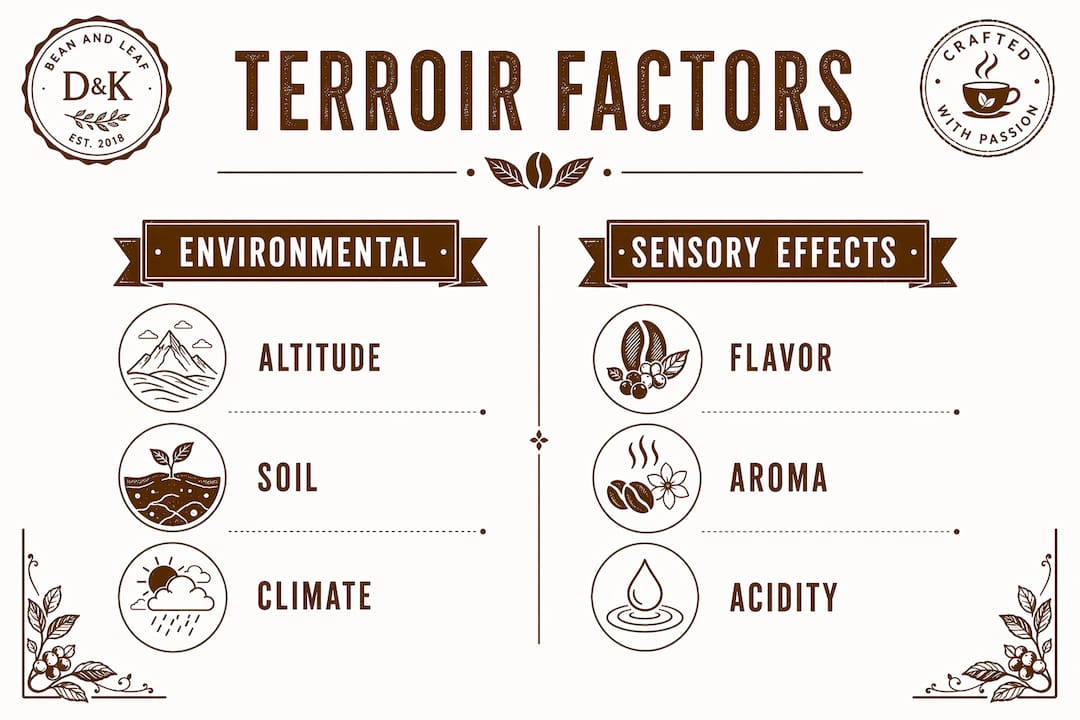
Sensory evaluations confirm that terroir zones produce distinct, repeatable flavor profiles. That repeatability is what makes terroir a reliable tool for sourcing, not just a romantic idea.
What distinguishes terroir from coffee processing and roasting?
Terroir shapes the raw flavor potential of a bean before harvest. Processing, roasting, and brewing then modify that potential. The distinction matters because confusing the two leads to poor sourcing decisions.
Post-harvest processing, roasting, and brewing modify or emphasize terroir but do not change the environmental origin of flavor potential. A natural-processed Ethiopian coffee tastes fruity partly because of terroir and partly because the processing method amplifies those fruit compounds. Strip away the processing and the terroir-driven fruitiness is still there, just quieter.
Here is how each stage interacts with terroir:
- Processing can amplify or mask terroir expression. Wet processing tends to preserve the clean, origin-driven flavors that terroir creates. Natural processing adds fermentation-derived notes on top. You can read more about this dynamic in Dkbeanleaf’s breakdown of wet processed coffee.
- Roasting transforms chlorogenic acids and trigonelline into hundreds of flavor-active compounds. A light roast preserves more of the terroir-driven acidity and fruitiness. A dark roast overwrites much of it with roast-derived bitterness. Dkbeanleaf’s guide on how roasting shapes flavor explains this chemistry in depth.
- Brewing extracts selectively from whatever the roast left behind. Brew method, water temperature, and grind size all determine which terroir-linked compounds reach your cup.
The industry consensus is clear: terroir is one foundational pillar, and processing plus roasting are the others. Ignoring any one of them gives you an incomplete picture of cup quality.
How does understanding terroir enhance coffee sourcing and tasting?
Terroir knowledge turns coffee tasting from guesswork into a skill. When you know that a Yirgacheffe from Ethiopia grows at elevations above 1,800 meters on iron-rich red clay soils, you can predict bright acidity, floral aromatics, and a light body before you ever open the bag. That predictive ability is what separates a connoisseur from a casual drinker.
Practical ways to apply terroir knowledge:
- Read origin labels with specificity. Country of origin is the least useful data point. Look for region, farm name, altitude, and processing method. A coffee labeled “Ethiopia, Yirgacheffe, 1,900m, washed” tells you far more than “Ethiopian blend.”
- Seek out single-origin coffees. Single-origin sourcing isolates terroir expression. Blends mix origins and obscure the environmental signal you are trying to read.
- Use tasting notes as terroir feedback. When you taste a coffee, connect the notes back to the growing conditions. Bright citrus acidity in a high-altitude Kenyan is not a coincidence. It is terroir at work. Dkbeanleaf’s guide on creating tasting notes gives you a framework for doing this systematically.
- Understand sub-farm variability. Soil composition can vary meters apart, driving different flavor expressions within a single farm. Precision agriculture maps these differences and manages them. When a producer offers micro-lot coffees from specific blocks, that is terroir management in action.
- Engage with producers and importers. The best terroir information comes from people who visit farms. Ask your roaster where the coffee grew, what the soil is like, and what the harvest season looked like.
Pro Tip: Smell your coffee before you brew it and again after. The aroma compounds that volatilize from dry grounds are heavily terroir-driven. Comparing the dry aroma to the brewed cup reveals how much the roast and brewing process transformed the origin character. Dkbeanleaf’s sensory guide explains exactly why this happens.
Key Takeaways
Terroir in coffee is the interaction of altitude, soil chemistry, climate, and microbial life that determines a bean’s flavor potential before any human intervention begins.
| Point | Details |
|---|---|
| Terroir is multi-factor | Altitude, soil, climate, slope, and microbial communities all interact to shape flavor. |
| Soil chemistry is measurable | Boron predicts fruitiness; Magnesium and Zinc predict rough notes; organic matter predicts caramel. |
| Microbial terroir is real science | Bacterial communities in soil and on cherries produce distinct, farm-specific flavor signatures. |
| Terroir differs from processing | Terroir sets the raw flavor ceiling; processing, roasting, and brewing work within that ceiling. |
| Terroir knowledge improves sourcing | Reading altitude, region, and soil data lets you predict cup quality before you taste it. |
Terroir is a living system, not a fixed label
I have tasted coffees from the same country, the same variety, and the same processing method that tasted nothing alike. For years I chalked that up to roasting differences. Then I started paying attention to farm-level data, and the picture changed completely.
The part of terroir that most people overlook is the microbial dimension. Microbial terroir is an emerging frontier in coffee science, revealing that soil and cherry microbiomes contribute to unique flavor signatures. This is not a fringe idea anymore. Researchers are mapping bacterial communities on farms and connecting specific taxa to specific flavor outcomes. That means two farms 10 kilometers apart, at the same altitude, with similar soil chemistry, can still taste different because their microbial populations diverge.
The practical implication is that terroir is not a fixed label you apply to a region. It is a living system that changes with farming practices, seasonal weather, and even the health of the soil over time. Farmers who treat terroir as a tool, not just a marketing term, are the ones producing the most consistent and expressive coffees right now. I think the next decade of specialty coffee will be defined by how well producers learn to manage terroir at the sub-farm level, and how well consumers learn to read that story in the cup.
— Kristopher
Terroir-inspired picks from Dkbeanleaf
Terroir shapes what ends up in your cup. It also shapes what ends up in your teapot. At Dkbeanleaf, the approach to sourcing starts with origin character, the same principle that makes terroir worth understanding.

Dkbeanleaf’s curated tea collection brings the same origin-focused thinking to tea, where soil type, elevation, and regional climate produce flavor profiles just as distinct as any single-origin coffee. Whether you are exploring high-mountain oolongs or low-grown black teas, each selection reflects a specific growing environment. Pair your tasting sessions with a white glossy mug designed to let color, aroma, and flavor come through without distraction. Good terroir deserves a good vessel.
FAQ
What is terroir in coffee, simply defined?
Terroir in coffee is the total set of environmental conditions, including altitude, soil, climate, and microbial life, that shape a coffee bean’s flavor before harvest. No two growing environments are identical, which is why coffees from different origins taste different even when processed and roasted the same way.
Does altitude alone determine coffee terroir?
Altitude is one factor, but experts warn against simplistic terroir assessments that focus on elevation only. Soil chemistry, rainfall patterns, slope, shade, and microbial communities all interact with altitude to produce the final flavor profile.
How does soil affect coffee flavor?
Soil mineral content directly influences flavor compounds in the bean. Boron-rich soils link to fruity notes, while high Magnesium and Zinc levels associate with rough or astringent flavors. Organic matter and soil wetness index predict caramel-like sweetness in the cup.
Is microbial terroir a proven concept?
Yes. Research shows that bacterial communities in soil and on coffee cherries differ across farms with distinct flavor profiles. These microbial populations influence flavor precursors during cherry development, making them a measurable part of terroir.
How does terroir differ from processing in coffee?
Terroir determines the raw flavor potential locked inside the green bean at harvest. Processing methods like washed or natural fermentation then modify or amplify that potential. Roasting transforms it further, but neither step creates flavor that the terroir did not first make possible.